Other robot conferences have robot or drone shows – at Robophilosophy 2026 in Dublin, you could admire a solar eclipse. This year’s Organizing Committee consists of Prof. Naonori Kodate, Dr. Vivek Nallur, and Dr. Sun Park of University College Dublin. The Series Organizer is Prof. Johanna Seibt of Aarhus University. Together, they have succeeded in putting together a philosophically ambitious program. In antiquity, Thales of Miletus (c. 624–546 BCE) was one of the thinkers who took a particular interest in solar eclipses. To the general public, the philosopher is perhaps best known as a mathematician. He is credited with predicting a solar eclipse, probably the eclipse of May 28, 585 BCE. Other ancient thinkers and astronomers, such as Anaxagoras, also studied solar eclipses and sought to explain them in natural rather than mythological terms. Robophilosophy 2026 opened on August 11 at University College Dublin (UCD) in Dublin, Ireland. Running through August 14 under the theme „Connected Futures – Nature, Robots, and Society“, the conference brings together researchers from across disciplines to explore how robotics and artificial intelligence are reshaping society and our relationship with the natural world.
The Robophilosophy Conference 2026 (RP2026) opened on August 11, 2026, at University College Dublin (UCD) in Dublin, Ireland. Held under the theme „Connected Futures – Nature, Robots, and Society“, the conference runs from August 11–14 and brings together researchers from a wide range of disciplines to explore how robotics and artificial intelligence are transforming human societies and the natural world. RP2026 is the seventh installment in the international Robophilosophy conference series. University College Dublin (UCD) is Ireland’s largest university and one of the country’s leading research institutions. Located in Dublin, the capital of Ireland, UCD is home to more than 34,000 students and has a strong international profile. As robotic systems become increasingly embedded in everyday life, RP2026 seeks to foster dialogue across fields including social robotics, computer science, human-robot interaction, the humanities, social sciences, law, economics, and environmental research. Key questions include how robotic technologies can uphold human dignity, autonomy, and social justice; how legal systems need to adapt to autonomous decision-making; and whether robots can contribute to sustainability rather than accelerate ecological decline. The conference also addresses the impact of automation on labor markets and economic inequality, the changing meaning of work and human care, and the responsibilities humans may have toward the artificial agents they create. The first day of the conference featured keynote presentations by Lynne Baillie and Arno Klein. The program also included two sessions: „Environmental Robotics and Society“ (chaired by Oliver Bendel) and „Responsible Technology Development“ (chaired by Sun Park). Several workshops complemented the program, offering additional perspectives on the social, ethical, and environmental dimensions of robotics and artificial intelligence. The Robophilosophy Conference 2026 provides a space for dialogue between technological, philosophical, social-scientific, and environmental perspectives. At its core is the question of how technological innovation can be shaped not only to create new possibilities, but also to contribute to a humane, just, and sustainable future. Further details are available at www.ucd.ie/robophilosophy2026/.
Die Robophilosophy ist neben der ICSR die vielleicht wichtigste Konferenz, wenn es um philosophische und soziale Aspekte in der Sozialen Robotik geht. Der Begriff der Roboterphilosophie wird unterschiedlich verstanden. Während die Organisatoren ihn auf die Soziale Robotik beziehen, hat ihn Oliver Bendel – Technikphilosoph und Betreiber der Plattform robophilosophy.com – gegenüber der Robotik insgesamt geöffnet, bezieht also z.B. auch ontologische, ästhetische und ethische Aspekte der Industrierobotik und der Servicerobotik mit ein. Die Robophilosophy ist eine Biennale, die zuletzt in Aarhus und Helsinki stattfand. Dieses Mal trifft man sich vom 11. bis 14. August 2026 in Dublin. Am Nachmittag des ersten Tags wird Session 2 zu „Environmental Robotics and Society“ durchgeführt, mit Oliver Bendel als Chair. Janko Munjić referiert zum Thema „Posthuman Victims in the Anthropocene: Environmental Social Robots, Layered Harm, and the Edges of Criminal Law“. Oliver Bendel selbst hält den Vortrag „Towards a Discipline of Animal-Machine Interaction: Ethical and Design Challenges of Machines in Animal Habitats“. Es folgen Catherine F. Botha mit „Ecobots and Ecological Capabilities: Ethical Reflections on Robots as Functional Ecological Agents“ und Ghulam E. Mustafa Abro and Johanna Seibt mit „Aerial Robotics in Society: Energy, Ethics, and Accountability for Sustainable Monitoring“. Parallel findet Session 1 zu „Responsible Technology Development“ statt, mit Sun Park als Chair. Zu den Vortragenden gehört Katharina Kühne, die das Paper „No Red Romance for Robots? Investigating the Red Attraction Effect in Humanlike Robots“ von E. L. M. Waller, Diana P. Edenburger, Oliver Bendel, Martin H. Fischer und Katharina Kühne vorstellt.
From August 11 to 14, 2026, the Robophilosophy Conference 2026 will take place at University College Dublin in Dublin, Ireland, under the theme „Connected Futures – Nature, Robots, and Society“. The conference will bring together researchers from philosophy, robotics, artificial intelligence, ethics, law, and the environmental and social sciences to discuss the evolving relationship between intelligent technologies, the natural world, and society. One of the conference highlights is Session 2, „Environmental Robotics and Society“, scheduled on the first day from 2:10 p.m. to 4:25 p.m. The session will open with Janko Munjić’s presentation, „Posthuman Victims in the Anthropocene: Environmental Social Robots, Layered Harm, and the Edges of Criminal Law“, which examines legal and ethical questions surrounding environmental social robots. Oliver Bendel will then present „Towards a Discipline of Animal-Machine Interaction: Ethical and Design Challenges of Machines in Animal Habitats“, exploring the emerging field of interactions between machines and animals. Catherine F. Botha’s talk, „Ecobots and Ecological Capabilities: Ethical Reflections on Robots as Functional Ecological Agents“, will consider the ethical implications of robots acting as ecological agents. The session will conclude with „Aerial Robotics in Society: Energy, Ethics, and Accountability for Sustainable Monitoring“, presented by Ghulam E. Mustafa Abro and Johanna Seibt, addressing the societal, ethical, and sustainability aspects of aerial robotic systems. For more information about the conference and the full program, please visit www.rp2026.org/.
Fig.: Oliver Bendel with a teddy bear from the HUGGIE Project (Photo: Jork Weismann)
Oliver Bendel’s paper „Towards a Discipline of Animal-Machine Interaction“ has been accepted for presentation at Robophilosophy 2026. The renowned conference on the philosophical aspects of social robotics has been held since 2014 and will take place in Dublin this year. Autonomous and semi-autonomous machines such as robots and drones are increasingly moving into natural and urban environments, leading to a growing number of interactions between animals and machines and raising corresponding new ethical and conceptual challenges. This article proposes animal-machine interaction (AMI) as a distinct discipline concerned with the design and governance of machines that encounter animals. After clarifying core concepts and delineating AMI from related fields, the article highlights the role of machine ethics in developing animal-friendly systems. Selected application examples illustrate how machines can support animal survival and well-being, while the ethical discussion addresses both opportunities and risks of technological intervention in animal habitats. It is becoming clear that AMI is an increasingly important field of research, but one that must be constantly reoriented and questioned. Oliver Bendel has participated in the biennial conference series since 2018. That year, he delivered a keynote speech in Vienna alongside Hiroshi Ishiguro, Guy Standing, and Joanna Bryson. His book „Tier-Maschine-Interaktion“ („Animal-Machine Interaction“) was recently published by Springer Gabler.
The Robophilosophy Conference 2026 (RP2026), titled „Connected Futures – Nature, Robots, and Society“, will take place August 11-14, 2026, in Dublin, Ireland, bringing together researchers from across disciplines to examine how robotics and artificial intelligence are reshaping human societies and the natural world. As robotic systems become increasingly embedded in everyday life, the conference aims to foster dialogue between fields ranging from social robotics, computer science, and human-robot interaction to the humanities, social sciences, law, economics, and environmental research. Central questions include how robotic technologies can uphold human dignity and social justice, how legal systems must adapt to autonomous decision-making, and whether robots can contribute to sustainability rather than accelerate ecological decline. The event marks the seventh installment in the Robophilosophy conference series and features plenary speakers such as Lynne Baillie, Ryan Calo, Hideki Kajima, Arno Klein, Bertram Malle, and Shannon Vallor. Importantly, the submission deadline for research papers, posters, and artistic contributions has been extended to March 15, 2026, offering additional time for scholars and practitioners to contribute to this interdisciplinary conversation. Registration will open soon, and further details are available here and at www.rp2026.org.
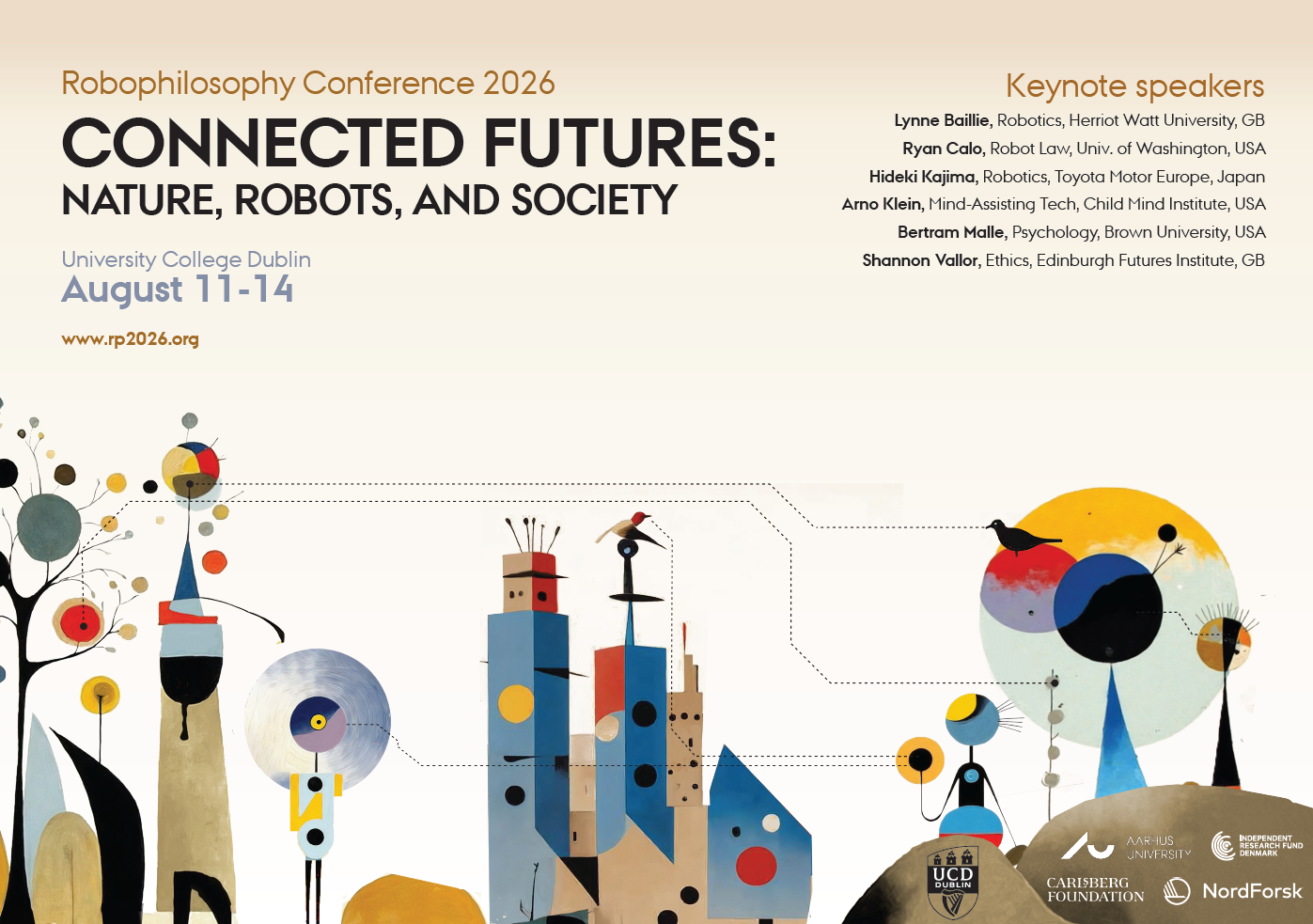
Fig.: The poster of the conference (Image: Robophilosophy)
The Robophilosophy Conference 2026 will take place August 11–14 at University College Dublin in a hybrid format and centers on the theme „Connected Futures: Nature, Robots, and Society“. As robotics and AI become deeply embedded in human life, the conference invites researchers across disciplines to explore how autonomous systems shape society, ecology, law, labor, and human self-understanding. It raises questions about responsible design, accountability, environmental impact, social justice, cultural perspectives, and the ethics of coexistence with artificial agents. Workshop proposals are due January 16, session papers and posters February 6, with notifications in February and April and proceedings pre-submission on June 15. RP2026 aims to foster interdisciplinary dialogue that advances both technological insight and collective wisdom for a future in which humans and autonomous systems share social and ecological worlds. Further information is available at cas.au.dk/en/rpc2026.
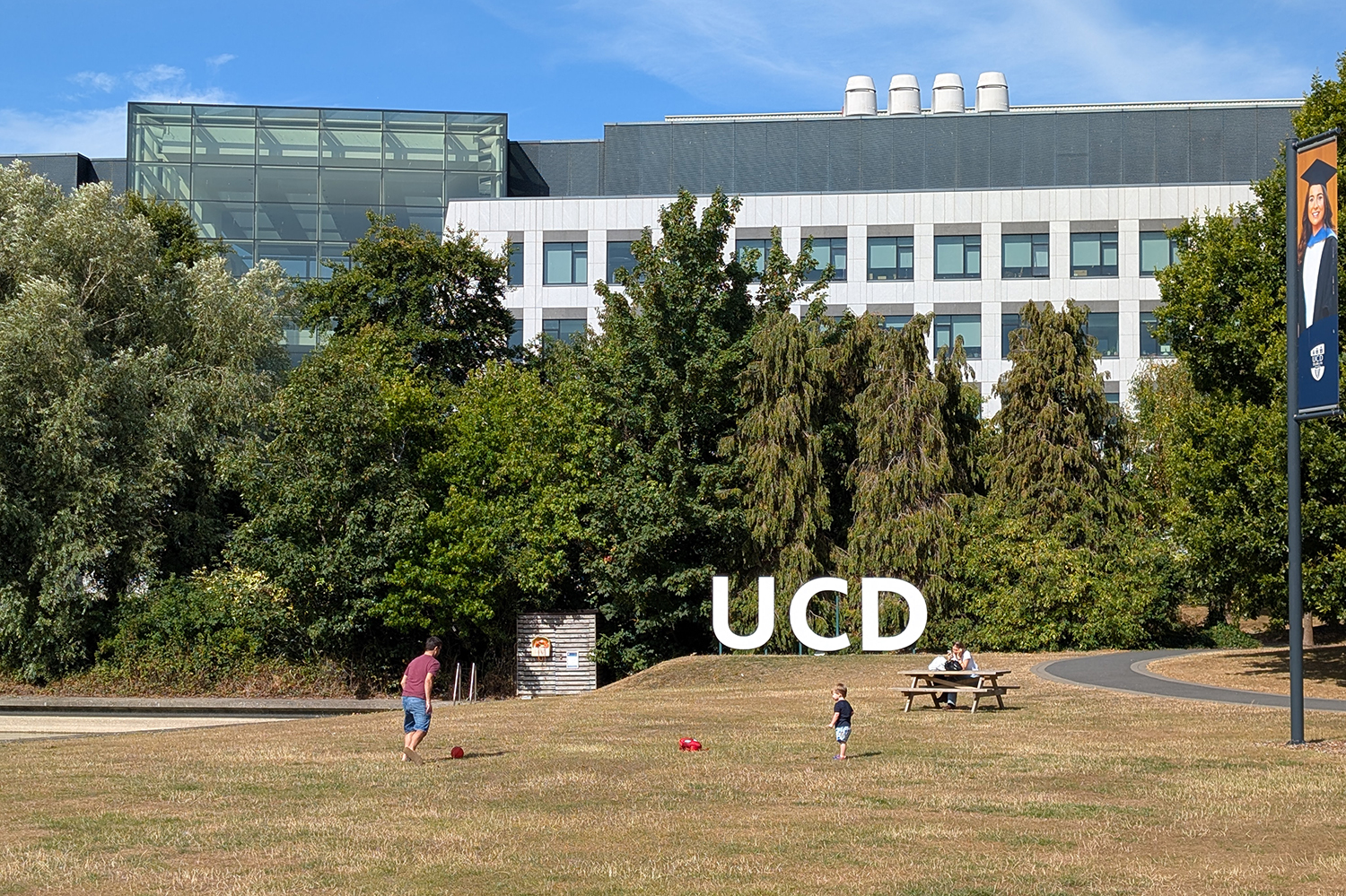
Fig.: University College Dublin (Foto: Sharonlflynn, CC BY-SA 4.0)