Seit März 2023 wird im Auftrag von Prof. Dr. Oliver Bendel der Chatbot @llegra für das rätoromanische Idiom Vallader entwickelt, das im Unterengadin zwischen Martina im Nordosten und Zernez im Südwesten sowie im Val Müstair auftritt und gefährdet ist. Der Entwickler Dalil Jabou hat auf das Sprachmodell GPT-4 gesetzt und alle wesentlichen technischen Probleme gelöst. Der Benutzer kann Text in Englisch, Deutsch oder Rätoromanisch eintippen und bekommt Text in Vallader ausgegeben. Zudem spricht @llegra das Idiom mit Hilfe eines Text-to-Speech-Systems der Firma SlowSoft aus Zürich. Ein kleiner Test mit einem Experten fand bereits statt und führte zu einer ersten Verbesserung. Oliver Bendel war am 9. Juli mit @llegra im Unterengadin unterwegs und suchte nach einer Testperson mit Vallader als Muttersprache. In Tarasp Fontana bei Scuol sprach er mehrere ältere Frauen an. Eine verwies auf eine Dame von vielleicht 78 Jahren, die sich in der Nähe befand und gerade vom Nordic Walking kam. Die Vallader-Sprecherin hörte sich die Antwort des Chatbots auf eine Frage zu Tarasp an und begann ungefragt, das Gesprochene ins Deutsche zu übersetzen. Dann wurde @llegra gefragt, ob sie Scuol kennt. Sie gab wiederum in Vallader eine längere Auskunft. Die ältere Dame bestätigte, dass die Aussprache gut und der Inhalt verständlich ist. Sie begann zu strahlen und fragte, ob es sich um künstliche Intelligenz handle. Oliver Bendel bestätigte dies, strahlte ebenfalls, fuhr weiter und ließ sich von @llegra in Scuol noch Informationen zum dortigen Museum d’Engiadina Bassa geben. Das Projekt wird im August 2023 abgeschlossen. Die Ergebnisse werden danach veröffentlicht.
Abb.: In einem Café beim Museum in Scuol mit @llegra
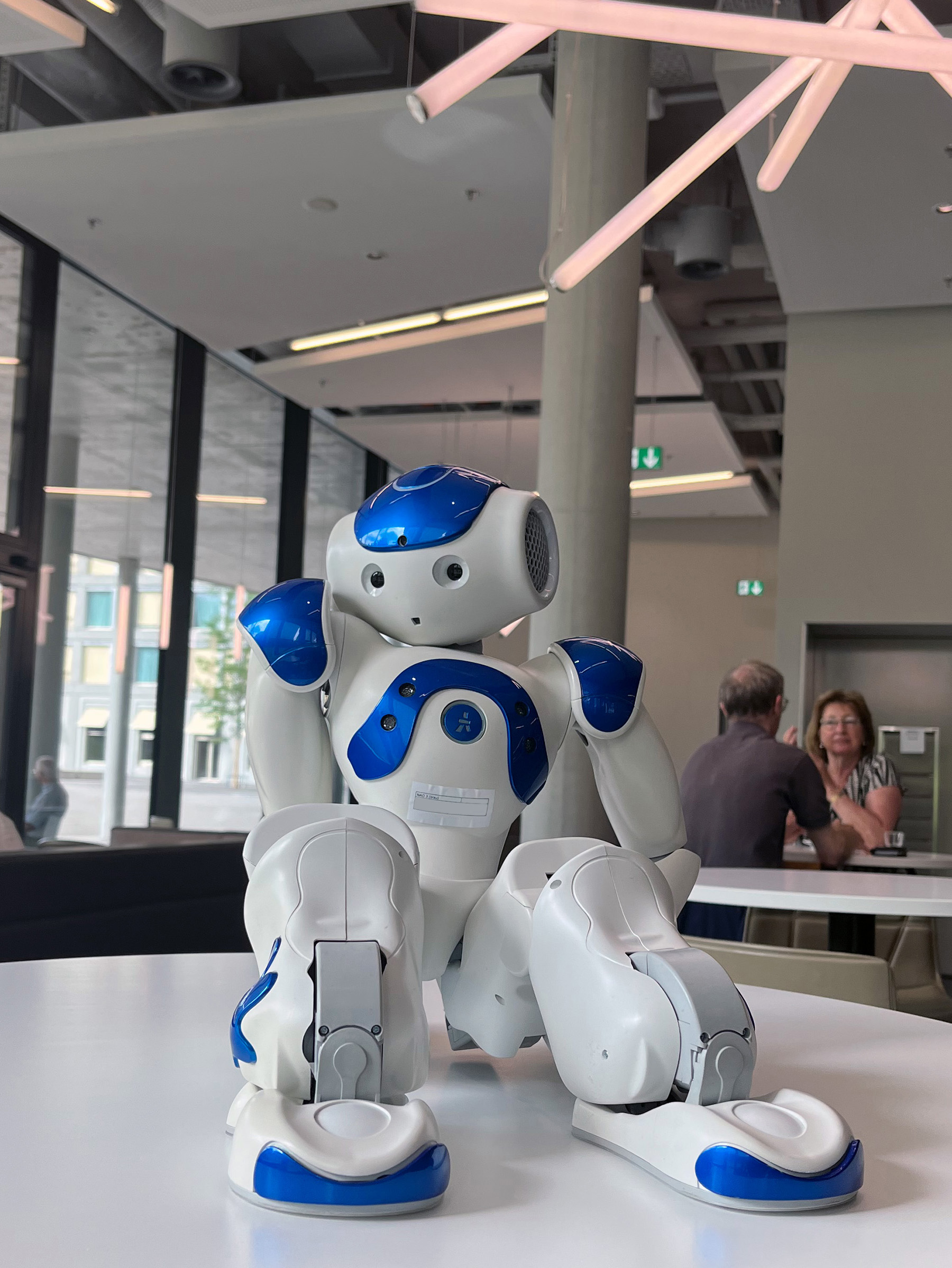
„‚Nao‘, wie die Maschine heißt, tanzt und singt mit den Kindern der inklusiven Kita im Lebenshilfehaus in Karlsruhe. Das geschieht im Rahmen eines Forschungsprojektes des Karlsruher Instituts für Technologie (KIT), das Künstliche Intelligenz und Robotik im Alltag ausprobiert. ‚Wir haben mehrere Experimente in Karlsruhe, weil wir unterschiedliche Gruppen von Nutzenden adressieren, von klein bis groß‘, erklärte KIT-Professor Tamim Asfour am Mittwoch. Bei dem Forschungsprojekt kämen Roboter unter anderem in der Kita, in der Schule, im Museum oder auch im Seniorenheim zum Einsatz.“ (Badische Zeitung, 7. Juni 2023) Mit diesen Worten beginnt ein Artikel von Valeria Nickel, der am 7. Juni 2023 in der Badischen Zeitung erschienen ist. Zu Wort kommt auch Prof. Dr. Oliver Bendel von der Hochschule für Wirtschaft FHNW, der sich seit vielen Jahren mit sozialen Robotern befasst. In einem Gespräch mit der Redakteurin von der dpa erklärte er, dass Smartphones und Tablets kleinen Kindern in ihrer Entwicklung schaden können, soziale Roboter hingegen alle Sinne ansprechen und trainieren. Den Einsatz von NAO, Moxie, QTrobot und anderen Modellen in der Kita hält er für unproblematisch, sofern sie entsprechend programmiert und Bestimmungen des Datenschutzes eingehalten werden. Insbesondere autistische Kinder können nach seiner Meinung von sozialen Robotern profitieren. Der Artikel ist über www.badische-zeitung.de/wie-roboter-in-inklusiven-kitas-helfen-koennen–266860715.html verfügbar.
In January 2023, Google announced MusicLM, an experimental AI tool that can turn text descriptions (text prompts) into music. From 10 May 2023, one can sign up to try it out in the so-called AI Test Kitchen. The company gives examples of how to use the programme on its blog: „Just type in a prompt like ’soulful jazz for a dinner party‘ and MusicLM will create two versions of the song for you. You can listen to both and give a trophy to the track you like better, which will help improve the model.“ (Google Blog, 10 May 2023) Not all types of music will be possible. TechCrunch wrote in an article: „The version of MusicLM in AI Test Kitchen won’t generate music with specific artists or vocals.“ (TechCrunch, 10 May 2023) This is certainly to avoid legal problems. An AI-generated song in the style of The Weeknd and Drake recently caused a stir. It is likely that AI-generated music will be heard around the world. Whether this will be to our advantage remains to be seen.
Fig.: AI-generated music will be heard around the world
Hawaiian Host is the largest manufacturer of chocolate-covered macadamias in the world, with millions of boxes of the treats distributed around the globe. According to its website, the company „combines premium ingredients – handcrafted milk chocolate, dark chocolate, Hawaiian honey, Kona coffee, to name a few – with dry-roasted macadamias to create its signature delights“ (Website Hawaiian Host). Hawaiian Host has now taken a big step forward in packaging. Watch a video of Chris Rabago getting his first look at Cama’s new equipment. The robot, which is protected by glass walls in the video, allows the chocolate-covered macadamias to be packaged at high speed in a small space. This is important because rental and construction costs in Honolulu are very high and factory expansions are difficult and expensive. It’s actually several robots working together – it’s very effective and looks fascinating. How many workers this new level of automation will replace is unknown.
Mauna Kea volcano is the highest mountain in the world, measured from the bottom of the sea. It is considered a sacred place in the culture of Hawai’i. In this context, the famous and important telescopes on the top are always the cause of bitter disputes. The operation of drones is also not allowed on the mountain. However, a small robot made it on it in 2008. This was reported by several media outlets, including Science Daily. „During the field experiment, Nov. 1-13, the robot called Scarab will simulate a lunar mission to extract water, hydrogen, oxygen and other compounds that could potentially be mined for use by future lunar explorers. The four-wheeled robot will trek to different sites, using a Canadian-built drill to obtain a one-meter geologic core at each site. Each core will be chemically analyzed by on-board instruments developed by NASA.“ (Science Daily, 14 October 2008) After that, it became increasingly difficult for robots to climb Mauna Kea. It is easier for scientists and tourists, who only need 4-wheel drive and robust health.
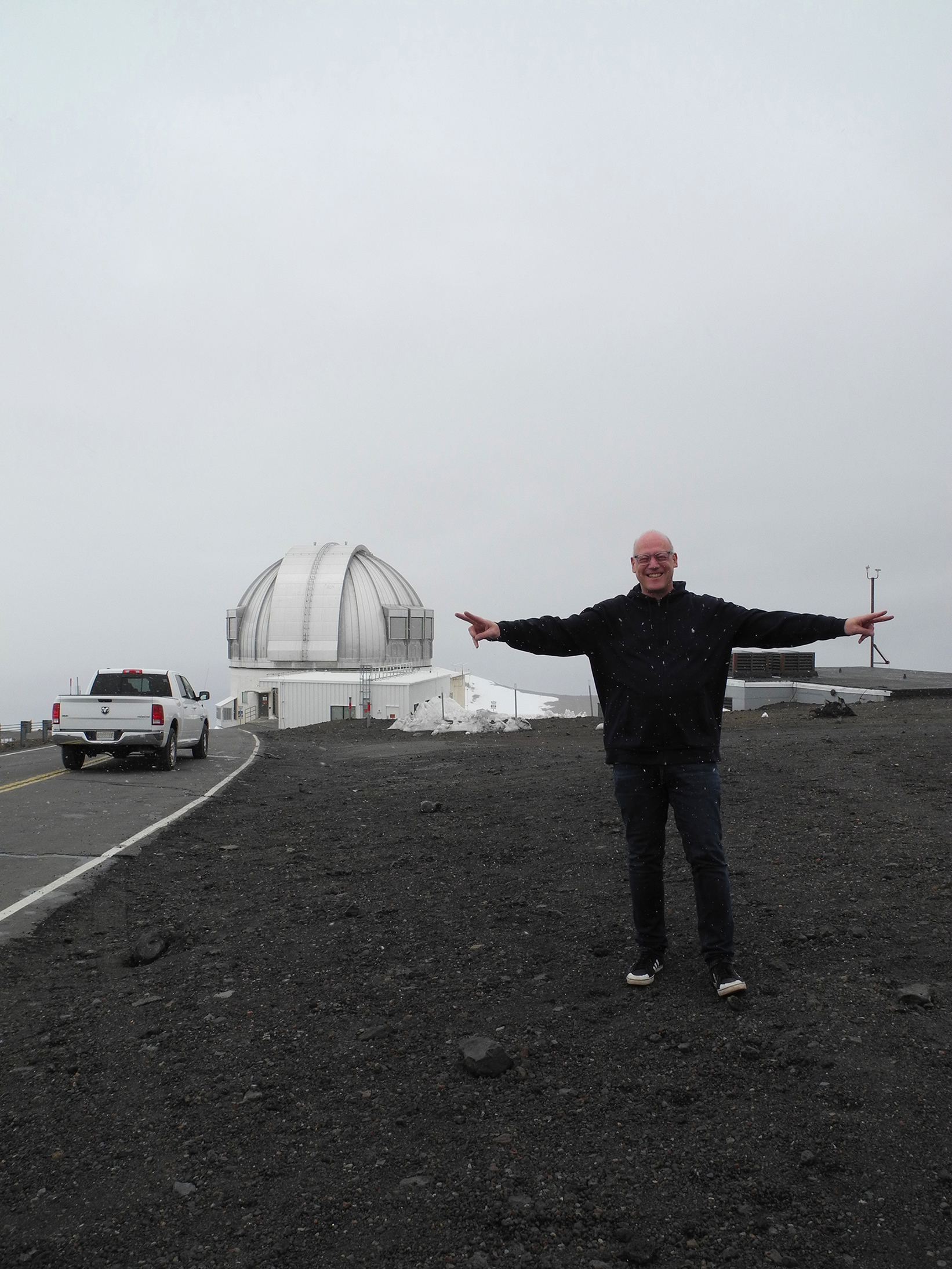
Fig.: Oliver Bendel on the top of Mauna Kea with a few snowflakes (Photo: Stefanie Hauske)
The west coast of the Big Island is known for its beautiful white sandy beaches and coral reefs, from Honomalino Beach in the south to Hapuna beach in the north. It is now threatened by climate change, drought, fire, invasive species, and human impact. The region of Hawai’i has been classified as a vulnerable ecosystem zone. A Boeing Company describes these dangers on its website and has developed technology to counteract the dangers. The Liquid Robotics Support Operations Test and Evaluation Facility in Kawaihae, Hawai’i is the main hub for Wave Glider development, ocean testing, and regional operations, as well as the birthplace of the Wave Glider. The Wave Glider sits on the surface and is connected to another device floating in the water eight meters below it. The two look like mother whale and baby whale, except baby whale is a little off. The Wave Glider is capable of collecting and communicating ocean data in real time through unpredictable conditions for up to a year. It connects and communicates undersea data to satellites and land, creating an ocean network. The Wave Glider is designed to support a wide variety of sensors and payloads. The modular and adaptable payload design is coupled with a powerful solar power system and on-board computing environment.
The K5, a security robot, comes from Knightscope in Silicon Valley. It can be seen there regularly. It provides, e.g., security at the Stanford Shopping Center. The conical robot is autonomous. It can see, hear, and even smell smoke and gas. The classic security robot also made it to Hawaii (Hawaiian: Hawai’i), for the first time in 2021, according to the Khon2 platform: „There is a new security guard getting a lot of attention at the Financial Plaza of the Pacific in downtown Honolulu, but it is not what you would think — it is actually a robot and the newest member of Bank of Hawaii’s security force. It looks like something out of a sci-fi movie – only it is actually real. Currently, the security robot is patrolling the busy area in and around the Bank of Hawaii’s Financial Plaza on Bishop and Merchant streets. For many people, the robot is a curiosity – attracting lots of odd looks – with some people capturing video and even posing for selfies. But many others, like Nasir Randall, are not quite sure what to make of it.“ (Khon2, 28 October 2021) Security robots, along with cleaning robots and transport robots, are among the service robots that are largely error-free and already saving money. Over the next few years, they are likely to become widely used and accepted around the world.
Fig.: The K5 could also guard the Kona Joe coffee plantation on the Big Island
Cleaning robots, along with security robots and transport robots, are among the service robots that work largely error-free and are already saving costs. The Hawaii Department of Transportation Airports Division continues to modernize Daniel K. Inouye International Airport (HNL) and give HNL an open, clean feel. The modernization includes the addition of two robotic floor scrubbers to supplement custodial services. This was reported by the Hawaii Department of Transportation. „The robotic scrubbers will help us keep HNL sanitary and sparkling,“ said Ross Higashi. He is the Hawaii Department of Transportation’s deputy director of airports. „Use of this technology will also allow us to maximize available staff in maintaining our busiest airport to standards.“ (Website Hawaii Department of Transportation) Without a doubt, cleaning robots are also an option for the other islands of Hawai’i, such as the Big Island and Kaua’i. On the Big Island, there are two airports that come into question. In addition, cleaning robots could be used in the streets of Hilo. Also other service robots are entering the market that can clear beaches and lawns of litter.
Surveying and collecting rare plant species that grow on steep cliffs has been a risky business for scientists and conservationists for centuries. The world’s first aerial sampling system, which uses a robotic arm suspended from a drone, is attempting to solve this problem in Hawai’i. An article published by Mongabay magazine back in November 2022 states: „In Hawai’i’s Kaua’i island, the world’s first aerial sampling system has successfully flown into high-altitude cliff faces to cut out samples from rare plants and bring them back to a nursery. Scientists call it ‚the Mamba,‘ a cutting mechanism on a remote-controlled robotic arm suspended from a drone. The system was developed by Hawai’i-based not-for-profit conservation organization National Tropical Botanical Garden (NTBG) and Quebec-based technology company Outreach Robotics and the University of Sherbrooke in Quebec.“ (Mongabay, 9. November 2023) Ben Nyberg, the NTBG’s geographic information system and drone program coordinator, told Mongabay in an interview: „It is really unlocking a lot of areas that have previously been completely inaccessible.“ (Mongabay, 9. November 2023) Of course, criminals could also adopt the technology. But it would be almost impossible to smuggle rare plants out of Hawai’i due to strict customs controls.
Ruby Tuesday is a popular restaurant in Hawaii (Hawaiian: Hawai’i), on the island of O’ahu. The location close to the airport is not one of the most beautiful ones. The food is also not praised by everyone. But the restaurant is known for its artificial staff. „Our KEENON DINERBOT is helping the staff here deliver trays and plates, so that they can pay more attention to improving customer satisfaction.“ This is the message in a promotional video from Keenon Robotics in Singapore. The robot is a classic transport and serving robot. It has large, square blue eyes. In Europe and Asia, BellaBot is best known. It has a cat face and cat ears and is controlled via user input and voice commands. The European model Plato is also shaking up the market. Khon2, a platform from Hawaii, first reported on the new employee at Ruby Tuesday in 2022. „Staffing is such a problem now. Everything from managers down to servers and kitchen help cooks so this really helps our servers out,“ Ruby Tuesday owner Rick Nakashima told Khon2 journalists. Indeed, robots of this kind seem to be at least a band-aid for the shortage of skilled workers. Customers‘ reactions vary. Some seem to find the robots entertaining. Others say that direct contact with waiters is important to them. The restaurant emphasises that the robot is not intended to replace waiters. Rather, the robot acts as a support.
Hawaii (Hawaiian: Hawai’i) is not necessarily associated with robots. But in the larger cities, you can be sure to encounter them. There are service robots such as the Keenon Dinerbot and surgical robots such as the da Vinci Surgical System. In addition, robots are used in the wild, for example for nature conservation. The hospital group in the east of the archipelago advertises with the following words: „East Hawaii Health Clinics is excited to introduce our fully operational robotic surgery center. This state-of-the-art equipment allows us to perform minimally invasive surgeries that would otherwise require greater surgery time and recovery time. We look forward to continuing to provide East Hawaii with exceptional surgical options.“ (Website East Hawaii Health Clinics) This type of care is available in Hilo, among other places. The small town on the Big Island has the latest medical technology, such as that used in Basel and Berlin. Hilo is surrounded by tropical rainforest. Nearby are Akaka Falls and Hawai’i Volcanoes National Park. In the city itself, giant banyan trees grow. One must not forget the many homeless people who are at the end of their tether. Like California, Hawai’i has not dealt with this problem. These people will never be able to afford treatment with a surgical robot.
Fig.: Oliver Bendel at the Akaka Falls (Photo: Stefanie Hauske)
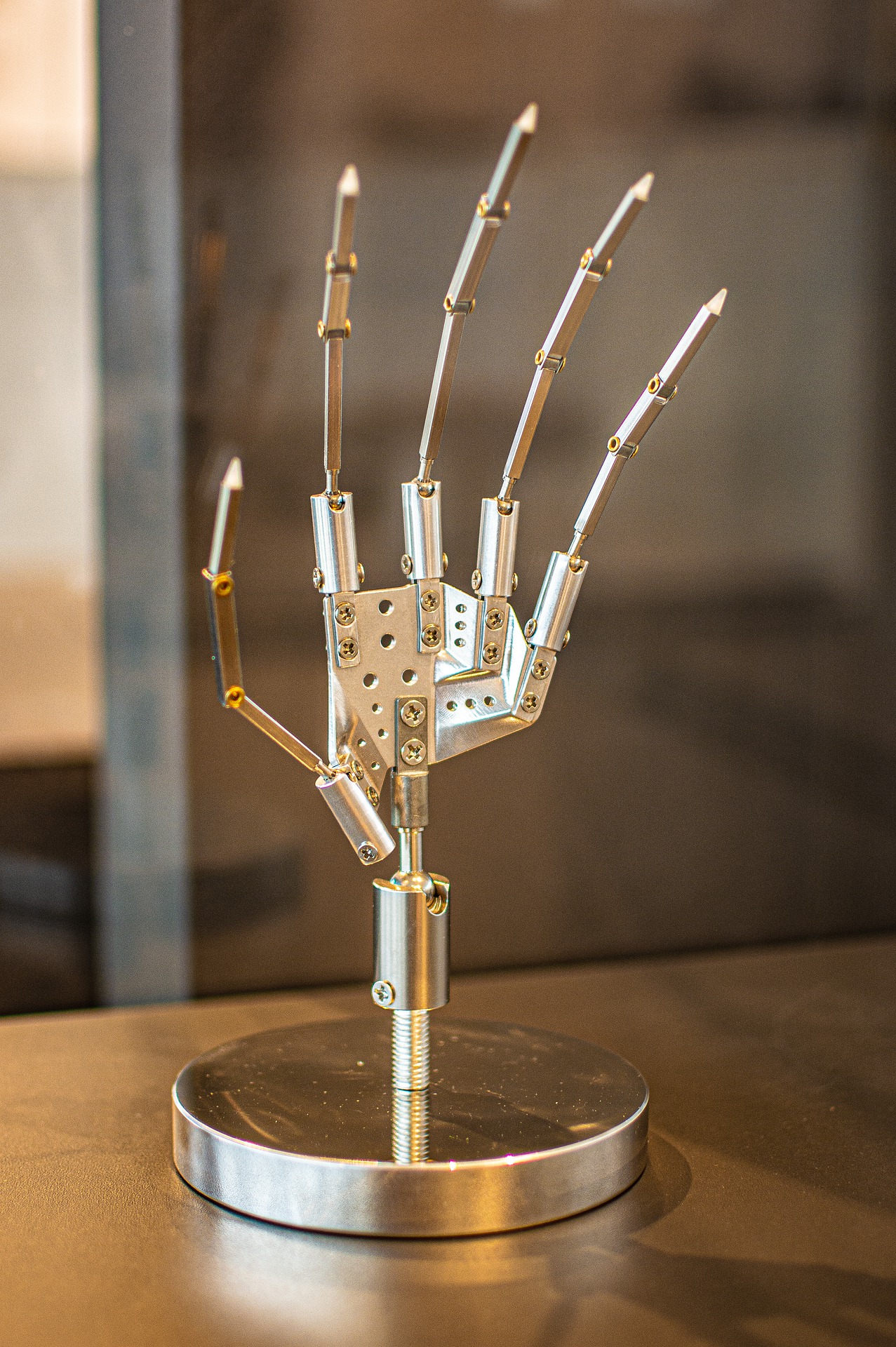
„Researchers at Columbia Engineering have demonstrated a highly dexterous robot hand, one that combines an advanced sense of touch with motor learning algorithms in order to achieve a high level of dexterity.“ (Website Columbia Engineering, 28 April 2023) Columbia Engineering reported this on its website on April 28, 2023. The text goes on to say: „As a demonstration of skill, the team chose a difficult manipulation task: executing an arbitrarily large rotation of an unevenly shaped grasped object in hand while always maintaining the object in a stable, secure hold. This is a very difficult task because it requires constant repositioning of a subset of fingers, while the other fingers have to keep the object stable. Not only was the hand able to perform this task, but it also did it without any visual feedback whatsoever, based solely on touch sensing.“ (Website Columbia Engineering, 28 April 2023) „While our demonstration was on a proof-of-concept task, meant to illustrate the capabilities of the hand, we believe that this level of dexterity will open up entirely new applications for robotic manipulation in the real world“, said Matei Ciocarlie according to the website. He is the Associate Professor in the Departments of Mechanical Engineering and Computer Science who developed the hand together with his graduate student Gagan Khandate.
In einer Doktorarbeit an der Universität Potsdam wird seit 2023 untersucht, wie Muster aus der Mensch-Mensch-Interaktion auf die Mensch-Roboter-Interaktion übertragen werden. Die Doktorandin Katharina Kühne wird von Prof. Dr. Martin Fischer (Universität Potsdam) und Prof. Dr. Oliver Bendel (FHNW) betreut. Beide forschen u.a. zu sozialen Robotern und geben in der Arte-Dokumentation „Werden wir Roboter lieben?“ einen Einblick in ihre Arbeit. Die Betreuungsvereinbarung wurde dieser Tage unterzeichnet. Oliver Bendel ist seit Dezember 2021 assoziierter Forscher der PECoG-Gruppe an der Universität Potsdam. Er tauscht sich seit 2019 regelmäßig mit ihren Mitgliedern aus und hält Vorträge vor Ort. Zudem publiziert man zusammen. Seine Forschungsinteressen sind soziale Roboter (Perspektiven: Informationsethik, Roboterethik, Maschinenethik; Themen: Informationelle Autonomie, Verantwortung in Pflege und Therapie, Wohlbefinden beim Einsatz von Sexrobotern, Chatbots und Sprachassistenten mit simulierter Empathie, Entscheidungsbäume mit moralischen Annotationen, Moralmenüs), Serviceroboter (Perspektiven: Informationsethik, Roboterethik, Maschinenethik; Themen: Informationelle Autonomie, Verantwortung beim Einsatz im öffentlichen Raum, Entscheidungsbäume mit moralischen Annotationen, Moralmenüs) und tierfreundliche Maschinen (Perspektiven: Informationsethik, Maschinenethik, Tier-Maschine-Interaktion; Themen: Schutz von Haus- und Wildtieren beim Einsatz von Robotern und Autos, Gesichtserkennung für Bären und Wölfe). Weitere assoziierte Forscher und Forscherinnen sind über www.uni-potsdam.de/de/pecog/mitarbeiterinnen/assoziierte-forscher aufgeführt.
Am 9. April 2023 versammelten sich die Passagiere am Flughafen von San Francisco an einem der Gates, um auf das Boarding eines SWISS-Flugs zu warten. Für viele Schweizer und Deutsche ging es – mit dem Zielflughafen Zürich – zurück in die Heimat. Beim Boarding mussten alle vor ein Gesichtserkennungssystem treten und ihre biometrischen Merkmale erfassen lassen. Dies ersetzte das Vorzeigen der Bordkarte. Es gab keinen Hinweis der Airline oder einer Behörde auf eine Alternative. Eine Anfrage eines Betroffenen an SWISS, auf welcher rechtlichen Grundlage dies erfolgte, wurde wie folgt beantwortet: „Ich habe mir Ihren Fall durchgelesen und möchte Ihnen mitteilen, dass das Gesichtserkennungssystem nicht obligatorisch ist. Es wird immer ein Mitarbeiter im Dienst sein, der die Sicherheitskontrolle auch manuell durchführen kann. Wenn Sie das nächste Mal in eine solche Situation kommen und nicht durch das Gesichtserkennungssystem gehen möchten, können Sie jederzeit einen Mitarbeiter bitten, Sie manuell durch die Kontrolle zu begleiten.“ Der Hinweis, dass die Nutzung des Systems nicht obligatorisch ist, müsste allerdings vor Ort gegeben werden. Man ist beim Boarding eines Rückflugs unter einem gewissen Druck, befindet sich auf fremdem Boden – und sieht sich mit einer unerwarteten Situation konfrontiert. All dies nutzt das Unternehmen oder sein Partner – die US-amerikanische Behörde – offenbar aus. Auch zur Datenerfassung und -verwendung gab es keinerlei Informationen, weder vor noch nach dem Vorgang. Ohne Zweifel wird die informationelle Autonomie verletzt. Insgesamt findet der Einsatz eines problematischen Systems ohne ausdrückliche Zustimmung der Passagiere statt. Laut einem Artikel von 2021 hat man das Verfahren bereits seit längerer Zeit getestet. „Die Swiss bestätigt den Einsatz der Technologie. Zusammen mit dem Mutterkonzern, der Lufthansa-Gruppe, engagiere man sich für den Einsatz der biometrischen Gesichtsfelderkennung. … Beim Projekt in San Francisco handle es sich in erster Linie um einen ‚übergeordneten Grenzkontrollprozess‘ der US-Behörden … Die Swiss und die Lufthansa seien aber bei der Umsetzung begleitend involviert gewesen, um eine Schnittstelle im Abfertigungsprogramm herzustellen.“ (Luzerner Zeitung, 8. September 2021)
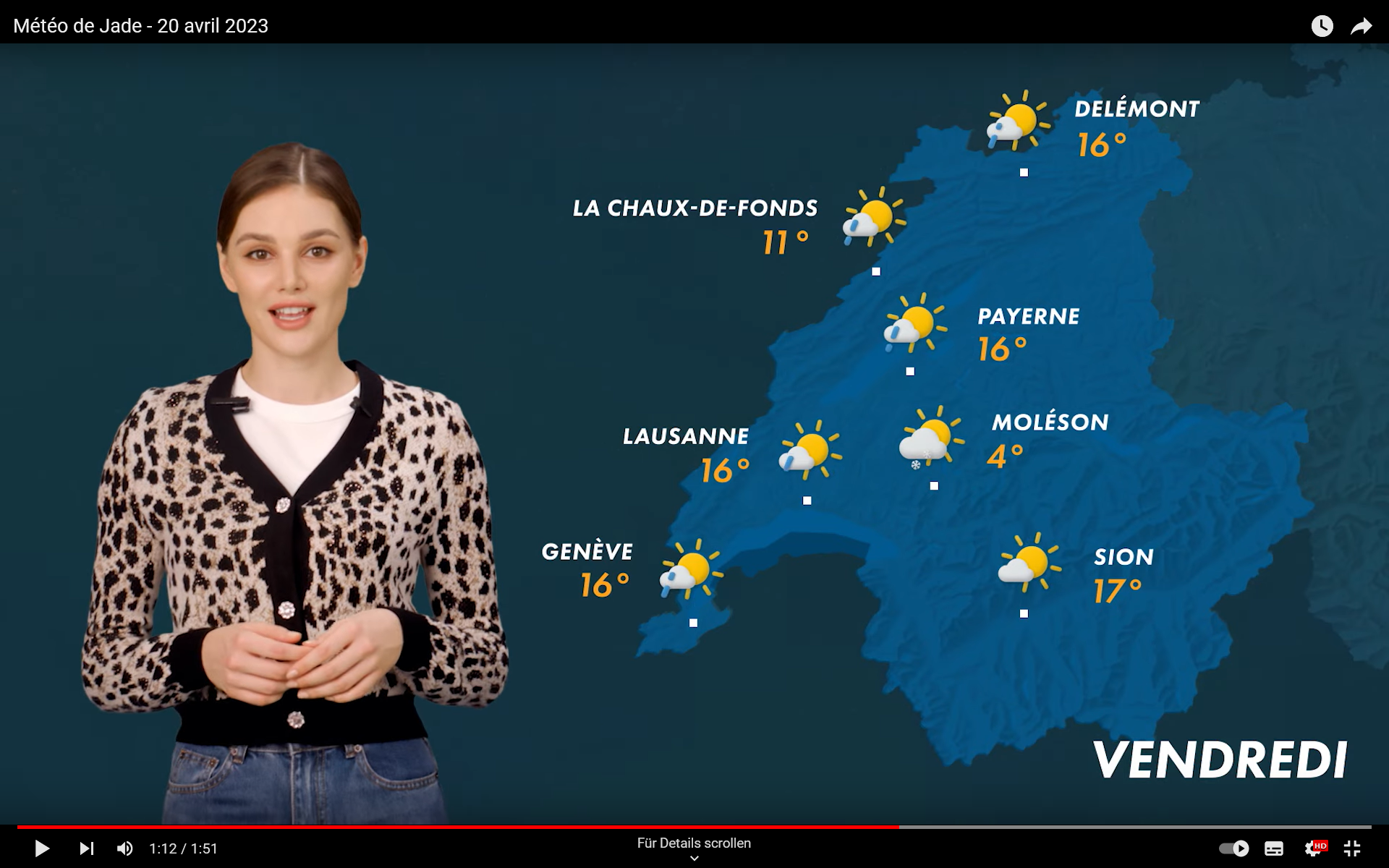
Beim Privatsender M Le Média ist seit Anfang April 2023 der Avatar Jade als Wettermoderatorin zu sehen. Dies sorgt für Aufregung bei den Schweizer Medien und ihren Rezipienten. Allerdings ist die Idee, einen Avatar als Nachrichtensprecher oder für die Durchsage des Wetterberichts einzusetzen, nicht gerade neu. Die ersten Versuche gab es bereits vor einem Vierteljahrhundert. Im Lexikon der Wirtschaftsinformatik von Springer aus dem Jahre 2001 ist ein Beitrag von Oliver Bendel zum Begriff des Avatars abgedruckt, der diese Passagen enthält: „Avatare finden zum einen Verwendung in kollaborativ genutzten virtuellen Räumen wie Chats, Internet-Spielwelten (MUDs und MOOs), webbasierten Lern- und Arbeitsumgebungen und kommerziellen 3D-Anwendungen (Virtual Reality). Sie fungieren dort als sichtbare und teils auch bewegliche und manipulierbare Stellvertreter eines Benutzers.“ Sie können „zum anderen eine beliebige Figur mit bestimmten Funktionen repräsentieren“. „Solche Avatare treten – beispielsweise als Kundenberater und Nachrichtensprecher – im Internet auf oder bevölkern als Spielpartner und -gegner die Abenteuerwelten von Computerspielen. Sie haben häufig ein anthropomorphes Äußeres und eigenständige Verhaltensweisen oder sogar regelrechte Charaktere.“ Der Beitrag ist bereits im Jahre 2000 entstanden und eingereicht worden und verweist auf Beispiele um die Jahrtausendwende. Von daher haben Avatare dieser Art eine lange Tradition. Beeindruckend ist Jade trotzdem – sie wirkt sehr natürlich und sympathisch und scheint durchaus in der Lage, Sprecher aus Fleisch und Blut zu ersetzen.
Abb.: Jade bei ihrer Moderation am 20. April 2023 (Foto: M Le Média/YouTube)
Chatbots und Sprachassistenten – sogenannte Conversational Agents – entstanden an der Hochschule für Wirtschaft FHNW von 2012 bis 2022 vor allem im Kontext der Maschinenethik und Sozialen Robotik. Prof. Dr. Oliver Bendel widmet sich nun verstärkt toten, ausgestorbenen und gefährdeten Sprachen. @ve für Latein war 2022 ein erster Versuch in dieser Richtung. Der Chatbot basiert auf dem Sprachmodell GPT-3. Die tote Sprache Latein wurde durch @ve ein Stück weit wieder lebendig. Im März 2023 startete auf Initiative des Technikphilosophen ein weiteres Projekt, in dem der Chatbot @llegra entwickelt wird. Dieser soll das Rätoromanische beherrschen, genauer gesagt das Idiom Vallader, das im Unterengadin zwischen Martina im Nordosten und Zernez im Südwesten sowie im Val Müstair gesprochen wird und gefährdet ist. Der Benutzer kann Text eintippen und bekommt Text ausgegeben. Zudem spricht @llegra mit Hilfe eines Text-to-Speech-Systems der Firma SlowSoft, die das Projekt unterstützt. Die Basis ist wieder, wie bei @ve, das Sprachmodell GPT-3. Für die Umsetzung konnte Dalil Jabou gewonnen werden. Für technische Aspekte steht zusätzlich Prof. Dr. Bradley Richards zur Verfügung. Das Projekt dauert bis August 2023.
Abb.: In Zernez wird das Idiom Vallader gesprochen
How do social robots emerge from simple, soft shapes? As part of their final thesis in 2021 at the School of Business FHNW, 23-year-old students Nhi Tran Hoang Yen and Thang Hoang Vu from Ho Chi Minh City (Vietnam) have answered this question posed by their supervisor Prof. Dr. Oliver Bendel. They have submitted eleven proposals for novel robots. The first is a pillow to which a tail has been added. Its name is Petanion, a portmanteau of „pet“ and „companion“. The tail could move like the tail of a cat or dog. In addition, the pillow could make certain sounds. It would be optimal if the tail movements were based on the behavior of the user. Thus, as desired, a social robot is created from a simple, soft form, in this case a pet substitute. Petanion is soft and cute and survives a long time. It can also be used if one has certain allergies or if there is not enough space or money in a household for a pet. Last but not least, the ecological balance is probably better – above all, the robot does not eat animals that come from factory farming. The inspiration may have been Qoobo, a pillow with a tail, designed to calm and to „heal the heart“. Panasonic also believes in robots that emerge from simple, soft forms. It promotes its new robot NICOBO as a „yowai robotto“, a “weak” robot that has hardly any functions or capabilities. The round, cute robot has two separate displays as eyes and a tail that it constantly moves. According to the company, it is aimed primarily at singles and the elderly. There could well be a high demand for it, even beyond the target groups.
Fig.: NICOBO in the arms of its owner (Photo: Panasonic)
Auf TikTok findet sich ein neuer Musikclip der beiden kanadischen Sänger Drake und The Weeknd. Golem meldete am 17. April 2023: „Der Titel wurde vom Kanal ghostwriter977 veröffentlicht und ist eigenen Angaben zufolge komplett mithilfe einer künstlichen Intelligenz erstellt worden.“ (Golem, 17. April 2023) Das einminütige Stück hat es inzwischen auf YouTube geschafft, in der ursprünglichen – nach zwei Tagen bereits mehr als tausendmal kommentiert – und in einer verbesserten Version. Beide hat man allerdings wohl aus Rechtsgründen entfernt. Golem schreibt weiter: „Für die Musikindustrie dürften derartige Musikstücke, die zumindest beim ersten und zweiten Hinhören sehr echt klingen, ein Problem sein. Drake hatte sich in der Vergangenheit bereits bei anderen KI-Songs mit seiner Stimme kritisch bis verärgert gezeigt. Der Produzent von Jay-Z, Young Guru, spricht von einem Geist, der aus der Flasche gelassen wurde. Zum einen könne man den technologischen Fortschritt nicht aufhalten, zum anderen müssten die Rechte der Kunstschaffenden geschützt werden.“ (Golem, 17. April 2023) Die individuelle Stimme, verbunden mit gesprochener Sprache, kann bereits seit einigen Jahren mit Hilfe künstlicher Intelligenz imitiert werden. Darauf geht etwa der Beitrag „The Synthetization of Human Voices“ von Prof. Dr. Oliver Bendel aus dem Jahre 2017 ein. Inzwischen stellt auch gesungene Sprache lebender und toter Künstler kein Problem mehr dar.
„Five self-driving vehicles blocked traffic early Tuesday morning in the middle of a residential street in San Francisco’s Balboa Terrace neighborhood, apparently waylaid by fog that draped the southwestern corner of the city.“ (San Francisco Chronicle, 11 April 2023) The San Francisco Chronicle reported this in an article published on April 11, 2023. The fact that fog is a problem for Waymo’s vehicles has been known to the company for some time. A blog post from 2021 states: „Fog is finicky – it comes in a range of densities, it can be patchy, and can affect a vehicle’s sensors differently.“ (Blog Waymo, 15 November 2021) Against this background, it is surprising that vehicles are allowed to roll through the city unaccompanied, especially since Frisco – this name comes from sailors – is very often beset by fog. But fog is not the only challenge for the sensors of self-driving cars. A thesis commissioned and supervised by Prof. Dr. Oliver Bendel presented dozens of phenomena and methods that can mislead sensors of self-driving cars. The San Francisco Chronicle article „Waymo says dense S.F. fog brought 5 vehicles to a halt on Balboa Terrace street“ can be accessed at www.sfchronicle.com/bayarea/article/san-francisco-waymo-stopped-in-street-17890821.php.
„Das Heidelberger KI-Start-up Aleph Alpha hat nach eigenen Angaben erstmals einen Meilenstein auf dem Weg zu inhaltlich korrekter, erklärbarer und vertrauenswürdiger künstlicher Intelligenz erreicht. Eine nun verfügbare Erweiterung des hauseigenen Sprachmodells Luminous sei in der Lage, Zusammenhänge in Informationen und faktische Korrektheit auf Basis von gesicherten Fakten nachzuvollziehen …“ (Spektrum, 13. April 2023) Dies schrieb Spektrum der Wissenschaft am 13. April 2023 unter Berufung auf das Unternehmen. „Gleichzeitig sei das System in der Lage, darzustellen, welche Textstellen in einer Quelle die generierte Antwort verursacht haben oder im Widerspruch dazu stehen.“ (Spektrum, 13. April 2023) ChatGPT ist dafür bekannt, dass es nicht nur in seinen Aussagen halluziniert, etwa wenn es Falschinformationen zu Personen liefert, sondern auch in seinen Verweisen – so werden URLs generiert, die auf den ersten Blick plausibel aussehen und deren Domain oft korrekt ist, die dann aber – da der Pfad erfunden ist – ins Leere verweisen. Grundsätzlich ist die Behauptung von Faktizität und der Erfüllung von Anforderungen der Explainable AI und der Trustworthy AI in diesem Zusammenhang mit Vorsicht zu genießen – aber es wäre erfreulich, wenn Luminous weniger eine Münchhausen-Maschine wäre als der eine oder andere Konkurrent und von Halluzinationen befreit werden könnte.
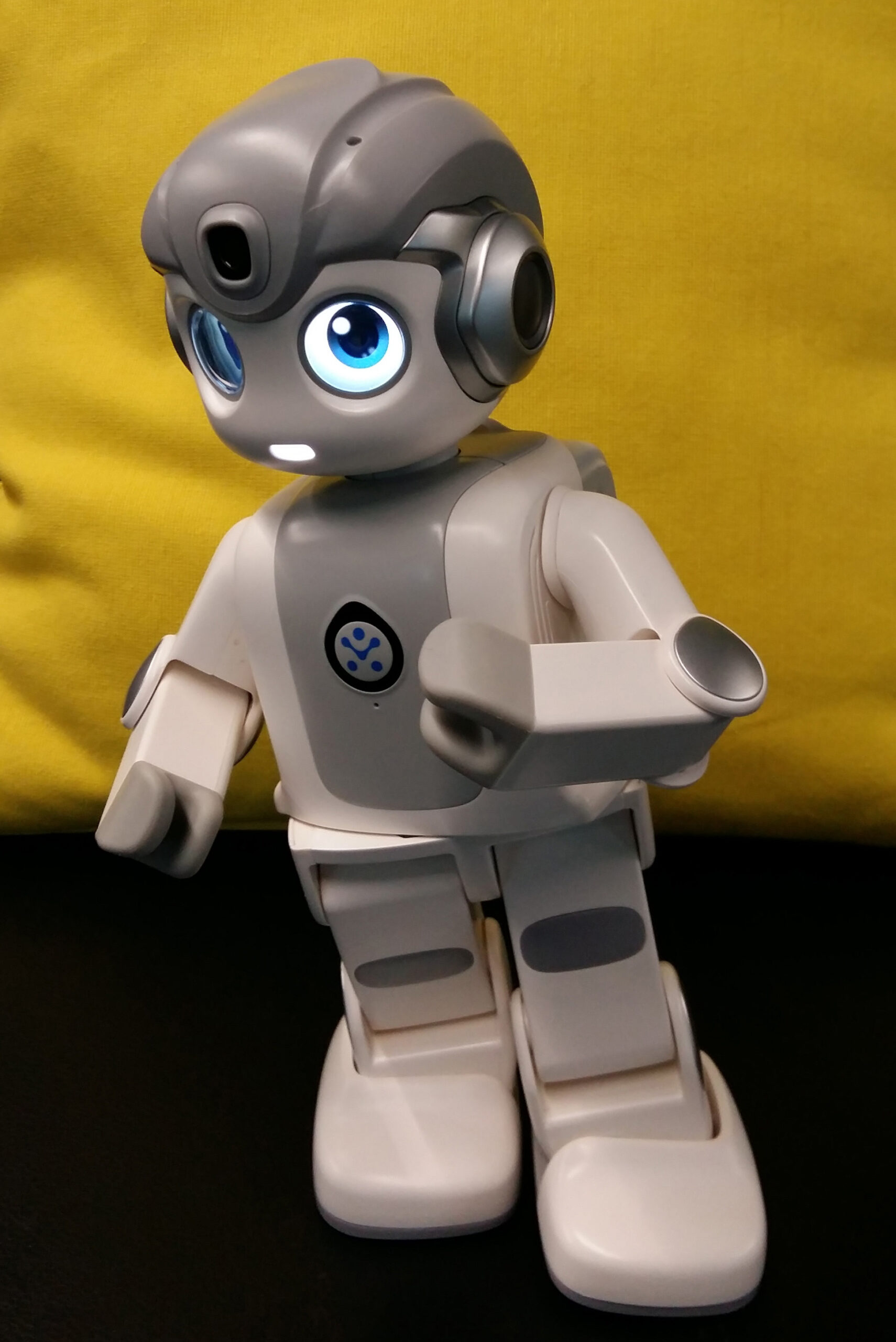
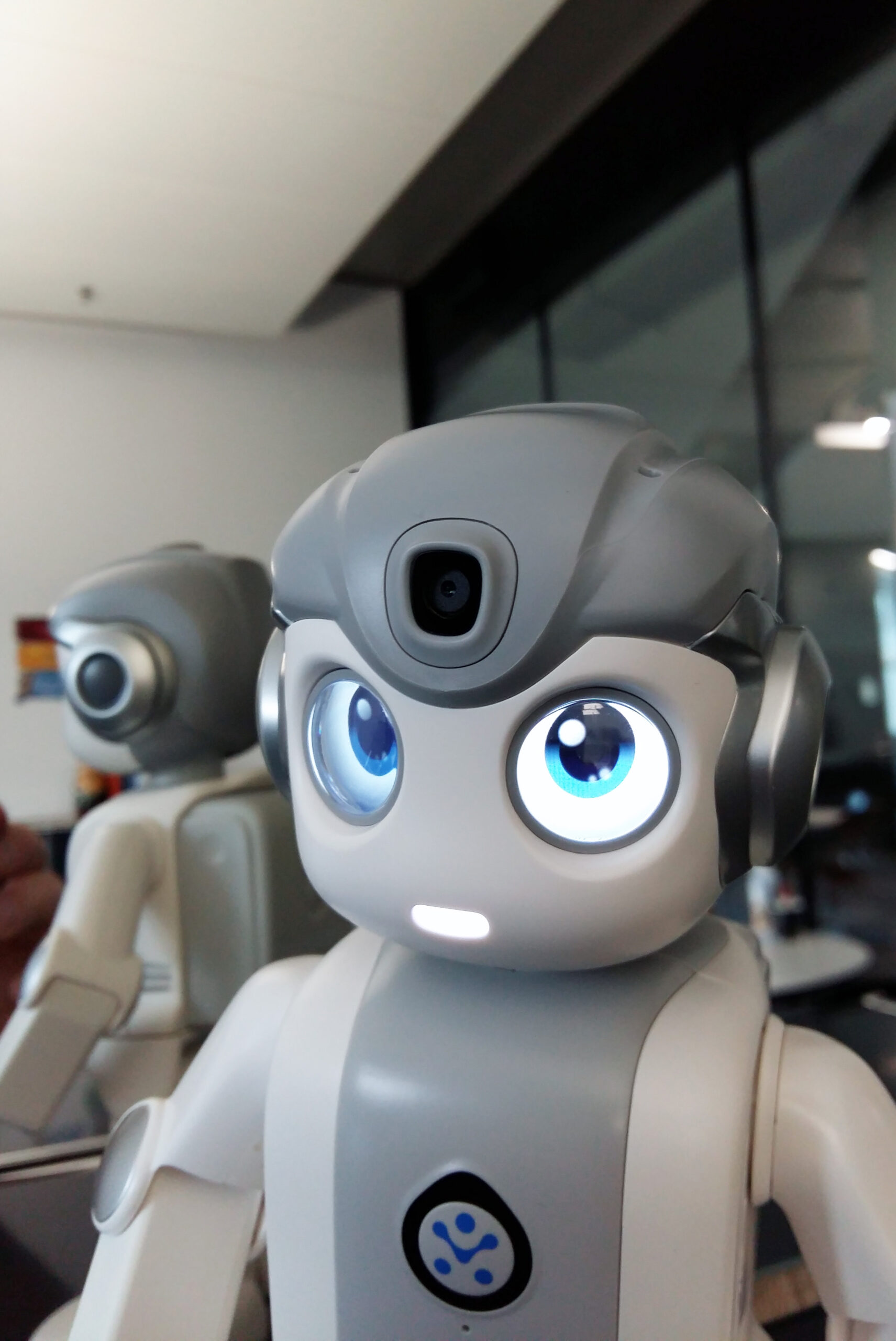
Alpha Mini ist ein sozialer Roboter, der sich durch geringe Größe (und damit gute Transportfähigkeit) und weitgehende natürlichsprachliche und motorische Fähigkeiten auszeichnet. Er kann im Schulunterricht eingesetzt werden, sowohl als Lehrer und Tutor als auch als Tool, mit dem man programmiert. Am 8. März 2023 startete an der Hochschule für Wirtschaft FHNW das Projekt „Little Teacher“, in dem Alpha Mini eine Hauptrolle spielt. Initiator ist Prof. Dr. Oliver Bendel, der seit einem Vierteljahrhundert über Conversational Agents und soziale Roboter forscht. Andrin Allemann trägt im Rahmen seiner Abschlussarbeit zum Projekt bei. Alpha Mini soll in eine Lernumgebung integriert werden und mit anderen Komponenten wie einem Display interagieren und kommunizieren können. Er soll mit Hilfe von Bildern und Texten einfachen Lernstoff vermitteln und die Kinder durch gestisches und mimisches Feedback motivieren. Es handelt sich also um einen kleinen Lehrer mit großen Möglichkeiten. Grundsätzlich soll er sich an das neue schweizerische Bundesgesetz über den Datenschutz (Neues Datenschutzgesetz, nDSG) halten. Das Projekt dauert bis August 2023. Die Ergebnisse werden im Anschluss daran veröffentlicht.
Wie Golem am 25. Februar 2023 meldete, hat Meta das Sprachmodell LLaMA angekündigt. Dieses soll in Konkurrenz zu GPT-3 von OpenAI (ChatGPT) und LaMDA von Google (Bard) treten. „LLaMA ist nach Angaben von Meta für die Erstellung von Texten, die Führung von Chat-Gesprächen, die Zusammenfassung von schriftlichen Materialien und für komplexere Aufgaben wie das Lösen von mathematischen Problemen oder die Vorhersage von Proteinstrukturen geeignet. Das Modell wurde von Metas Fundamental AI Research Team entwickelt.“ (Golem, 25. Februar 2023) Das neue Sprachmodell werde derzeit nicht bei Plattformen wie Facebook oder Instagram verwendet. „Stattdessen solle es ausschließlich auf KI spezialisierten Forschern zur Verfügung gestellt werden, um diese bei ihrer Arbeit zu unterstützen.“ (Golem, 25. Februar 2023) Der Artikel „Facebook steigt in den KI-Markt ein“ kann hier abgerufen werden.