Semi-autonomous machines, autonomous machines and robots inhabit closed, semi-closed and open environments, more structured environments like the household or more unstructured environments like cultural landscapes or the wilderness. There they encounter domestic animals, farm animals, working animals, and wild animals. These creatures could be disturbed, displaced, injured, or killed by the machines. Within the context of machine ethics and social robotics, the School of Business FHNW developed several design studies and prototypes for animal-friendly machines, which can be understood as moral and social machines in the spirit of these disciplines. In 2019-20, a team led by Prof. Dr. Oliver Bendel developed a prototype robot lawnmower that can recognize hedgehogs, interrupt its work for them and thus protect them. Every year many of these animals die worldwide because of traditional service robots. HAPPY HEDGEHOG (HHH), as the invention is called, could be a solution to this problem. This article begins by providing an introduction to the background. Then it focuses on navigation (where the machine comes across certain objects that need to be recognized) and thermal and image recognition (with the help of machine learning) of the machine. It also presents obvious weaknesses and possible improvements. The results could be relevant for an industry that wants to market their products as animal-friendly machines. The paper „The HAPPY HEDGEHOG Project“ is available here.
The book „Culturally Sustainable Social Robotics“ (eds. Marco Nørskov, Johanna Seibt, and Oliver Santiago Quick) was published in December 2020 by IOS Press. From the publisher’s information: „Robophilosophy conferences have been the world’s largest venues for humanities research in and on social robotics. The book at hand presents the proceedings of Robophilosophy Conference 2020: Culturally Sustainable Social Robotics, the fourth event in the international, biennial Robophilosophy Conference Series, which brought together close to 400 participants from 29 countries. The speakers of the conference, whose contributions are collected in this volume, were invited to offer concrete proposals for how the Humanities can help to shape a future where social robotics is guided by the goals of enhancing socio-cultural values rather than by utility alone. The book is divided into 3 parts; Abstracts of Plenaries, which contains 6 plenary sessions; Session Papers, with 44 papers under 8 thematic categories; and Workshops, containing 25 items on 5 selected topics.“ (Website IOS Press) Contributors include Robert Sparrow, Alan Winfield, Aimee van Wynsberghe, John Danaher, Johanna Seibt, Marco Nørskov, Peter Remmers, John P. Sullins, and Oliver Bendel.
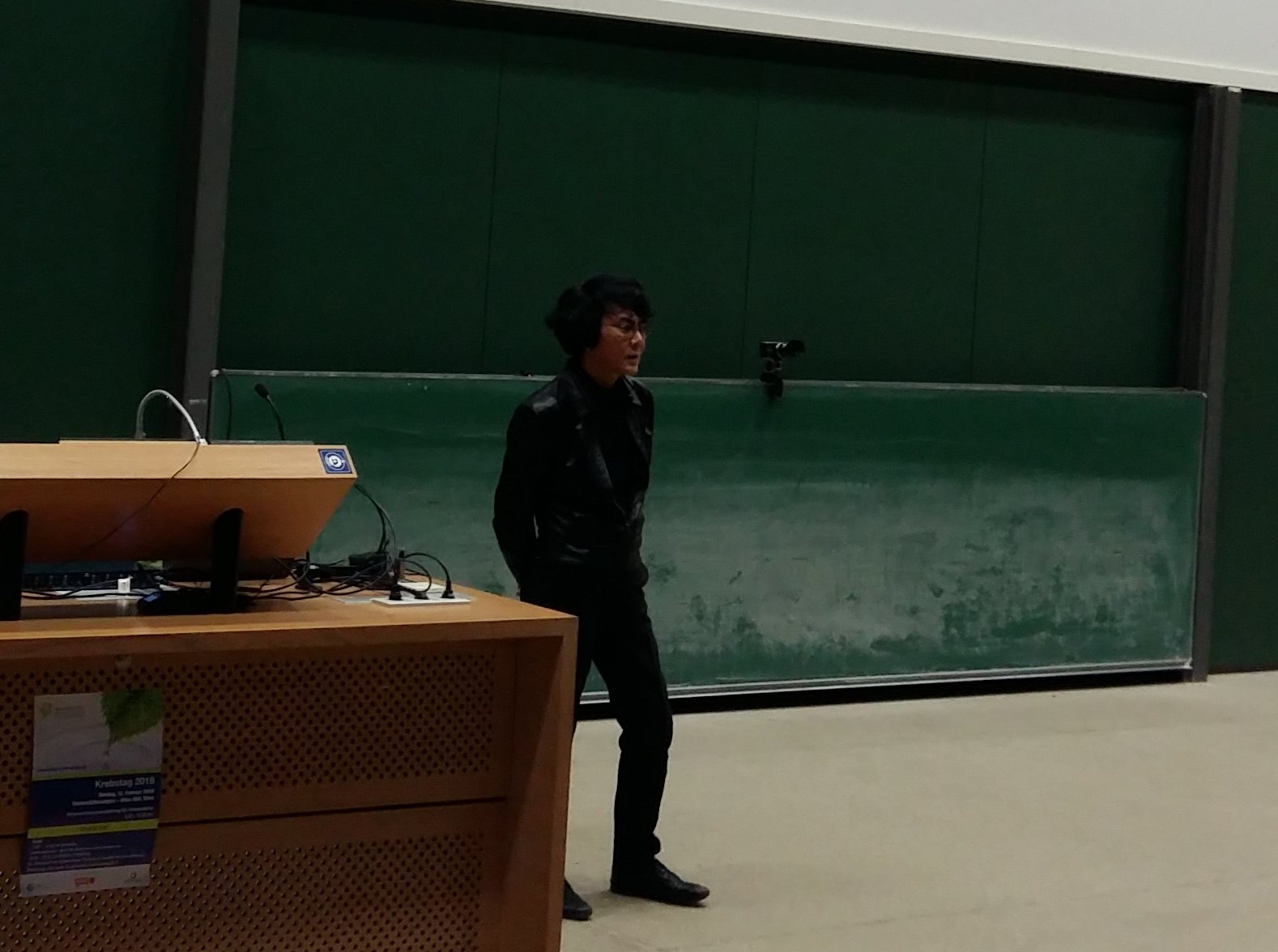
Fig.: A photo from the 2018 conference (with Hiroshi Ishiguro)
In the first part of the HUGGIE project initiated by Oliver Bendel, two students of the School of Business FHNW conducted an online survey with almost 300 participants. In the management summary of their bachelor thesis Ümmühan Korucu and Leonie Stocker (formerly Leonie Brogle) write: „The results of the survey indicated that people have a positive attitude towards robots in general as robots are perceived as interesting and useful rather than unnecessary and disturbing. However, only a minority of the participants stated that they would accept a hug from a robot. A possible reason for this could be that for the majority of participants, a hug is an act of intimacy with a deeper meaning attached to it which is only being shared with selected persons. For a robot to be perceived as an attractive hugging partner, a human-like design including a face, eyes, a friendly look as well as the ability to communicate verbally and non-verbally is desired. However, an appearance being too realistic has a deterrent effect. Furthermore, an in-depth analysis of the data in relation to age and gender of the participants resulted in the discovery of interesting facts and differences. Overall, the findings contribute to a clearer picture about the appearance and the features Huggie should have in order to be accepted as a hugging counterpart.“ The bachelor thesis will be publicly available in autumn 2020. There will also be a paper with the results next year.
A multi-stage HUGGIE project is currently underway at the School of Business FHNW under the supervision of Prof. Dr. Oliver Bendel. Ümmühan Korucu and Leonie Stocker (formerly Leonie Brogle) started with an online survey. The aim was to gain insights into how people of all ages and sexes judge a hug by a robot. In crises and catastrophes involving prolonged isolation, such as the COVID 19 pandemic, proxy hugs of this kind could well play a role. Prisons and longer journeys through space are also possible fields of applications. Nearly 300 people took part in the online survey. The evaluation is almost complete and the results are remarkable. Among other things, it was found that women want to be hugged by a robot that is bigger than them, and men want to be hugged by a robot that is smaller than them. Not only the size is relevant for the acceptance of robotic hugging: „An interesting input given by one of the participants was that it could be more pleasant to hug a robot if it smelled nicely, for example like chocolate.“ (Draft of Bachelor Thesis) Whether this is a typically Swiss view remains to be investigated. The results of the survey and the conclusions drawn from them for the design of HUGGIE will be compiled in a paper in the course of the year.
The topic of the 12th International Conference on Social Robotics (ICSR 2020) is „Entertaining Robots“, which is meant to be – according to the organizers – a play on words signifying that robots can serve as captivating social agents but also suggesting the challenges associated with managing these artifacts. „In the near future robots will be entering our social world taking on a wide variety of roles. This conference offers a venue for researchers and those interested in social robots to examine the progress that is being made towards the creation of social robots. ICSR 2020 will foster discussion related to the innovative approaches to developing social robots, the promise new robotic technologies, and possible positive and negative influences of social robots on society.“ (Website ICSR) ICSR 2020 was supposed to take place in Colorado, but will be conducted in a virtual format because of concerns surrounding the COVID-19 pandemic. Deadline for paper submission is 29 June 2020. More information via sites.psu.edu/icsr2020/.
The field of animal-machine interaction is gaining new research topics with social robots. Meiying Qin from Yale University and her co-authors have brought together a Nao and a dog. From the abstract of their paper: „In two experiments, we investigate whether dogs respond to a social robot after the robot called their names, and whether dogs follow the ’sit‘ commands given by the robot. We conducted a between-subjects study (n = 34) to compare dogs‘ reactions to a social robot with a loudspeaker. Results indicate that dogs gazed at the robot more often after the robot called their names than after the loudspeaker called their names. Dogs followed the ’sit‘ commands more often given by the robot than given by the loudspeaker. The contribution of this study is that it is the first study to provide preliminary evidence that 1) dogs showed positive behaviors to social robots and that 2) social robots could influence dog’s behaviors. This study enhance the understanding of the nature of the social interactions between humans and social robots from the evolutionary approach. Possible explanations for the observed behavior might point toward dogs perceiving robots as agents, the embodiment of the robot creating pressure for socialized responses, or the multimodal (i.e., verbal and visual) cues provided by the robot being more attractive than our control condition.“ (Abstract) You can read the full paper via dl.acm.org/doi/abs/10.1145/3371382.3380734.