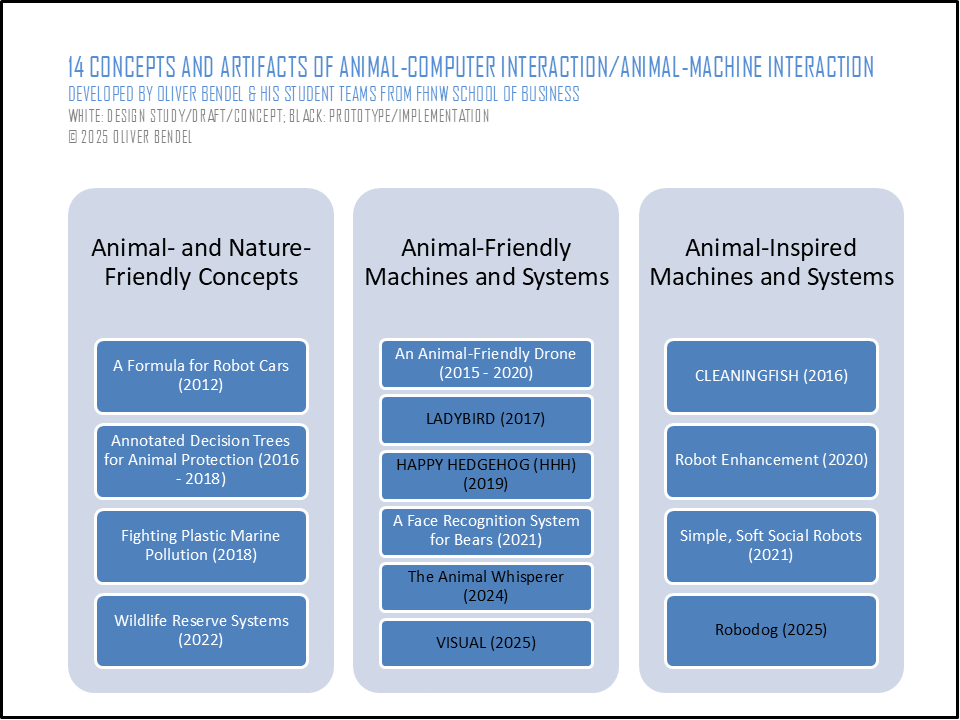
Since 2012, Oliver Bendel has developed 14 concepts and artifacts in the field of animal-computer interaction (ACI) or animal-machine interaction (AMI) together with his students. They can be divided into three categories. The first are animal- and nature-friendly concepts. The second are animal-friendly machines and systems (i.e., forms of moral machines). The third are animal-inspired machines and systems that replace the animals or bring them closer to you. Articles and book chapters have been published on many of the projects. The names of the developers can be found in these. A few prototypes made it into the media, such as LADYBIRD and HAPPY HEDGEHOG. Oliver Bendel repeatedly refers to Clara Mancini, the pioneer in the field of animal-computer interaction. Recently, ethicists such as Peter Singer have also turned their attention to the topic. Current projects include „Robodog“ (in which a robot dog meets real dogs) and „VISUAL“ (which is designed to enable photo safaris for the blind).
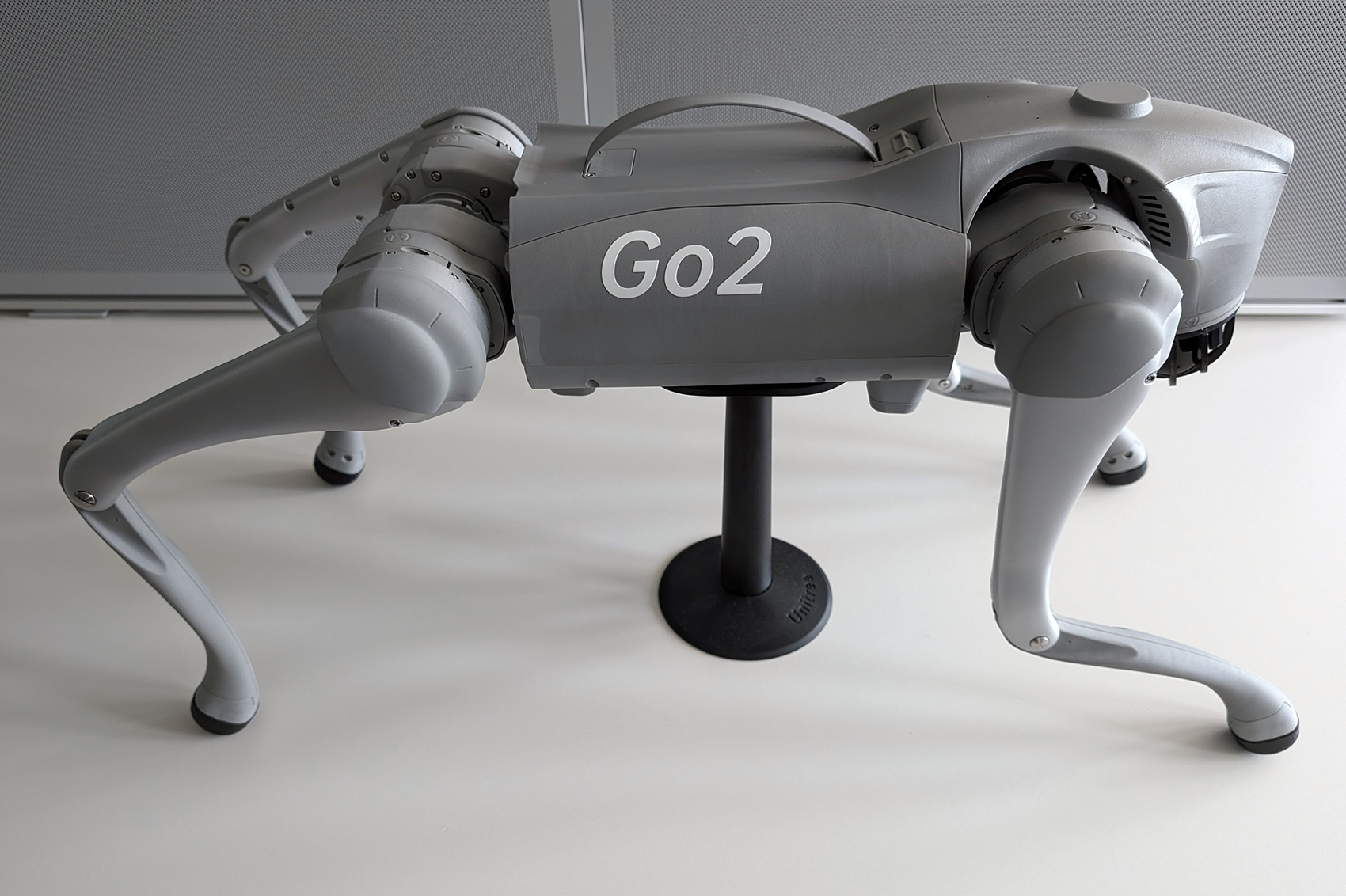
Robotic four-legged friends – often referred to as robot dogs – are becoming more and more widespread. As a result, they will also encounter more and more real dogs. The question is how to design, control, and program the robot in such a way that the animals do not overreact and cause no harm to robots, animals, or bystanders. As part of “The Robodog Project”, smaller dogs are to be confronted with a walking, running, and jumping Unitree Go2. The plan is to visit controllable environments such as dog training grounds and arrange meetings with dog owners. The findings will lead to suggestions for design and control. Robot enhancement can also play a role here. For example, hobbyists have produced heads for Unitree Go2 using a 3D printer, giving the robot a completely different look. Suggestions for programming will also be made. The project is due to start at the FHNW School of Business in March 2024. It is part of Prof. Dr. Oliver Bendel’s research in the field of animal-machine interaction.
Since 2012, Oliver Bendel has developed 13 concepts and artifacts in the field of animal-computer interaction (ACI) or animal-machine interaction (AMI) together with his students. They can be divided into three categories. The first are animal- and nature-friendly concepts. The second are animal-friendly machines and systems (i.e., forms of moral machines). The third are animal-inspired machines and systems that replace the animals or bring them closer to you. Articles and book chapters have been published on many of the projects. The names of the developers can be found in these. A few prototypes made it into the media, such as LADYBIRD and HAPPY HEDGEHOG. Oliver Bendel repeatedly refers to Clara Mancini, the pioneer in the field of animal-computer interaction. Recently, ethicists such as Peter Singer have also turned their attention to the topic.
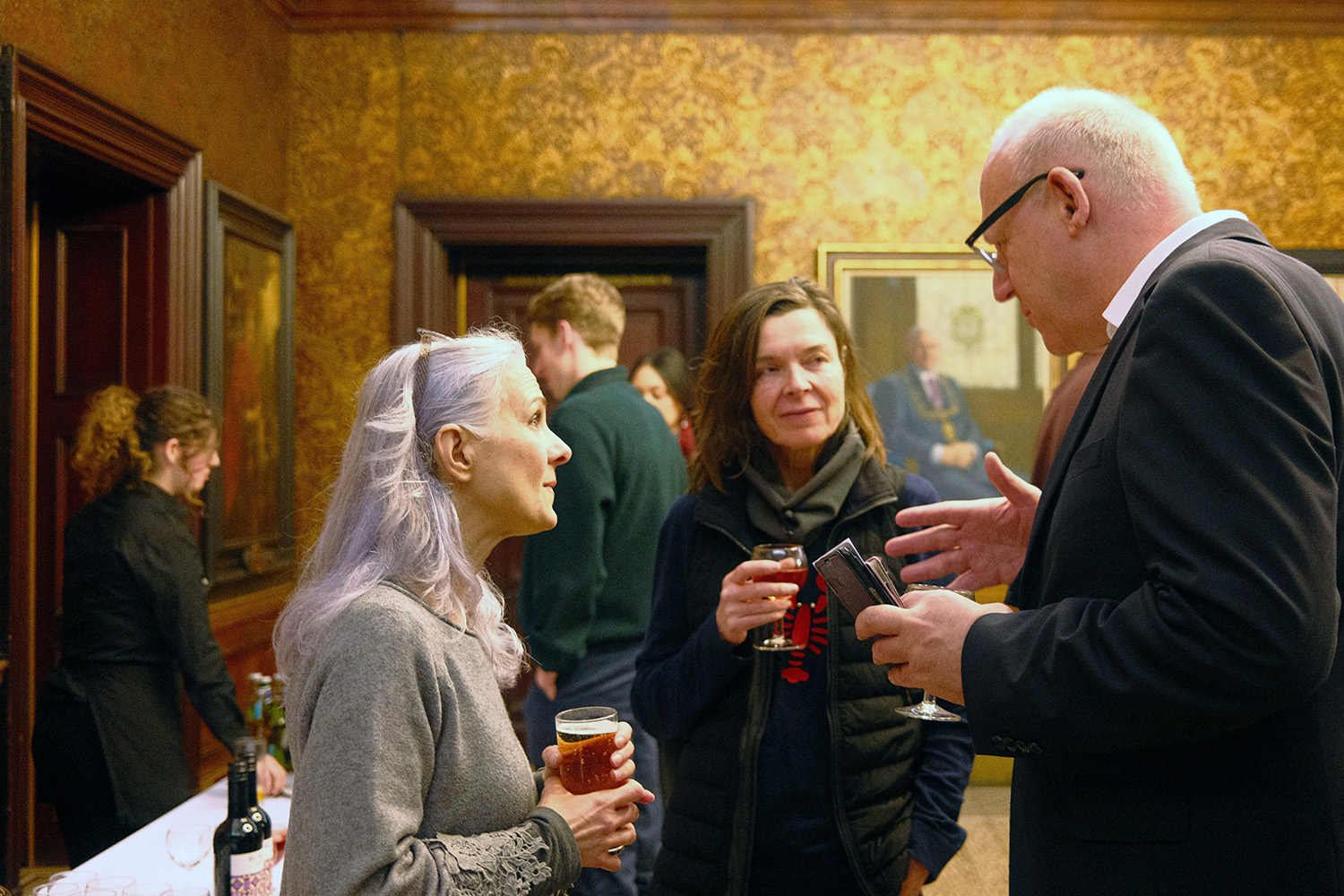
The International Conference on Animal-Computer Interaction (ACI) took place at the University of Glasgow from December 2 to 5, 2024. Clara Mancini and Fiona French are among the pillars of the ACI. Clara Mancini, PhD, is professor of animal-computer interaction (ACI) and founding director of the Open University ACI Laboratory. Her work explores the interaction between animals and technology, and the nexus between technology, animal well-being and justice, and human-animal relationships. Her research spans the theory, methodology, practice, and ethics of designing animal-centered interactive systems for and with animals to contribute to a more just and inclusive multispecies society. She is a co-founder of the ACI and has been promoting animal-centered research and design across disciplines for over a decade, organizing numerous scientific events and serving on various scientific committees. Dr. Fiona French is an associate professor in the School of Computing and Digital Media of the London Metropolitan University. She is course leader for the BSc Games Programming and a Fellow of the Higher Education Academy (FHEA). Her research interests are in the area of animal-computer interaction. Prof. Dr. Oliver Bendel attended the ACI International Conference 2022 and 2024. He has been conducting research in the field of animal-computer interaction and animal-machine interaction since 2012. Dr. Ilyena Hirskyj-Douglas (University of Glasgow) was the host of ACI 2024.
Fig.: Clara Mancini, Fiona French, and Oliver Bendel at the reception of the ACI 2024 (Photo: Jonathan Traynor)
Chinesische, indische und amerikanische Medien berichten immer wieder über die tierfreundlichen Maschinen und Systeme von Prof. Dr. Oliver Bendel. In seinem Studium ab 1987 war Tierethik einer seiner Schwerpunkte. Später verband er diese mit Maschinenethik und Sozialer Robotik und sprach sich für ein Arbeitsgebiet namens Animal-Machine Interaction aus, inspiriert von der Disziplin der Animal-Computer Interaction, die auf Clara Mancini zurückgeht. Bekannte Prototypen sind LADYBIRD und HAPPY HEDGEHOG. Das Projekt zu dem igelfreundlichen Mähroboter wurde 2019 durchgeführt. Das Paper „The HAPPY HEDGEHOG Project“ wurde Anfang 2021 beim Symposium „Machine Learning for Mobile Robot Navigation in the Wild“ im Rahmen der AAAI 2021 Spring Symposium Series vorgestellt. Nachdem es jahrelang über ein Google-Verzeichnis verfügbar war, kann es inzwischen über arxiv.org/abs/2401.03358 heruntergeladen werden. Damit wird es auch wieder verstärkt wahrgenommen. Die chinesische Plattform CSDN.net hat es am 9. Januar 2024 in der Rubrik „Daily Robotics Papers“ aufgeführt. Prof. Dr. Peter Singer beschäftigt sich seit kurzem ebenfalls mit dem Themenkomplex AI and Animals. In seinem Artikel „AI ethics: the case for including animals“ (zusammen mit Yip Fai Tse) vom Juli 2022 erwähnt er die Arbeit des Forschers aus Zürich.
Im privat finanzierten Social Robots Lab von Prof. Dr. Oliver Bendel ist seit Dezember 2023 der Unitree Go2 zu finden. Er hört auf den Namen Bao (chin. für „Juwel“ oder „Schatz“). Heise schreibt in einem Artikel: „Das Basismodell des Go2 ist am Kopf mit einem Lidar ausgestattet, das ein halbkugelförmiges Sichtfeld mit 90 vertikal und 360 Grad horizontal besitzt. Die Mindestreichweite des Lidar beträgt etwa 5 cm. Damit kann der Roboter im Gelände selbstständig navigieren, Hindernisse erkennen und sie auch umgehen. Der Roboter läuft mit einer Geschwindigkeit von bis zu 2,5 m/s und zeigt sich dabei äußerst agil. … Mit an Bord ist auch eine 2-Megapixel-Kamera, mit der Schnappschüsse und Videos aufgenommen werden können.“ (Heise News, 27. Juli 2023) Ein Anliegen des Wirtschaftsinformatikers und Technikphilosophen ist, bei der Tier-Maschine-Interaktion (Animal-Machine Interaction) voranzuschreiten. Dieses Arbeitsgebiet wurde von ihm im Jahre 2013 in seinem Beitrag „Considerations about the Relationship between Animal and Machine Ethics“ definiert, in Anlehnung an den Begriff der Animal-Computer Interaction, deren Pionierin Clara Mancini ist. Seit dieser Zeit entwickelte er mehrere Artefakte und Konzepte in diesem Bereich, darunter Robocar (Modellierung für tierfreundliche Autos), LADYBIRD (Prototyp eines insektenfreundlichen Staubsaugerroboters), HAPPY HEDGEHOG (Prototyp eines igelfreundlichen Staubsaugerroboters) und ANIFACE (Konzept für ein System mit Gesichtserkennung zur Identifizierung von Braunbären). Mit Bao sollen Reaktionen von Haus-, Nutz- und Wildtieren getestet werden. Ziel ist es, Roboter nicht nur menschen-, sondern auch tierfreundlich zu gestalten.
The online event „Artificial Intelligence & Animals“ will take place on 16 September 2023. „AI experts and attorneys will discuss the intersection of AI and animals in this UIA Animal Law Commission and GW Animal Law webinar“ (Website Eventbrite) Speakers are Prof. Dr. Oliver Bendel (FHNW University of Applied Sciences and Arts Northwestern Switzerland), Yip Fai Tse (University Center for Human Values, Center for Information Technology Policy, Princeton University), and Sam Tucker (CEO VegCatalyst, AI-Powered Marketing, Melbourne). Panelists are Ian McDougall (Executive Vice President and General Counsel, LexisNexis London), Jamie McLaughlin (Animal Law Commission Vice President, UIA), and Joan Schaffner (Associate Professor of Law, George Washington University). Oliver Bendel „has been thinking on animal ethics since the 1980s and on information and machine ethics since the 1990s“. „Since 2012, he has been systematically researching machine ethics, combining it with animal ethics and animal welfare. With his changing teams, he develops animal-friendly robots and AI systems.“ (Website Eventbrite) Yip Fai Tse co-wrote the article „AI ethics: the case for including animals“ with Peter Singer. Sam Tucker is an animal rights activist.
The Tenth International Conference on Animal-Computer Interaction will be held December 4-8, 2023, in Raleigh, North Carolina, hosted by North Carolina State University. „ACI is the leading International Conference on Animal-Computer Interaction. It is a highly multidisciplinary event drawing researchers and practitioners from diverse backgrounds to share and discuss work and topics related to the research and design of computing-enabled and interactive technology for and with animals.“ (Website ACI) The Ninth International Conference on Animal-Computer Interaction was held in Newcastle upon Tyne at the end of 2022. Also this year the organizers are interested in a variety of topics in animal-computer interaction and animal-machine interaction, as the call for papers (CfP) reveals: „Submissions might address topics such as: the role of technology in shaping human-animal relationships; studies and/or analysis of large-scale technology for animal deployments; considerations on the wider context of technology for animal use; methods and reflections on studying the next generation of technology for animals; or how to conduct ACI research in a world where commercial design and deployment of technology for animals outpaces academic thought.“ (Website ACI) The CfP can be accessed at www.aciconf.org/aci2023.
Fig.: The William B. Umstead State Park in North Carolina
The conference program for ACI’22 will be available in the course of November. In the meantime, the website lists the accepted papers in alphabetical order. Among them are the papers „A Face Recognition System for Bears: Protection for Animals and Humans in the Alps“ (Oliver Bendel and Ali Yürekkirmaz), „A Framework for Training Animals to Use Touchscreen Devices for Discrimination Tasks“ (Jennifer Cunha and Corinne Renguette), „Politicising Animal-Computer Interaction: an Approach to Political Engagement with Animal-Centred Design“ (Clara Mancini, Orit Hirsch-Matsioulas, and Daniel Metcalfe), and „TamagoPhone: A framework for augmenting artificial incubators to enable vocal interaction between bird parents and eggs“ (Rebecca Kleinberger, Megha Vemuri, Janelle Sands, Harpreet Sareen, Janet M. Baker). ACI2022 will take place 5-8 December 2022, hosted by Northumbria University, Newcastle upon Tyne, UK.
Fig.: The Gateshead Millennium Bridge between Gateshead and Newcastle upon Tyne
The impact of robotics and artificial intelligence on non-human animals has been researched by Oliver Bendel for several years. He has made it his task to complement the discipline of animal-computer interaction, which was founded by Clara Mancini, with the discipline of animal-machine interaction. His most recent paper is „Passive, Active, and Proactive Systems and Machines for the Protection and Preservation of Animals and Animal Species“, published February 25, 2022, in Frontiers of Animal Science. Also becoming active in this field now is the famous ethicist Peter Singer. Together with his co-author Yip Fai Tse, he published the article „AI ethics: the case for including animals“ in July 2022. From the abstract: „The ethics of artificial intelligence, or AI ethics, is a rapidly growing field, and rightly so. While the range of issues and groups of stakeholders concerned by the field of AI ethics is expanding, with speculation about whether it extends even to the machines themselves, there is a group of sentient beings who are also affected by AI, but are rarely mentioned within the field of AI ethics – the nonhuman animals. This paper seeks to explore the kinds of impact AI has on nonhuman animals, the severity of these impacts, and their moral implications. We hope that this paper will facilitate the development of a new field of philosophical and technical research regarding the impacts of AI on animals, namely, the ethics of AI as it affects nonhuman animals.“ (Peter Singer and Yip Fai Tse 2022) In the text, the authors write: „Of the hundreds of AI ethics related papers we reviewed in this project, we only found four that concern the impacts of AI on animals, in a general way, and discuss the relevant ethical implications. They are: ‚Towards animal-friendly machines‘ by Oliver Bendel, ‚AI Ethics and Value Alignment for Nonhuman Animals‘ by Soenke Ziesche, ‚Moral Consideration of Nonhumans in the Ethics of Artificial Intelligence‘ by Andrea Owe and Seth Baum and ‚Animals and AI. The role of animals in AI research and application – An overview and ethical evaluation‘ by Leonie Bossert and Thilo Hagendorf.“ (Peter Singer and Yip Fai Tse 2022) The article will certainly give the young disciplines a further boost.
Clara Mancini (The Open University) and Eleonora Nannoni (University of Bologna) are calling for abstracts and papers for the Frontiers research topic „Animal-Computer Interaction and Beyond: The Benefits of Animal-Centered Research and Design“. They are well-known representatives of a discipline closely related to animal-machine interaction. „The field of Animal-Computer Interaction (ACI) investigates how interactive technologies affect the individual animals involved; what technologies could be developed, and how they should be designed in order to improve animals’ welfare, support their activities and foster positive interspecies relationships; and how research methods could enable animal stakeholders to participate in the development of relevant technologies.“ (Website Frontiers) The editors welcome submissions that contribute, but are not necessarily limited, to the following themes: 1) „Applications of animal-centered and/or interactive technologies within farming, animal research, conservation, welfare or other domains“, and 2) „Animal-centered research, design methods and frameworks that have been applied or have applicability within farming, animal research, conservation, welfare or other domains Submission information is available through the website“ (Website Frontiers). More submission information is available through the Frontiers website.
In May 2020 the media was interested in a video by Rocos showing a robot from Boston Dynamics trying to be a shepherd dog. You could see the artificial quadruped running towards a flock of sheep. “Now, it’s clear that the video is mostly a fun teaser rather than a serious claim by Rocos (or Boston Dynamics) that robots will soon be replacing sheepdogs.” (The Verge, 22 May 2020) According to the magazine, it does invite a tantalizing question: if that did happen, „how well would the robots fare“ (The Verge, 22 May 2020)? „Terrible“, is the straight answer of sheep farmer and author James Rebanks. „The robot might be an amazing tool for lots of things but it is worthless and unwanted as a sheepdog …“ (The Verge, 22 May 2020) However, the profession of shepherd is not everywhere in the world the dream of all boys and girls, and shepherd dogs do not fall from the sky. It is also not clear whether there is a big difference for the sheep and how positively or negatively they react to the machine. It is just as unclear whether lambs that have never met real dogs would be comfortable with it. This would have to be researched in animal psychology and social robotics and in disciplines such as animal-machine interaction, which are still in their infancy. Only then would one know whether the shepherd interviewed by the magazine is right.
The field of animal-machine interaction is gaining new research topics with social robots. Meiying Qin from Yale University and her co-authors have brought together a Nao and a dog. From the abstract of their paper: „In two experiments, we investigate whether dogs respond to a social robot after the robot called their names, and whether dogs follow the ’sit‘ commands given by the robot. We conducted a between-subjects study (n = 34) to compare dogs‘ reactions to a social robot with a loudspeaker. Results indicate that dogs gazed at the robot more often after the robot called their names than after the loudspeaker called their names. Dogs followed the ’sit‘ commands more often given by the robot than given by the loudspeaker. The contribution of this study is that it is the first study to provide preliminary evidence that 1) dogs showed positive behaviors to social robots and that 2) social robots could influence dog’s behaviors. This study enhance the understanding of the nature of the social interactions between humans and social robots from the evolutionary approach. Possible explanations for the observed behavior might point toward dogs perceiving robots as agents, the embodiment of the robot creating pressure for socialized responses, or the multimodal (i.e., verbal and visual) cues provided by the robot being more attractive than our control condition.“ (Abstract) You can read the full paper via dl.acm.org/doi/abs/10.1145/3371382.3380734.