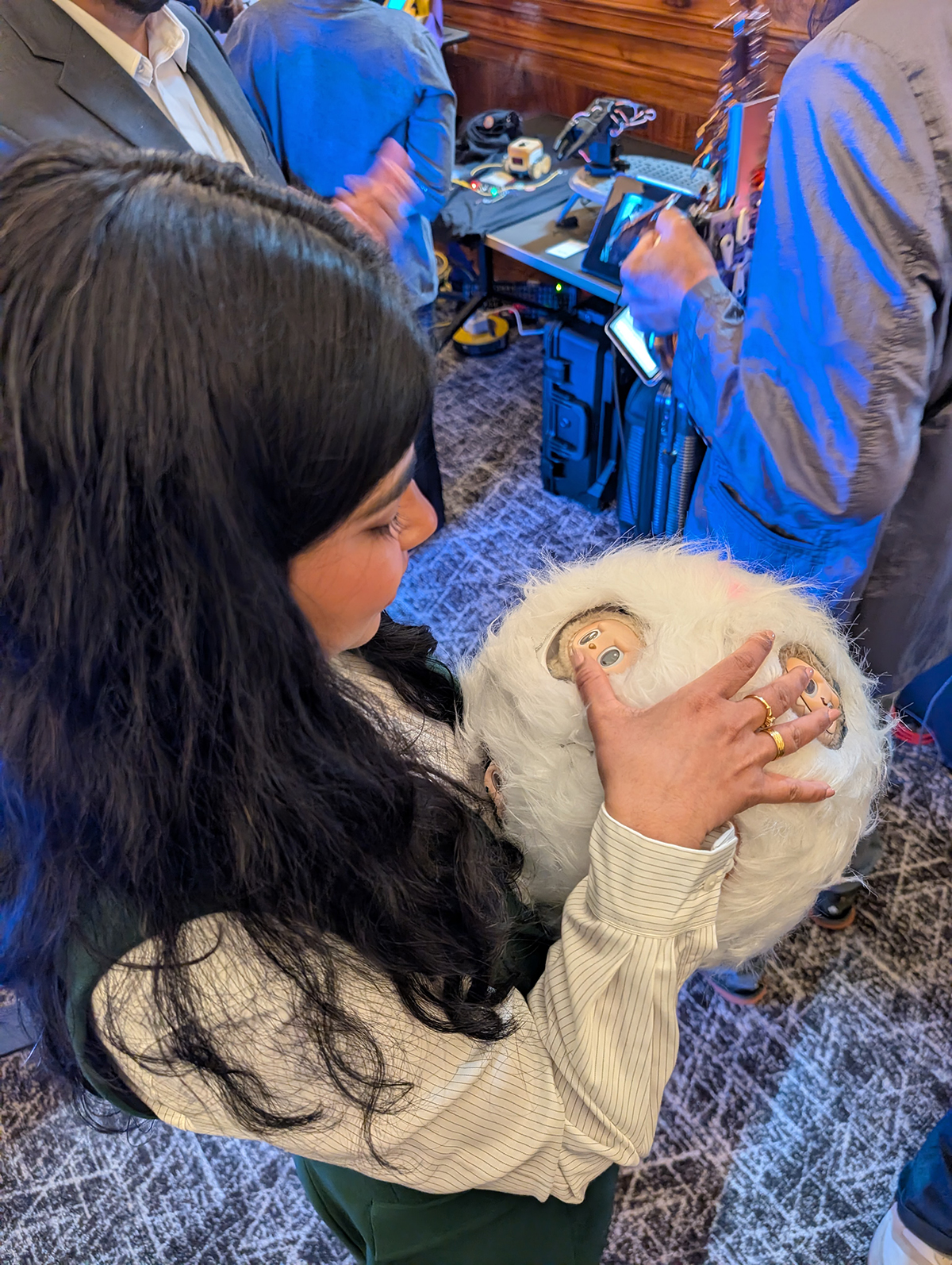
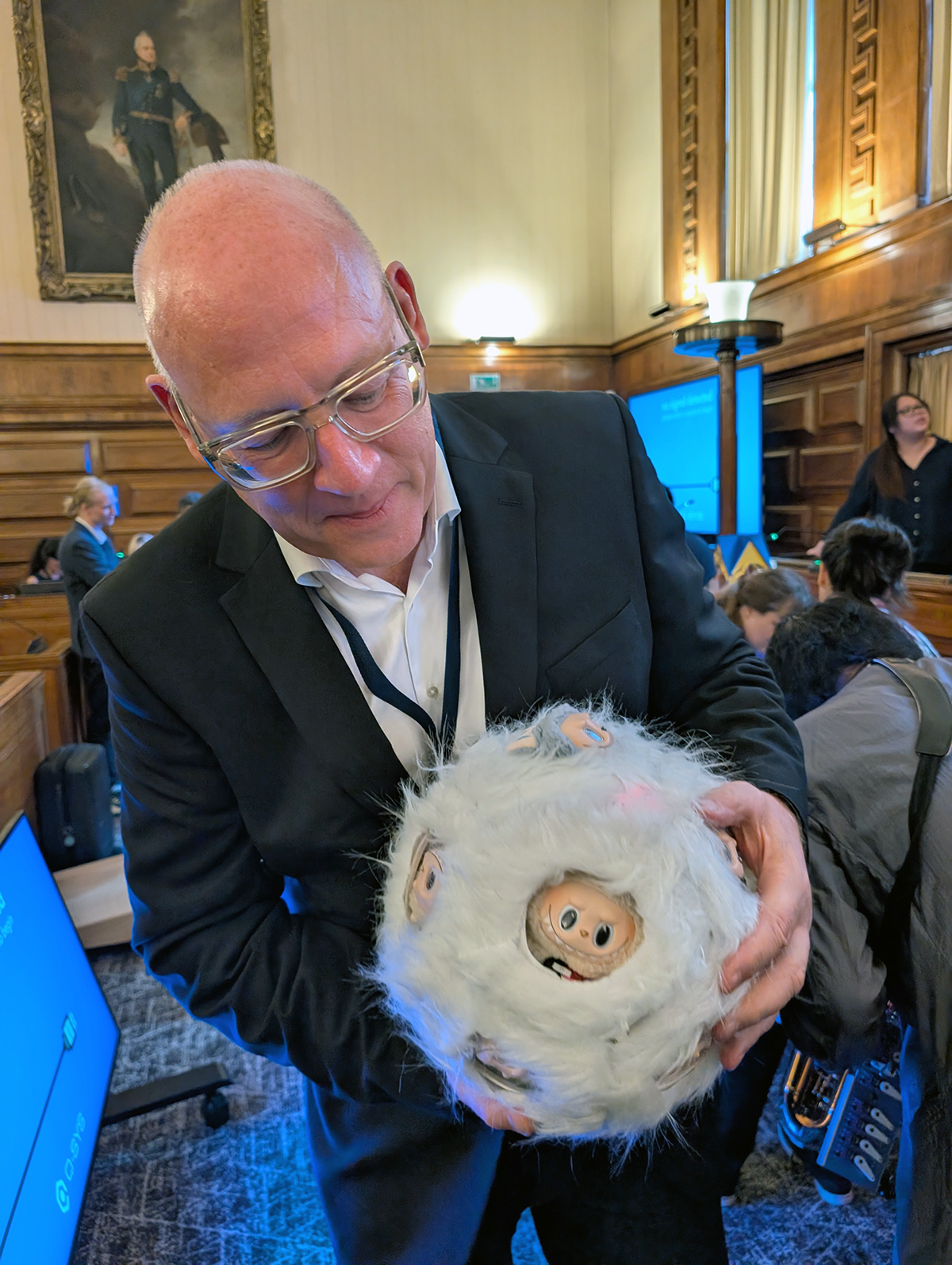
The 18th International Conference on Social Robotics (ICSR + Art 2026) took place from July 1–4, 2026, bringing together researchers, academics, and industry professionals from around the world to discuss the latest advances in social robotics. On the opening day, the ICSR Grand Challenge presentations, including optional demonstrations, took place in the Debate Hall. One of the standout projects was Labububot, presented by Miranda Li and developed by Miranda Li, Jake Read, Dimitar Dimitrov, and Cynthia Breazeal at the Massachusetts Institute of Technology. According to the MIT Media Lab, „This is Labububot — one of the rarest monsters on Earth. Twelve Labubu heads are reconstituted into a single spherical form: a Frankenstein’s Monster of pop culture iconography. Labububot is a playful critique of social robots, and a question made physical – what do the monsters we make reveal about the monsters we are?“ … Instead of following the familiar approach of designing social robots to be cute, friendly, and emotionally unambiguous, Labububot deliberately embraces monster theory and explores the productive potential of the uncanny. From the perspective of Oliver Bendel’s robot classification, Labububot can be regarded as a mythomorphic robot. It consists of twelve monster figures and also belongs to the category of soft robots, although it incorporates rigid structural elements. By combining unconventional design with references to popular culture and fashion, Labububot became one of the most memorable projects presented during the Grand Challenge. Rumor has it that the idea for the spherical monster emerged after its creators had enjoyed a few drinks too many, although this anecdote is best taken as part of the project’s growing mythology rather than established fact.
The 18th International Conference on Social Robotics (ICSR + Art 2026) is currently taking place from July 1–4, 2026, bringing together researchers, academics, and industry professionals from around the world to discuss the latest advances in social robotics. As the leading international forum in the field, ICSR features a broad range of presentations and demonstrations. On the first day of the conference, the ICSR Grand Challenge presentations, including optional demonstrations, took place in the Debate Hall. One of the standout projects was Labububot, presented by Miranda Li and developed by Miranda Li, Jake Read, Dimitar Dimitrov, and Cynthia Breazeal at the Massachusetts Institute of Technology. Instead of following the familiar approach of designing social robots to be cute, friendly, and emotionally unambiguous, Labububot embraces monster theory and deliberately explores the productive potential of the uncanny. The project argues that robots capable of provoking curiosity, discomfort, or surprise may ultimately foster deeper and more authentic long-term engagement than those designed solely to reassure. From the perspective of Oliver Bendel’s robot classification, Labububot can be regarded as a mythomorphic robot. It consists of twelve monster figures and also belongs to the category of soft robots, although it incorporates rigid structural elements. By combining unconventional design with references to popular culture and fashion, Labububot has become one of the most memorable projects presented during the Grand Challenge on the opening day of ICSR + Art 2026. Further information about the conference is available at ICSR 2026, while technical details about Labububot can be found in the project’s GitHub repository.
Fig.: Oliver Bendel with Labububot (Photo: Stephan Vonschallen)
The ICSR 2025 announces Daniela Rus as the event’s first keynote speaker. She is the Andrew (1956) and Erna Viterbi Professor of Electrical Engineering and Computer Science and Director of the MIT Computer Science and Artificial Intelligence Laboratory (CSAIL). Her research spans robotics, mobile computing, and data science, with a focus on the future of AI and automation. She is a MacArthur Fellow, a Fellow of ACM, AAAI, and IEEE, and a member of the National Academy of Engineering and the American Academy of Arts and Sciences. Professor Rus received her Ph.D. in computer science from Cornell University and continues to lead innovation in the field. Her keynote at the ICSR 2025 promises to provide valuable insights into the evolving landscape of robotics and AI. More information is available at icsr2025.eu.
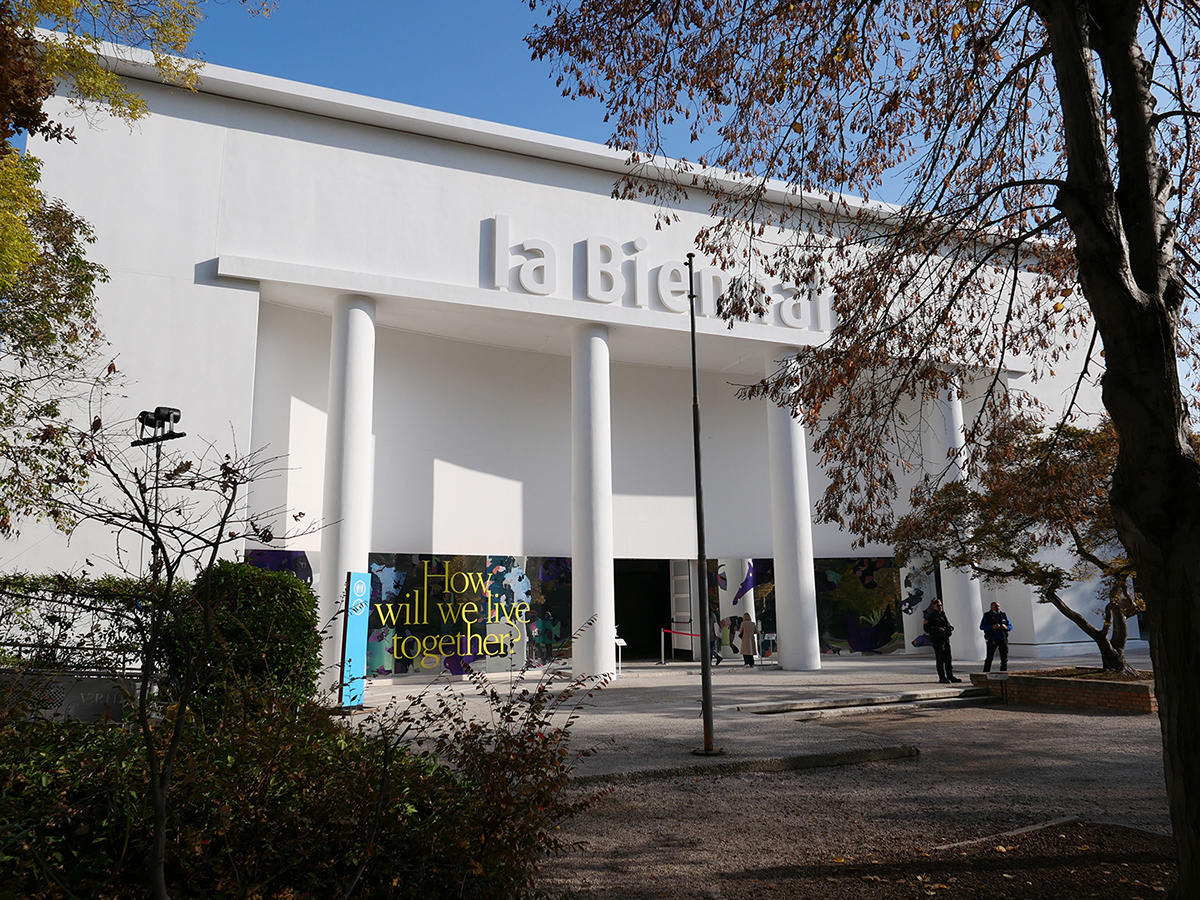
The 17th International Architecture Exhibition – the whole series, the art part included, is known under the name La Biennale di Venezia – ran from 22 May to 21 November 2021, curated by scholar and architect Hashim Sarkis. Its motto was „How will we live together?“. „We need a new spatial contract. In the context of widening political divides and growing economic inequalities, we call on architects to imagine spaces in which we can generously live together“, Sarkis said to the organizers (s. Website Biennale). „Hashim Sarkis has been Dean of the School of Architecture and Planning at the Massachusetts Institute of Technology (MIT) since 2015. He earned a Bachelor of Architecture and a Bachelor of Fine Arts from the Rhode Island School of Design, and a PhD in Architecture from Harvard University.“ (Website Biennale) Biennial themes ranged from architecture’s responses to climate change to proposals for living on other planets to the interactions between smart cities or smart houses and cyborgs. Ethical issues were repeatedly addressed.
The international workshop „Understanding AI & Us“ will take place in Berlin (Alexander von Humboldt Institute for Internet and Society) on 30 June 2018. It is hosted by Joanna Bryson (MIT), Janina Loh (University of Vienna), Stefan Ullrich (Weizenbaum Institute Berlin) and Christian Djeffal (IoT and Government, Berlin). Birgit Beck, Oliver Bendel and Pak-Hang Wong are invited to the panel on the ethical challenges of artificial intelligence. The aim of the workshop is to bring together experts from the field of research reflecting on AI. The event is funded by the Volkswagen Foundation (VolkswagenStiftung). The project „Understanding AI & Us“ furthers and deepens the understanding of artificial intelligence (AI) in an interdisciplinary way. „This is done in order to improve the ways in which AI-systems are invented, designed, developed, and criticised.“ (Invitation letter) „In order to achieve this, we form a group that merges different abilities, competences and methods. The aim is to provide space for innovative and out-of-the-box-thinking that would be difficult to pursue in ordinary academic discourse in our respective disciplines. We are seeking ways to merge different disciplinary epistemological standpoints in order to increase our understanding of the development of AI and its impact upon society.“ (Invitation letter)
Im März 2017 erfuhr die connectUS-Delegation der Hochschule für Wirtschaft FHNW am MIT von dem autonomen Dreirad, das dort entwickelt wurde. Sie wurde durch die heiligen Hallen der berühmten Hochschule geführt und durfte einen Blick auf die aktuellen Prototypen werfen. Auf der Website heißt es: „The PEV is a low-cost, agile, shared-use autonomous bike that aims to solve the ‘last-mile’ urban mobility challenge of today, and to become a healthy, sustainable alternative to cars for cities of tomorrow. The PEV can be either an electrically-assisted tricycle for passenger commute or an autonomous carrier for delivering packages.“ Auch die Universität Magdeburg setzt auf das autonome Dreirad, wie MDR am 20. März 2018 meldete: „Selbstfahrende Autos sind schon länger im Gespräch, selbstfahrende Fahrräder aber haben die wenigsten bisher gesehen. Die Uni Magdeburg erforscht, wie Fahrräder autonom durch die Stadt fahren können, um Nutzern flexibel zur Verfügung zu stehen. Für Einkäufe oder andere Transporte könnte man sie dann mieten.“ (Website MDR, 20. März 2018) Oliver Bendel, der Mitglied der Delegation war, ist skeptisch gegenüber autonomen Dreirädern, da diese die Komplexität in Städten erhöhen und Kollisionen nicht zu vermeiden sein werden, ähnlich wie bei Servicerobotern.
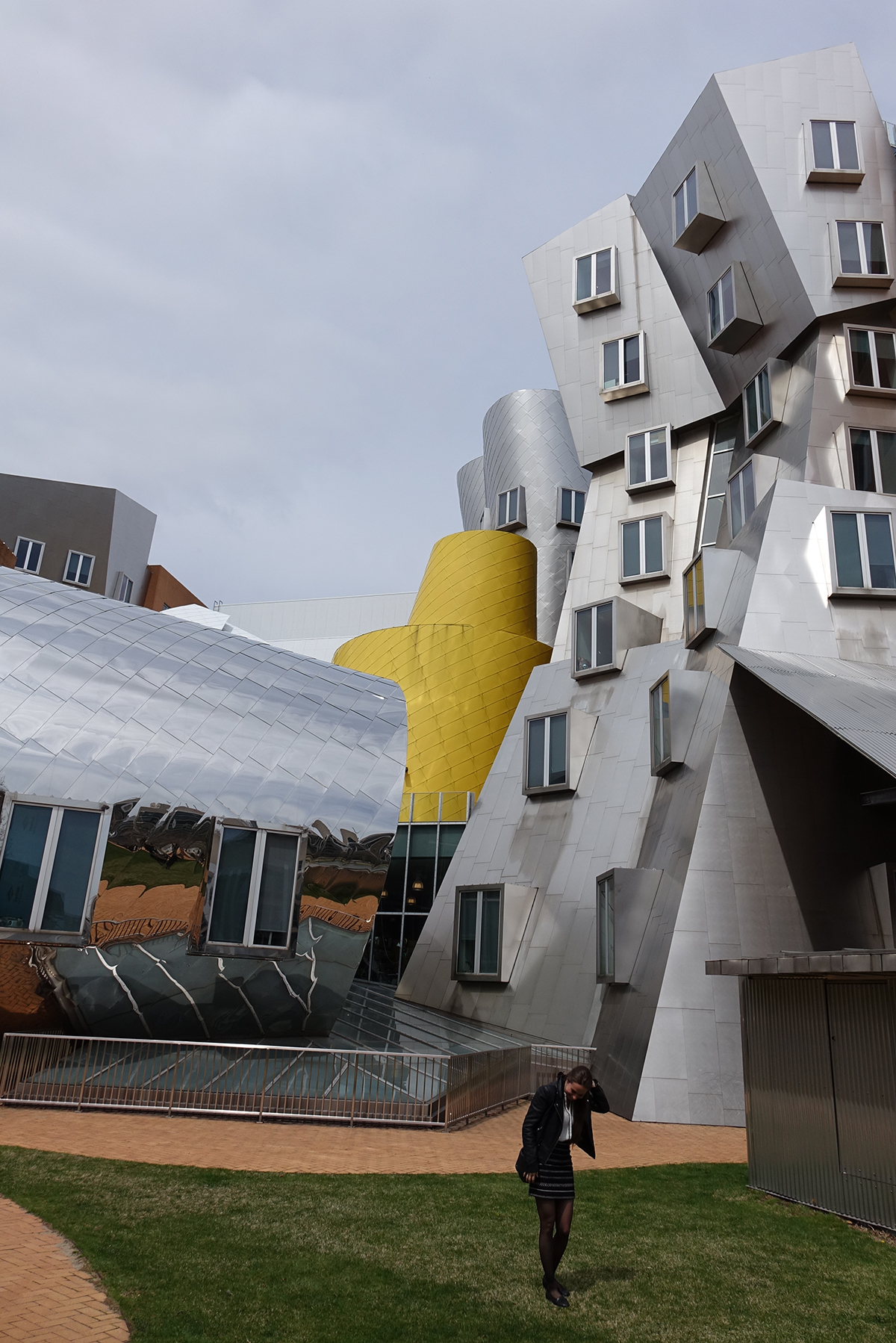
Der 14. April 2017 war für die Delegation aus Studierenden und Dozierenden der FHNW wieder ein besonderer Tag. Sie besuchte die Harvard University und das Massachusetts Institute of Technology (MIT) in Cambridge, das zuletzt mit der „moral machine“, einer Simulation zu autonomen Autos, Aufsehen erregt hatte. Empfangen worden war die Delegation von connectUS am Morgen von swissnex Boston, dem wissenschaftlichen schweizerischen Konsultat in Cambridge. Von einem Vertreter wurde sie zu den berühmten Hochschulen und ihren wichtigsten Plätzen und Einrichtungen geführt. Das Mittagessen fand im MIT statt, und im reichen internationalen Angebot waren auch vegetarische und vegane Gerichte enthalten. Eine weitere Station am Nachmittag war das CIC in Cambridge. Der CEO Tim Rowe begrüßte die Gruppe freundlich, eine Mitarbeiterin erklärte das Konzept, zu dem es auf der Website heißt: „C3 is a vibrant coworking center located at CIC. With well over 300 members, it is the largest coworking center in the Boston area, and is home to some of Boston’s most promising early-stage entrepreneurs.“ Auch in Boston, St. Louis, Rotterdam und Miami ist man präsent, und in den nächsten 10 Jahren will man stark wachsen. Im Venture Cafe des CIC lernten die Studierenden künftige und erfolgreiche Start-up-Gründer kennen. Zum Abendessen ging man in das Hard Rock Cafe in Boston.