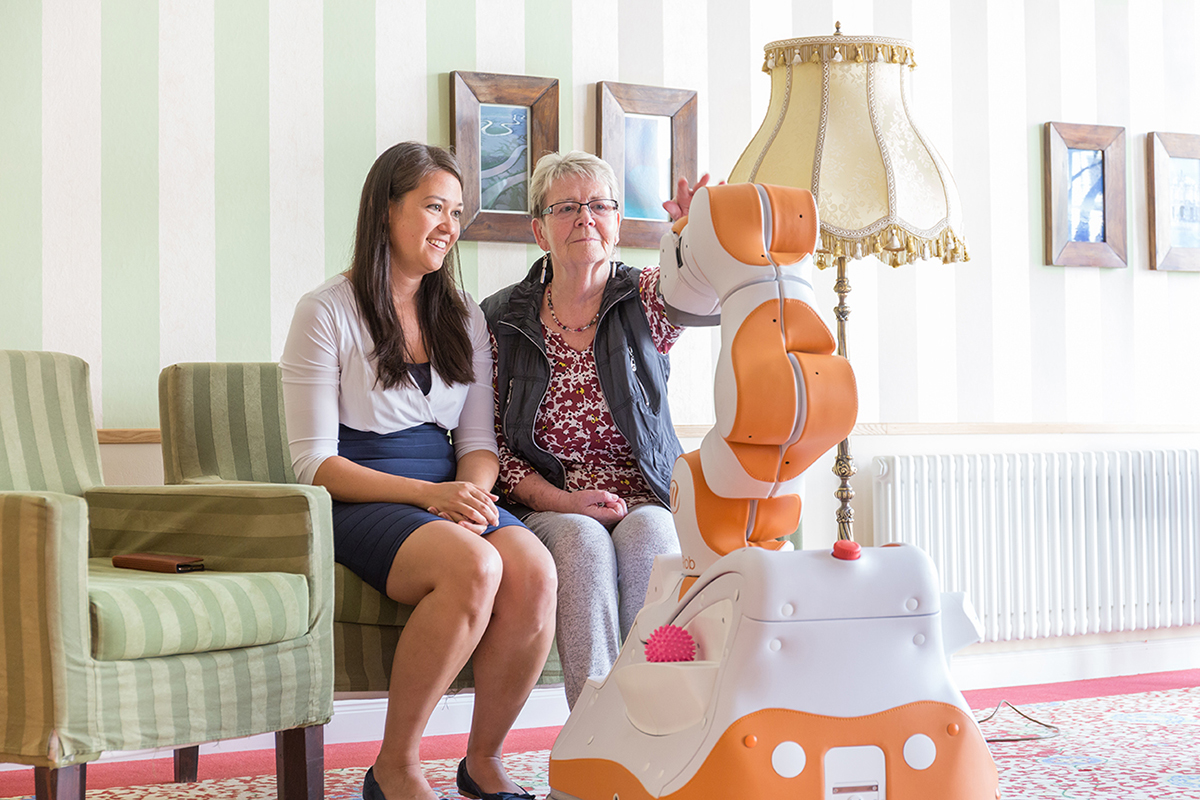
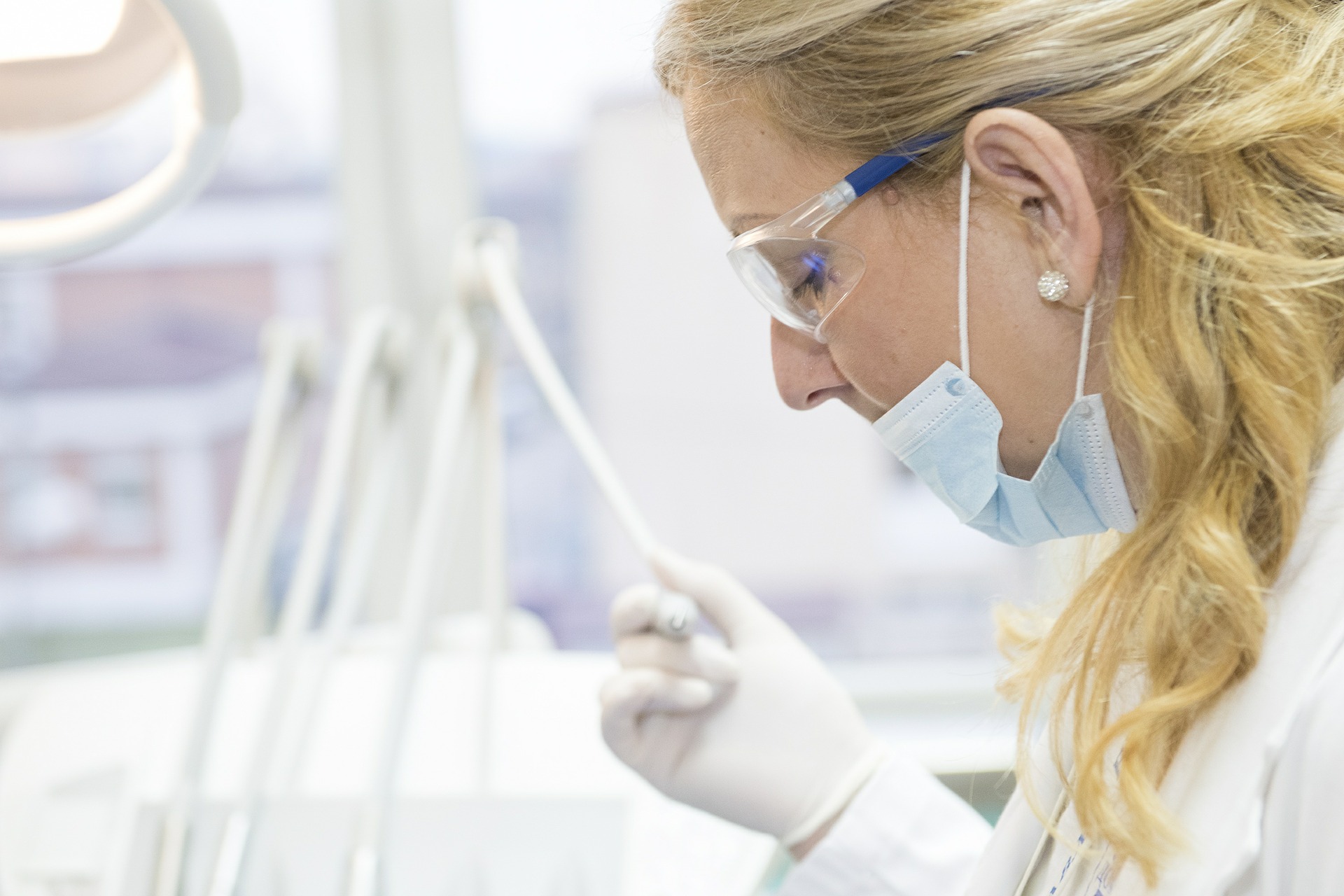
DIH-HERO is a project in the healthcare sector supported by the European Union since January 2019. According to the website, the mission is to create a sustaining network that connects players in the healthcare sector and to support small and medium sized enterprises. „Currently, Europe and countries all over the world are facing a global pandemic. Together with its extensive Robotics in Healthcare European network DIH-HERO decided to support the fight against COVID-19 by providing €1,000,000 for robotic technologies that can be deployed timely, in order to support healthcare professionals and save lives by satisfying a current clinical demand or need.“ (Website DIH-HERO) F&P Robotics based in Switzerland is one of the winners of the announcement. Lio – one of the company’s flagships – will now learn new tasks in the field of disinfection (door traps, lift buttons). The normal use of the care robot was last described in a paper by Oliver Bendel (School of Business FHNW), Alina Gasser and Joel Siebenmann (F&P Robotics) that was accepted at the AAAI 2020 Spring Symposia. Because of COVID-19 the lecture was postponed to late autumn.
The field of animal-machine interaction is gaining new research topics with social robots. Meiying Qin from Yale University and her co-authors have brought together a Nao and a dog. From the abstract of their paper: „In two experiments, we investigate whether dogs respond to a social robot after the robot called their names, and whether dogs follow the ’sit‘ commands given by the robot. We conducted a between-subjects study (n = 34) to compare dogs‘ reactions to a social robot with a loudspeaker. Results indicate that dogs gazed at the robot more often after the robot called their names than after the loudspeaker called their names. Dogs followed the ’sit‘ commands more often given by the robot than given by the loudspeaker. The contribution of this study is that it is the first study to provide preliminary evidence that 1) dogs showed positive behaviors to social robots and that 2) social robots could influence dog’s behaviors. This study enhance the understanding of the nature of the social interactions between humans and social robots from the evolutionary approach. Possible explanations for the observed behavior might point toward dogs perceiving robots as agents, the embodiment of the robot creating pressure for socialized responses, or the multimodal (i.e., verbal and visual) cues provided by the robot being more attractive than our control condition.“ (Abstract) You can read the full paper via dl.acm.org/doi/abs/10.1145/3371382.3380734.
COVID-19 führt uns derzeit vor Augen, dass Digitalisierung und Technologisierung bei Krisen und Katastrophen Menschen helfen, ja unter Umständen sogar Leben retten können. In China lieferten Serviceroboter in Spitälern und auf Quarantänestationen Medikamente und Nahrungsmittel aus. Wer in den entsprechenden Krisengebieten zuhause bleiben musste, konnte über einen Computerarbeitsplatz und Lernanwendungen weiterhin seinen Aufgaben nachkommen und sich weiterbilden. In Zukunft wird es durch Klimawandel, Artensterben und neuartige Krankheiten bzw. Antibiotikaresistenzen immer mehr Notlagen geben. Möglichst viele Länder sollten sich nach Meinung von Oliver Bendel regelrechte Kohorten von Servicerobotern zulegen, um die Herausforderungen zu meistern. Insbesondere sind Sicherheits-, Transport- und Pflegeroboter sowie Desinfektionsroboter gefragt. In seinem Beitrag „Serviceroboter als Helfer in der Not“ für Telepolis vom 13. Mai 2020 führt der Technikphilosoph an das Thema heran, indem er aus persönlicher Sicht die verschiedenen Typen von Servicerobotern vorstellt. In Bezug auf Pflegeroboter und Roboter in der Pflege schlägt er eine Systematisierung vor. Dann kommt er zu der genannten Forderung: Wir brauchen mehr Serviceroboter, die uns bei Krisen und Katastrophen (und Pandemien) unterstützen und entlasten – und Dinge tun, die uns nicht mehr möglich sind.
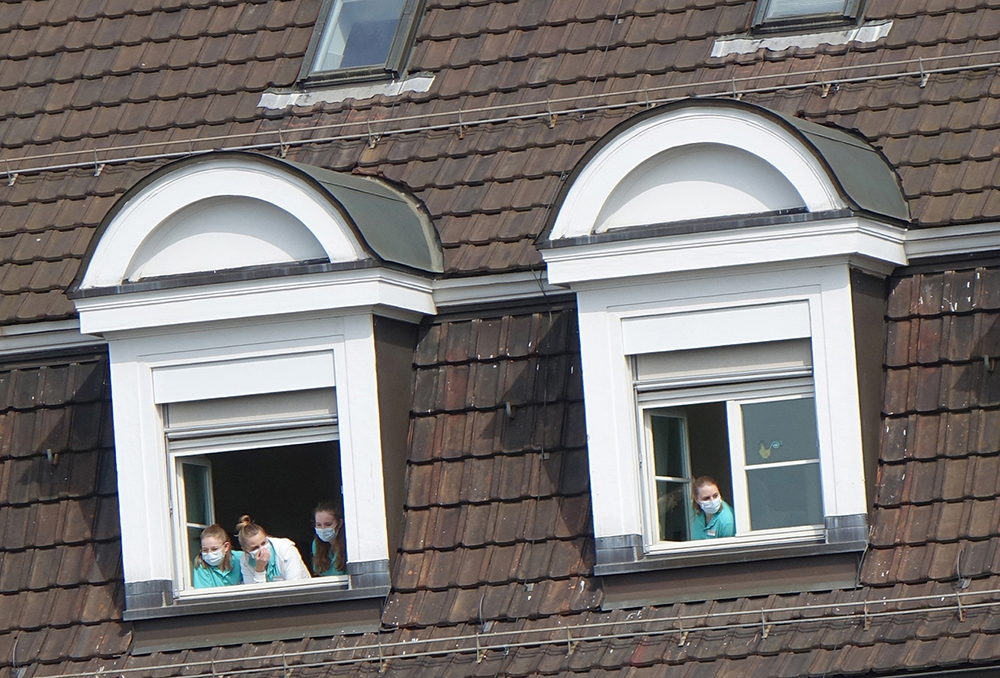
Abb.: Ärztehaus in Zürich während der COVID-19-Pandemie
Das autonome Fahren wird von vielen Unternehmen gefördert und erforscht. Manche halten es für ausgemacht, dass ihm die Zukunft gehört. In einem Artikel von Oliver Bendel aus dem Jahre 2018 wurde die Überlegung angestellt, dass die Sensorik des automatischen und später autonomen Autos durch simple Eingriffe gestört werden kann. So kann man Kameras mit Lack übersprühen und Sensoren aller Art mit Kaugummi zukleben. Farbbeutel können auch in voller Fahrt zum Einsatz kommen. Es können also Angriffe auf das Äußere stattfinden, mit dem Ergebnis, dass das Auto erst gar nicht losfährt oder während der Fahrt zum Stillstand kommt oder Störungen aufweist. Dazu kommen Hackerangriffe, also sozusagen Angriffe auf das Innere. Man könnte von Maschinenstürmern des 21. Jahrhunderts sprechen, mit Motivationen aller Art. Im Mai 2020 wurde ein Student an der Hochschule für Wirtschaft FHNW gefunden, der eine entsprechende Hypothese formulieren und überprüfen soll. Seine Abschlussarbeit soll den Schaden, den man dem automatischen oder autonomen Auto zufügen kann, möglichst vollständig erfassen. Es sollen mindestens 25 mögliche Angriffe identifiziert und systematisiert werden. Ideal wäre es, wenn ein automatisches Auto zum Test für die Angriffe auf das Äußere zur Verfügung stehen würde. Dafür werden vom Auftraggeber der Untersuchung – dem oben genannten Autor – Hersteller und Autohäuser angefragt.
Umarmungen und Berührungen durch soziale Roboter fühlen sich anders an als solche durch Menschen. Wärme und Weichheit helfen dabei, die Akzeptanz zu verbessern. Und dennoch ist der Effekt nicht derselbe. Grundsätzlich ist wichtig, dass uns eine andere Person umarmt, also wir das nicht selbst tun, und diese Person in einem bestimmten Verhältnis zu uns steht. Sie kann uns vertraut oder fremd sein, und es sollte ein Vertrauen, ein Interesse oder eine Begierde vorhanden sein. Wie es sich bei einem Roboter verhält, muss mit Blick auf das Modell und die Situation untersucht werden. An der Hochschule für Wirtschaft FHNW läuft derzeit das mehrstufige HUGGIE-Projekt unter der Leitung von Prof. Dr. Oliver Bendel, inspiriert von Arbeiten von Ishiguro (Hugvie) und Forschung im Zusammenhang mit dem HuggieBot. Den Auftakt macht eine Onlinebefragung im ganzen deutschsprachigen Raum von Ümmühan Korucu und Leonie Brogle, über die Erkenntnisse dazu gewonnen werden sollen, wie Menschen jeden Alters und jeden Geschlechts eine Umarmung durch einen sozialen Roboter beurteilen. Bei Krisen, Katastrophen und Pandemien, die mit längerer Isolation einhergehen, könnten Ersatzhandlungen dieser Art durchaus eine Rolle spielen. Auch Gefängnisse und längere Reisen durch den Weltraum sind mögliche Anwendungsgebiete. Über ww3.unipark.de/uc/HUGGIE/ gelangt man zur Befragung (bis ca. Mitte Mai). In einer späteren Phase des Projekts soll ein sozialer Roboter gebaut werden, dessen Umarmungen als angenehm empfunden werden. Dies bedeutet aber nicht, dass man solche durch Menschen im Alltag verdrängen will.
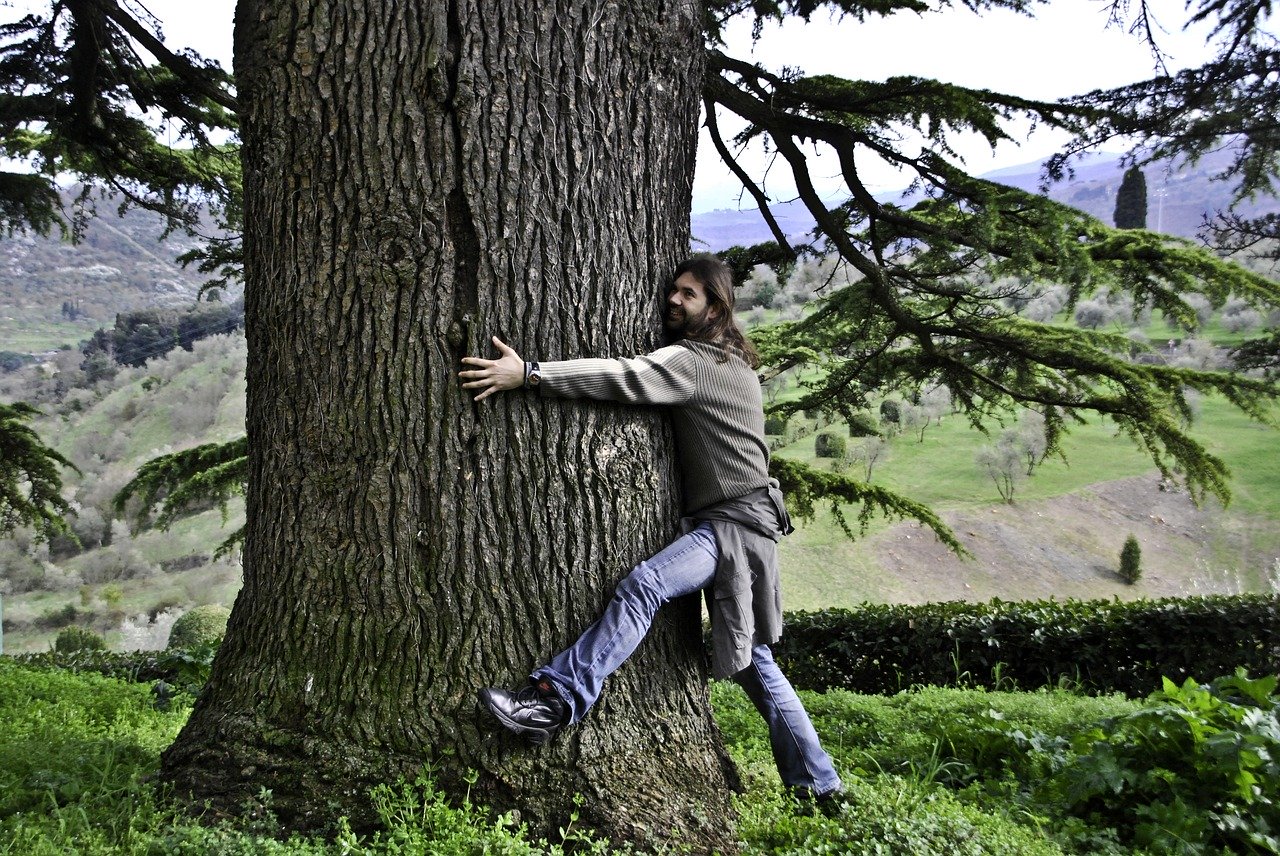
Abb.: Bäume umarmen einen nicht, aber man kann sie umarmen
Beim Bodyhacking greift man invasiv oder nichtinvasiv in den tierischen oder menschlichen Körper ein, oft im Sinne des Animal bzw. Human Enhancement und zuweilen mit der Ideologie des Transhumanismus. Es geht um die physische und psychische Umwandlung, und es kann der tierische oder menschliche Cyborg resultieren. Oliver Bendel hat über Bio- und Bodyhacking einen Beitrag für Bosch-Zünder geschrieben, die legendäre Mitarbeiterzeitschrift, die es seit 1919 gibt. Erschienen ist er im März 2020 in zehn Sprachen, in deutscher, aber auch in englischer, chinesischer und japanischer. Bereits vor einiger Zeit hatte Oliver Bendel betont: „Das Bodyhacking kann man aus der Perspektive von Bio-, Medizin-, Technik- und Informationsethik als Versuch sehen, das eigene oder fremde Leben und Erleben zu gestalten und zu verbessern. Problematisch wird es, sobald gesellschaftlicher, politischer oder wirtschaftlicher Druck entsteht, etwa wenn das Tragen eines Chips zur Speicherung von Daten und zur Identifizierung zur Norm wird, der sich kaum jemand entziehen kann.“ (Gabler Wirtschaftslexikon) Einen längeren wissenschaftlichen Beitrag zum Thema hat er unlängst in der HMD veröffentlicht. Mehr zu Bosch-Zünder über www.bosch.com/de/stories/bosch-zuender-mitarbeiterzeitung/.
Abb.: Auf der Insel Naoshima in Japan (Foto: Stefanie Hauske)
„Triage“ ist ein Begriff aus der Militärmedizin und bezeichnet die Einteilung der Verletzten (bei einer Katastrophe bzw. nach einem Angriff im Krieg) nach der Schwere der Verletzungen. Unterschieden werden leichte, mittlere und schwere Fälle; als prädestiniert gelten die mittleren Fälle, und zwar deshalb, weil die leichten auch ohne medizinische Versorgung überleben werden und die schweren hoffnungslos sind oder zu viele Ressourcen beanspruchen. Ein neuer Beitrag im Gabler Wirtschaftslexikon widmet sich dem Triage-Prinzip im Zusammenhang mit der Artenvielfalt und mit COVID-19. Es herrscht unter Ethikern weitgehend Einigkeit darüber, dass man bei schweren Erkrankungen und Ressourcenengpässen nach den Überlebens- bzw. Heilungschancen gehen sollte, ganz im Sinne der ursprünglichen Idee. Einige fordern aber auch, die Jungen leben und die Alten sterben zu lassen. Damit bezieht man sich auf Eigenschaften der Person, was problematisch erscheint. Natürlich sind auch die Überlebenschancen bei einer Infektion mit SARS-CoV-2 vom Alter abhängig, aber wenn man dieses direkt als Kriterium wählt, diskriminiert man damit den Betroffenen und die Gruppe, der er angehört. Der Beitrag von Oliver Bendel ist am 30. März 2020 erschienen und kann über wirtschaftslexikon.gabler.de/definition/triage-122418 aufgerufen werden.
Es existieren mehrere Markup Languages. Die bekannteste ist sicherlich die Hypertext Markup Language (HTML). Im Bereich der KI hat sich AIML etabliert. Für synthetische Stimmen wird SSML eingesetzt. Die Frage ist, ob damit die Möglichkeiten mit Blick auf autonome Systeme ausgeschöpft sind. In dem Beitrag „Das Moralmenü: Moralische Maschinen mit einer Stellvertretermoral“ von Prof. Dr. Oliver Bendel wurde zum ersten Mal eine Morality Markup Language (MOML) vorgeschlagen. Eine Studienarbeit unter der Betreuung des Informations- und Maschinenethikers hat 2019 untersucht, welche Möglichkeiten bestehende Sprachen hinsichtlich moralischer Aspekte haben und ob eine MOML gerechtfertigt ist. Die Ergebnisse wurden im Januar 2020 vorgestellt. Eine Bachelorarbeit an der Hochschule für Wirtschaft FHNW geht ab Ende März 2020 einen Schritt weiter. In ihr sollen Grundzüge einer Morality Markup Language erarbeitet werden. Es sollen die Grundstruktur und spezifische Befehle vorgeschlagen und beschrieben werden. Es sind die Anwendungsbereiche, Vorteile und Nachteile einer solchen Markierungssprache darzustellen. Auftraggeber der Arbeit ist Prof. Dr. Oliver Bendel, Betreuerin Dr. Elzbieta Pustulka.
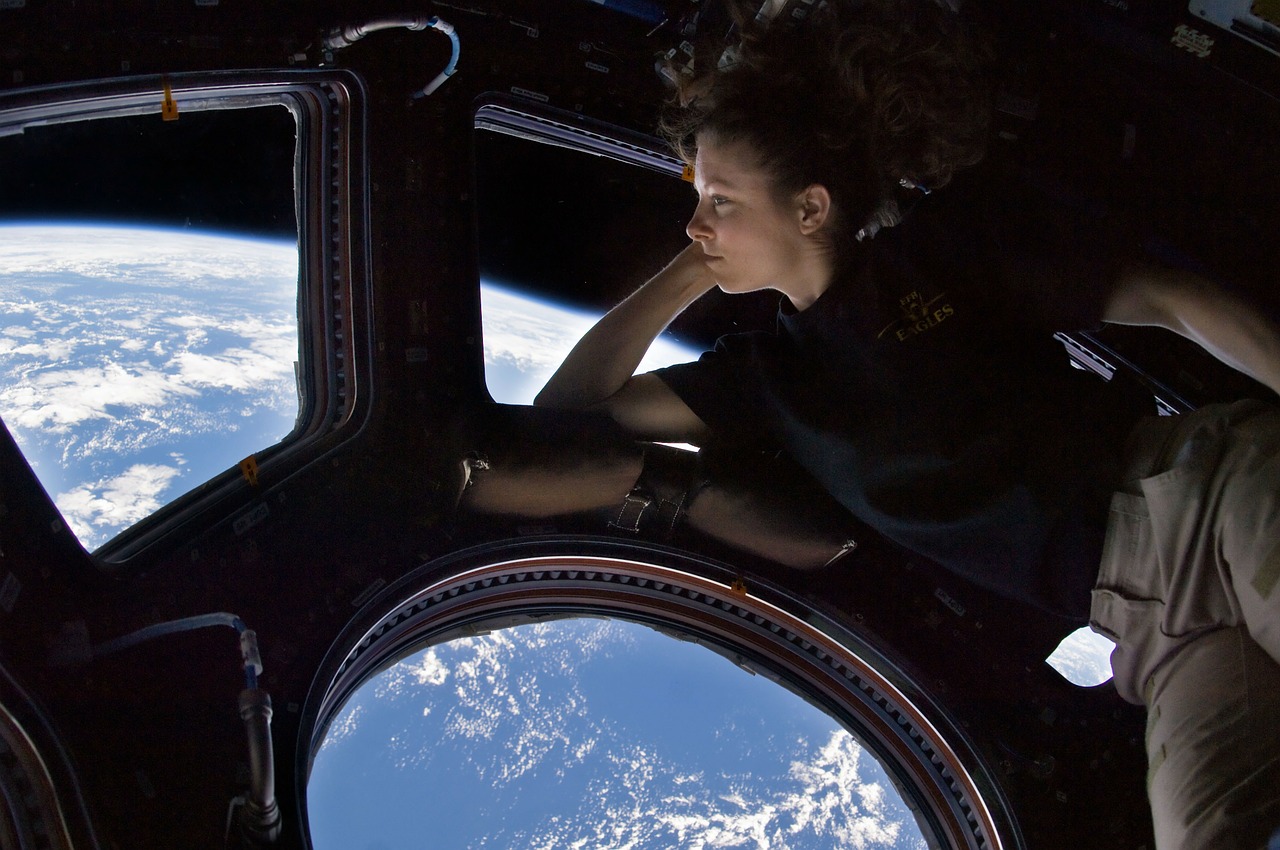
Space travel includes travel and transport to, through and from space for civil or military purposes. The take-off on earth is usually done with a launch vehicle. The spaceship, like the lander, is manned or unmanned. The target can be the orbit of a celestial body, a satellite, planet or comet. Man has been to the moon several times, now man wants to go to Mars. The astronaut will not greet the robots that are already there as if he or she had been lonely for months. For on the spaceship he or she had been in the best of company. SPACE THEA spoke to him or her every day. When she noticed that he or she had problems, she changed her tone of voice, the voice became softer and happier, and what she said gave the astronaut hope again. How SPACE THEA really sounds and what she should say is the subject of a research project that will start in spring 2020 at the School of Business FHNW. Under the supervision of Prof. Dr. Oliver Bendel, students will design a voicebot that shows empathy towards an astronaut. The scenario is a proposal that can also be rejected. Maybe in these times it is more important to have a virtual assistant for crises and catastrophes in case one is in isolation or quarantine. However, the project in the fields of social robotics and machine ethics is entitled THE EMPATHIC ASSISTANT IN SPACE (SPACE THEA). First results will be available by the end of 2021.
Die Daimler und Benz Stiftung hat im März 2020 den Jahresbericht für das Jahr 2019 vorgelegt. Sie operiert inhaltlich unabhängig vom Konzern und gewährt Forschern völlige Freiheit. Sie ist – im Vergleich etwa zur Bertelsmann-Stiftung – klein, aber enorm umtriebig und eine Säule der Wissenschafts- und Innovationsförderung im deutschsprachigen Raum. Seit mehreren Jahren begleitet sie die Arbeit des Informations- und Maschinenethikers Oliver Bendel. Sie hat ihn, wie auch im Jahresbericht thematisiert wird, zum wissenschaftlichen Direktor des Ladenburger Diskurses 2017 und des Berliner Kolloquiums 2019 gemacht. Beide Veranstaltungen widmeten sich Robotern in der Pflege und speziell Pflegerobotern, also solchen Robotern, die in Betreuung und Pflege eingesetzt werden oder eingesetzt werden sollen, sei es durch die Ergänzung von Pflegekräften, sei es durch die Unterhaltung, die Informierung, die Versorgung oder das „Einsammeln“ von Patienten bei anstehenden Terminen. Aus dem Ladenburger Diskurs ging das Buch „Pflegeroboter“ (2018) hervor, das zum Standardwerk in diesem Bereich geworden ist. Der Bericht kann über www.daimler-benz-stiftung.de heruntergeladen werden.
Abb.: Teilnehmerinnen und Teilnehmer beim Ladenburger Diskurs (Foto: Daimler und Benz Stiftung/Peter Dorn)
The first phase of the HUGGIE project will start at the School of Business FHNW in March 2020. Oliver Bendel was able to recruit two students from the International Management program. The project idea is to create a social robot that contributes directly to a good life and economic success by touching and hugging people and especially customers. HUGGIE should be able to warm up in some places, and it should be possible to change the materials it is covered with. A research question will be: What are the possibilities besides warmth and softness? Are optical stimuli (also on displays), vibrations, noises, voices etc. important for a successful hug? HUGGIE could also play a role in crises and disasters, in epidemics and pandemics and in cases of permanent social distancing. Of course it would be bad if only a robot would hug us, and of course it would be good if humans could hug us every day if we wanted them to do so – but maybe in extreme situations a hug by a robot is better than nothing. The HUGGIE project is located in the heart of social robotics and on the periphery of machine ethics. By summer 2020, the students will conduct an online survey to find out the attitudes and expectations of the users.
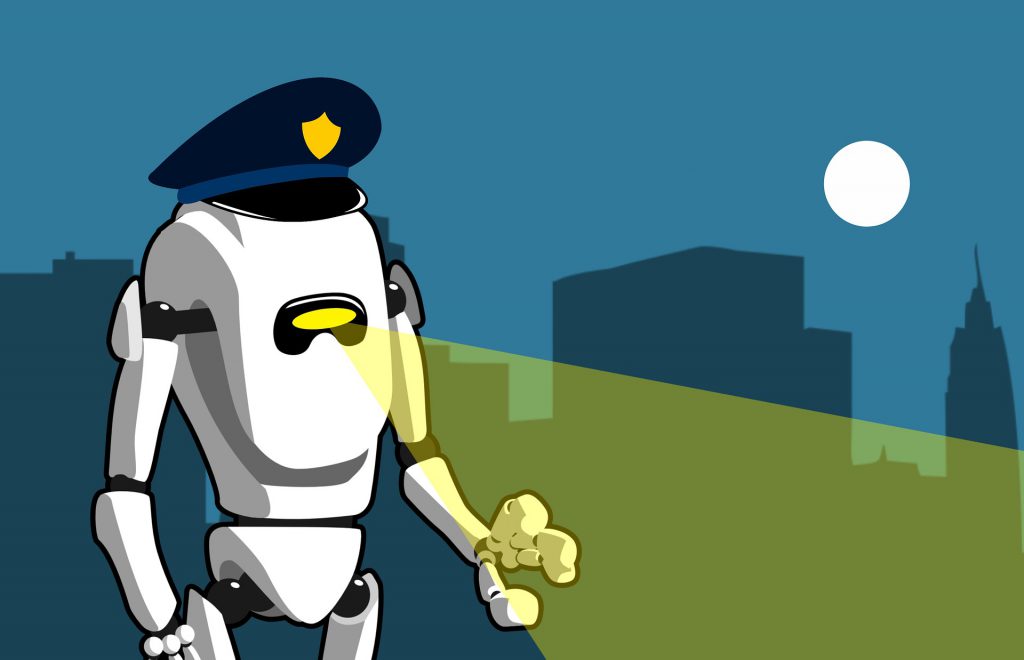
„Sicherheitsroboter verbreiten sich in den Stadtteilen, in den Einkaufszentren und auf den Firmengeländen, als rollende und fliegende Maschinen. Sie sollen für die Sicherheit der Unternehmen, Besucher und Kunden sorgen. Sie sind autonom bzw. teilautonom oder werden von Menschen oder weiteren Systemen zu Einsatzorten und Problemfällen navigiert. Je nach Zusammenhang werden sie auch als Überwachungsroboter oder Polizeiroboter bezeichnet.“ So beginnt ein neuer Beitrag von Oliver Bendel im Gabler Wirtschaftslexikon. Manche von ihnen können, so wird erklärt, mit Hilfe von Kameras und Mikrofonen „sehen“ und „hören“, einige zudem „riechen“, d.h. Gefahrenstoffe und Rauchentwicklung wahrnehmen. Sicherheitsroboter dieser Art stellt Knightscope im Silicon Valley her. Dort werden auch einige von ihnen eingesetzt. Der K5 beispielsweise ist in der Stanford Shopping Mall unterwegs. Dubai dagegen setzt auf REEM von PAL Robotics, in der rollenden Variante und mit der Mütze eines Polizisten. Der Beitrag ist am 5. März 2020 erschienen und kann über wirtschaftslexikon.gabler.de/definition/sicherheitsroboter-122267 heruntergeladen werden.
Living, working, and sleeping in small spaces next to the same people for months or years would be stressful for even the fittest and toughest astronauts. Neel V. Patel underlines this fact in a current article for MIT Technology Review. If they are near Earth, they can talk to psychologists. But if they are far away, it will be difficult. Moreover, in the future there could be astronauts in space whose clients cannot afford human psychological support. „An AI assistant that’s able to intuit human emotion and respond with empathy could be exactly what’s needed, particularly on future missions to Mars and beyond. The idea is that it could anticipate the needs of the crew and intervene if their mental health seems at risk.“ (MIT Technology Review, 14 January 2020) NASA wants to develop such an assistant together with the Australian tech firm Akin. They could build on research by Oliver Bendel. Together with his teams, he has developed the GOODBOT in 2013 and the BESTBOT in 2018. Both can detect users’ problems and react adequately to these problems. The more recent chatbot even has face recognition in combination with emotion recognition. If it detects discrepancies with what the user has said or written, it will make this a subject of discussion. The BESTBOT on Mars – it would like that.
An der FHNW wurden LADYBIRD und HAPPY HEDGEHOG gebaut, zwei Prototypen tierfreundlicher Maschinen. LADYBIRD hat inzwischen einige Bekanntheit erlangt und gilt als Vorzeigebeispiel der Maschinenethik. Aber was findet weltweit auf diesem Gebiet statt? Es ist bekannt, dass es Mähdrescher gibt, denen Drohnen voranfliegen, die Rehkitze im Feld zurückmelden. Auch Windkraftanlagen, die sich für nahende Vogelschwärme ausstellen, wurden ausprobiert. Aber was gibt es sonst, und was ist geplant? Die Studie, die im Februar 2020 im Studiengang Energie, Umwelt, Technik (EUT) begonnen wird, soll eine Bestandsaufnahme machen und eine Systematisierungsleistung vornehmen: In welchen Gebieten treffen Tiere mit Maschinen zusammen, auf dem Boden, im Wasser, in der Luft? Um welche Tiere handelt es sich, um Haus-, Nutz-, Versuchs- oder Wildtiere? Um welche Maschinen, um von Menschen gesteuerte, teilautonome oder autonome? Wie treffen Maschine und Tier aufeinander, wie ist das Tierwohl gefährdet und wie kann es gesichert werden? Welche Disziplinen nehmen sich dieses Themas an, Tier-Computer-Interaktion, Tier-Maschine-Interaktion, Tierethik, Umweltethik, Maschinenethik? Welche Projekte sind für die Zukunft geplant? Was sind die Gründe für die Projekte, ökonomische, ökologische, ethische? Der Betreuer ist der Informations- und Maschinenethiker Oliver Bendel. Als Auftraggeber hat er Animal Rights Switzerland gewonnen.
Abb.: Diese Maschine sieht selbst aus wie ein Tier
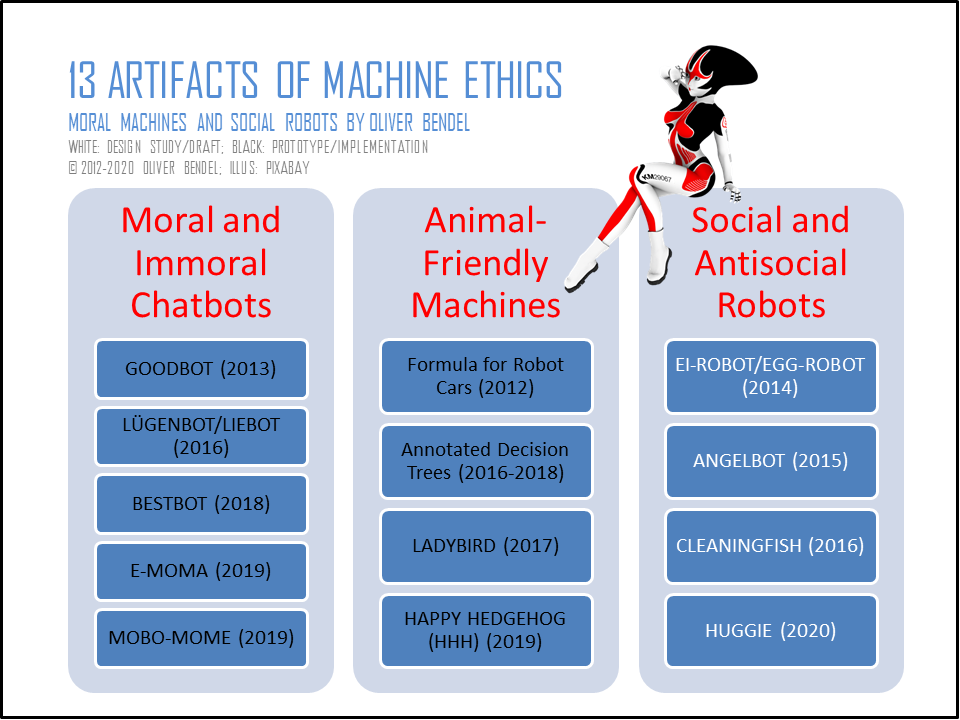
Since 2012, Oliver Bendel has invented 13 artifacts of machine ethics. Nine of them have actually been implemented, including LADYBIRD, the animal-friendly vacuum cleaning robot, and LIEBOT, the chatbot that can systematically lie. Both of them have achieved a certain popularity. The information and machine ethicist is convinced that ethics does not necessarily have to produce the good. It should explore the good and the evil and, like any science, serve to gain knowledge. Accordingly, he builds both moral and immoral machines. But the immoral ones he keeps in his laboratory. In 2020, if the project is accepted, HUGGIE will see the light of day. The project idea is to create a social robot that contributes directly to a good life and economic success by touching and hugging people and especially customers. HUGGIE should be able to warm up in some places, and it should be possible to change the materials it is covered with. A research question will be: What are the possibilities besides warmth and softness? Are optical stimuli (also on displays), vibrations, noises, voices etc. important for a successful hug? All moral and immoral machines that have been created between 2012 and 2020 are compiled in a new illustration, which is shown here for the first time.
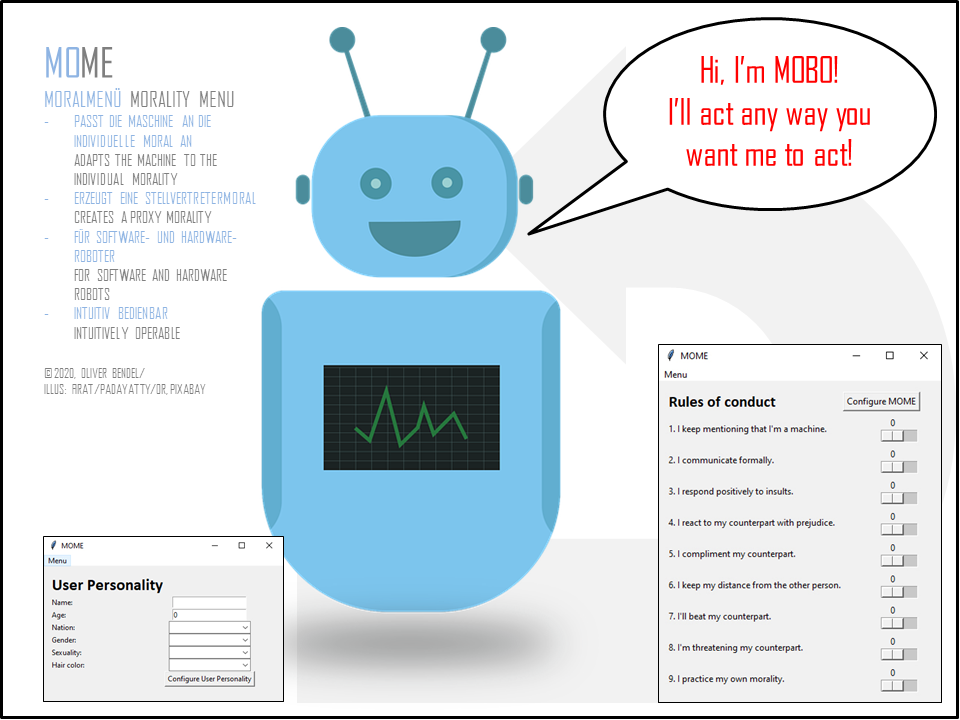
From June 2019 to January 2020 the Morality Menu (MOME) was developed under the supervision of Prof. Dr. Oliver Bendel. With it you can transfer your own morality to the chatbot called MOBO. First of all, the user must provide various personal details. He or she opens the „User Personality“ panel in the „Menu“ and can then enter his or her name, age, nationality, gender, sexual orientation, and hair color. These details are important for communication and interaction with the chatbot. In a further step, the user can call up the actual morality menu („Rules of conduct“) via „Menu“. It consists of 9 rules, which a user (or an operator) can activate (1) or deactivate (0). The behaviors 1 – 8, depending on how they are activated, result in the proxy morality of the machine (the proxy machine). It usually represents the morality of the user (or the operator). But you can also give the system the freedom to generate its morality randomly. This is exactly what happens with this option. After the morality menu has been completely set, the dialogue can begin. To do this, the user calls up „Chatbot“ in the „Menu“. The Chatbot MOBO is started. The adventure can begin! A video of the MOBO-MOME is available here.
„TA-SWISS schreibt ein Projekt aus, um die Chancen und Risiken von Stimm-, Sprach- und Gesichtserkennung abzuschätzen.“ (Website TA-SWISS) So lautet die Aussage auf der Website der Schweizer Einrichtung für Technologiefolgenabschätzung. Im Vorfeld hatte ein Expertengremium (u.a. mit Prof. Dr. Oliver Bendel) getagt, um die Inhalte und Schwerpunkte einzukreisen. In der Ausschreibung heißt es: „Stimm-, Sprach- und Gesichtserkennung können unseren Alltag erleichtern und sicherer machen. Durch diese Technologien können wir unsere Geräte einfach entsperren (und damit vor Missbrauch schützen), Grenzübertritte reibungsloser gestalten und smarten Helfern Befehle erteilen. Gleichzeitig dringen diese Technologien in den öffentlichen und privaten Raum ein und erheben biometrische Daten, die uns nicht nur identifizieren, sondern möglicherweise auch Auskunft über unsere Emotionen, Persönlichkeit oder Krankheiten geben könnten.“ (Website TA-SWISS) Die Projektskizzen sind bis zum 9. Februar 2020 einzureichen. Weitere Informationen über www.ta-swiss.ch/en/projects/call-for-tenders/.
At the request of Prof. Dr. Oliver Bendel, a student at the School of Business FHNW, Alessandro Spadola, investigated in the context of machine ethics whether markup languages such as HTML, SSML and AIML can be used to transfer moral aspects to machines or websites and whether there is room for a new language that could be called Morality Markup Language (MOML). He presented his results in January 2020. From the management summary: „However, the idea that owners should be able to transmit their own personal morality has been explored by Bendel, who has proposed an open way of transferring morality to machines using a markup language. This research paper analyses whether a new markup language could be used to imbue machines with their owners‘ sense of morality. This work begins with an analysis how a markup language is structured, describes the current well-known markup languages and analyses their differences. In doing so, it reveals that the main difference between the well-known markup languages lies in the different goals they pursue which at the same time forms the subject, which is marked up. This thesis then examines the possibility of transferring personal morality with the current languages available and discusses whether there is a need for a further language for this purpose. As is shown, morality can only be transmitted with increased effort and the knowledge of human perception because it is only possible to transmit them by interacting with the senses of the people. The answer to the question of whether there is room for another markup language is ‚yes‘, since none of the languages analysed offer a simple way to transmit morality, and simplicity is a key factor in markup languages. Markup languages all have clear goals, but none have the goal of transferring and displaying morality. The language that could assume this task is ‚Morality Markup‘, and the present work describes how such a language might look.“ (Management Summary) The promising results are to be continued in the course of the year by another student in a bachelor thesis.
In a paper published on 13 January 2020, researchers from the University of Vermont and Tufts University discuss computer-designed, novel organisms called Xenobots. Xenobots consist of skin and muscle cells. The skin cells stabilize the organisms, the muscle cells enable them to perform different activities. A nervous system is not present. An AI system calculates the optimal structure and ratio of the cells in relation to a specific function. The Xenobots are assembled according to the resulting construction plan. In fact, the cells appear to work together. They receive their energy from their embryonic resources – for this one must know that they were developed from stem cells from frog embryos. The researchers see different areas of application. One could build Xenobots that clean blood vessels, for example by removing plaque. However, this could also lead to dangers, because it will be easy to insert the biorobots into the bloodstream, but not so easy to remove them. However, there will also be ways to break down the cells.
Die Idee eines Moralmenüs (MOME) entstand 2018 im Kontext der Maschinenethik. Damit sollte es möglich sein, die Moral einer Person auf eine Maschine zu übertragen. Auf einem Display bekommt man verschiedene Verhaltensregeln angezeigt und kann diese über Schieberegler aktivieren oder deaktivieren. Oliver Bendel entwickelte zwei Designstudien, eine für einen tierfreundlichen Staubsaugroboter namens LADYBIRD, eine andere für einen Sprachassistenten wie Google Duplex. Ende 2018 schrieb er an der Hochschule für Wirtschaft FHNW ein Projekt aus. Drei Studenten – Ozan Firat, Levin Padayatty and Yusuf Or – implementierten von Juni 2019 bis Januar 2020 das MOME für einen Chatbot mit dem Namen MOBO. Der Benutzer macht Angaben zu seiner Person und aktiviert oder deaktiviert dann neun verschiedene Verhaltensregeln. MOBO gibt Komplimente oder gibt keine Komplimente, antwortet voller Vorurteile oder ohne Vorurteile, bedroht den Gesprächspartner oder bedroht ihn nicht. Dabei geht er auf jeden Benutzer individuell ein, nennt dessen Namen – und spricht ihn je nach Einstellung formell oder informell an. Ein Video zum MOBO-MOME ist hier abrufbar.
Die Firma Neon greift mit ihren Neons ein altes Konzept auf, nämlich das der Avatare. Im Lexikon für Wirtschaftsinformatik unterschied Oliver Bendel vor zwanzig Jahren zwischen zwei verschiedenen Typen. Zum zweiten schrieb er: „Avatare können zum anderen eine beliebige Figur mit bestimmten Funktionen repräsentieren. Solche Avatare treten – beispielsweise als Kundenberater und Nachrichtensprecher – im Internet auf oder bevölkern als Spielpartner und -gegner die Abenteuerwelten von Computerspielen. Sie haben häufig ein anthropomorphes Äußeres und eigenständige Verhaltensweisen oder sogar regelrechte Charaktere …“ (Lexikon der Wirtschaftsinformatik, 2001) Genau diesen Typ greift nun die Firma auf, die zum Samsung-Konzern gehört und von Pranav Mistry gegründet wurde, wobei man freilich die heutigen Möglichkeiten nutzt. „Es handelt sich um virtuelle Figuren, die komplett am Computer erzeugt werden und quasi in Echtzeit autonom reagieren sollen; Mistry sprach von unter 20 Millisekunden Latenz.“ (Heise Online, 8. Januar 2019) Die Neons sollen Emotionen zeigen, wie auch einige soziale Roboter, die den Markt erobern, und damit Bindungen erleichtern und festigen. „Der KI-getriebene Charakter sei weder Sprachassistent a la Bixby noch eine Schnittstelle ins Internet. Es sei stattdessen ein Freund, der mehrere Sprachen spricht, neue Skills lernen und sich mit anderen Services verbinden kann, erklärte Mistry auf der CES.“ (Heise Online, 8. Januar 2019)
Abb.: Neons sollen Gefühle zeigen, die sie nicht haben
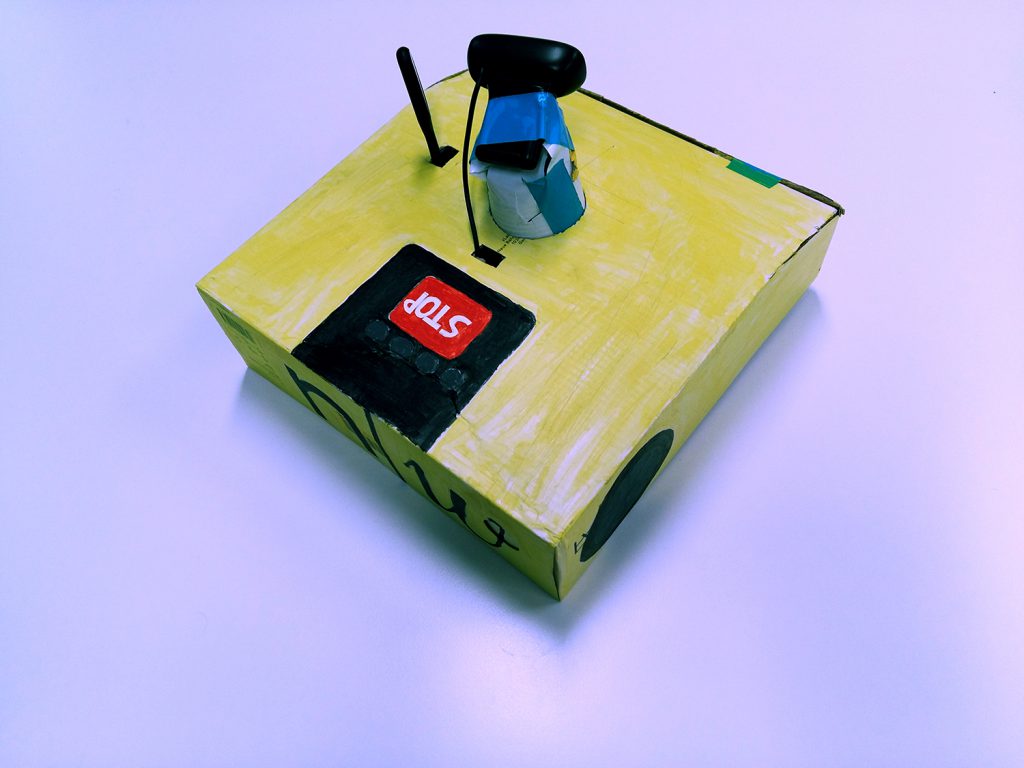
Zwischen Juni 2019 und Januar 2020 wurde an der Hochschule für Wirtschaft FHNW unter der Leitung von Oliver Bendel das Projekt HAPPY HEDGEHOG (HHH) durchgeführt. Die Studierenden Emanuel Graf, Kevin Bollier, Michel Beugger und Vay Lien Chang entwickelten im Kontext der Maschinenethik den Prototyp eines Mähroboters, der seine Arbeit einstellt, sobald er einen Igel entdeckt hat. HHH verfügt über eine Wärmebildkamera. Wenn er auf ein warmes Objekt stößt, wird dieses mittels Bilderkennung weiter untersucht. Nachts hilft eine oben angebrachte Lampe dabei. Nach dem Training mit hunderten Fotos kann HHH ziemlich treffsicher einen Igel identifizieren. Es ist nicht nur eine weitere moralische Maschine im Labor entstanden. Das Team liefert mit ihr auch einen Lösungsvorschlag für ein Problem, das in der Praxis häufig auftritt. Handelsübliche Mähroboter töten nämlich immer wieder Igelbabys in der Dunkelheit. HAPPY HEDGEHOG könnte dabei helfen, sie zu retten. Das Bild unterhalb des Beitrags zeigt ihn mit, das Video auf youtu.be/ijIQ8lBygME ohne Verkleidung. Der Roboter steht in der Tradition von LADYBIRD.