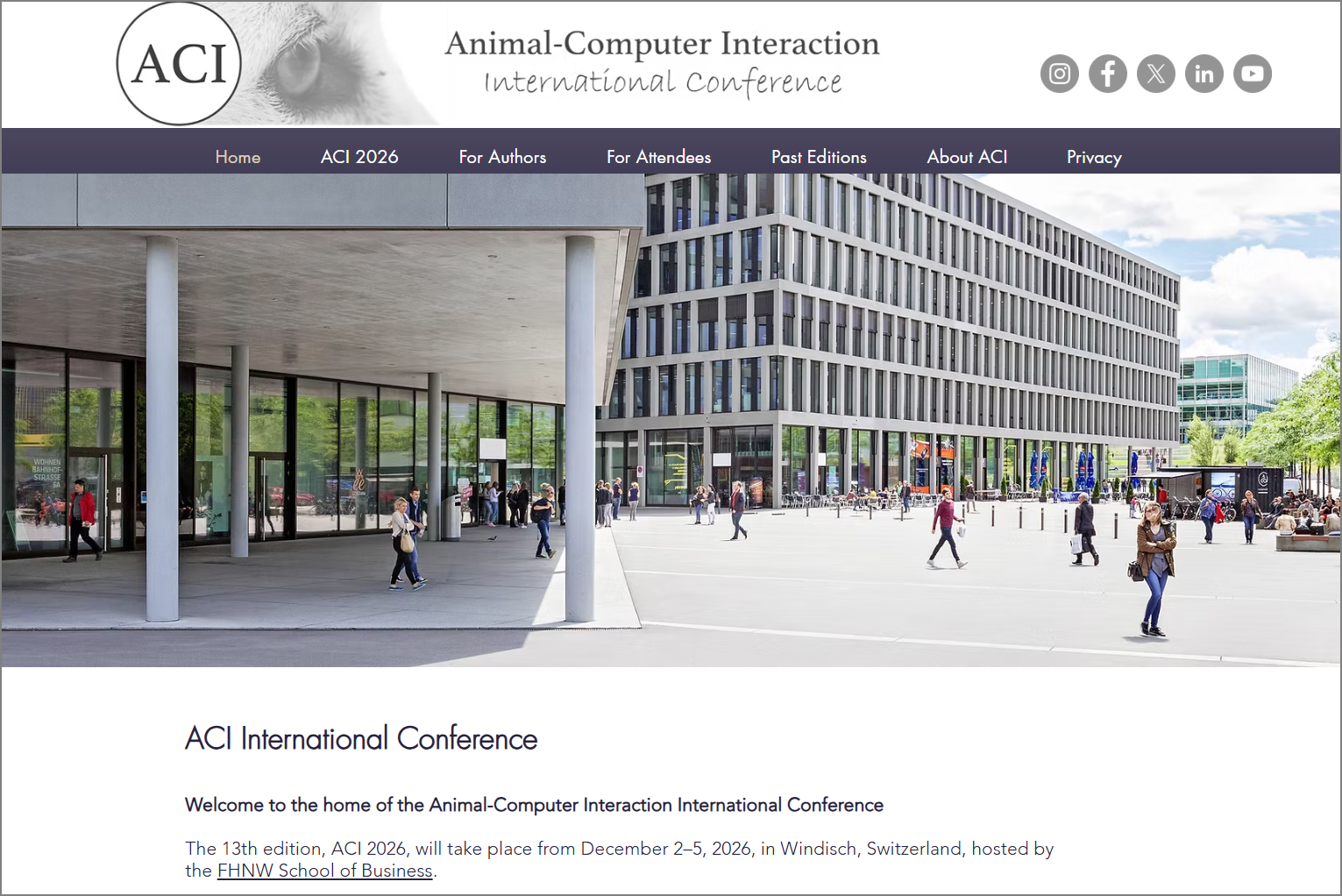
The 13th International Conference on Animal-Computer Interaction (ACI 2026), taking place from December 2 to 5, 2026, at the FHNW Campus Brugg-Windisch in Switzerland, will offer exclusively vegan and vegetarian food and drinks. This decision reflects the conference’s commitment to animal welfare and the interests of animals, which are central concerns of Animal-Computer Interaction (ACI) and Animal-Machine Interaction (AMI). The conference dinner, lunches, and coffee breaks will be catered by the SV Group, while the organizers themselves will take care of the reception. For this occasion, they have purchased vegan wine from Spain, vegan beer from the region, and locally produced vegan juice. Attempts to secure local sponsors for the catering and refreshments were unfortunately unsuccessful, including approaches to Hiltl, Tibits, and Zweifel. The commitment to animal-friendly choices extends even to the small gifts for the award winners, which will also be entirely vegan. Finding suitable gifts proved surprisingly challenging, as even traditional Swiss wooden cows often contain leather components. These details illustrate that avoiding animal-derived products requires attention not only to food and drinks but also to seemingly harmless everyday objects. With this approach, ACI 2026 aims to put its concern for animals into practice, demonstrating that ethical considerations can shape not only the scientific program but also the organization of the conference itself. Further information about ACI 2026 is available at www.aciconf.org.
Fig.: A wooden cow in front of the ACI 2026 website
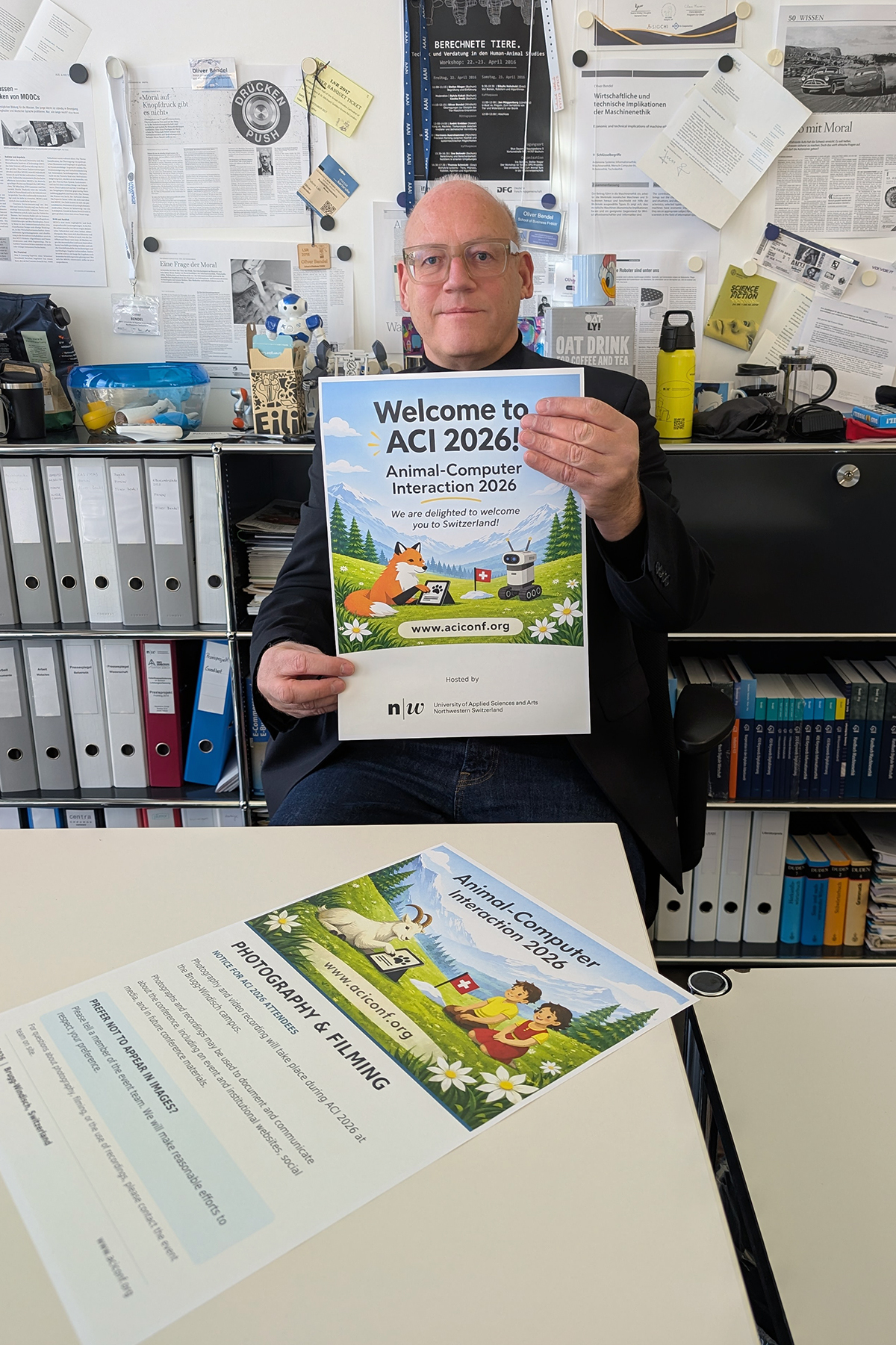
The visual identity of the 13th International Conference on Animal-Computer Interaction (ACI 2026), taking place from December 2 to 5, 2026, at the FHNW Campus Brugg-Windisch in Switzerland, reflects two central dimensions of the relationship between animals and technology. The main motif, which has been developed into numerous variations, shows a fox on the left interacting with a tablet, representing animals as users and stakeholders in Animal-Computer Interaction (ACI). On the right, a robot symbolizes the growing presence of semi-autonomous and autonomous machines in environments shared with animals. Whether wild animals, pets, or farm animals, they will inevitably encounter such machines, raising the question of how these can be designed and developed to become animal-friendly. This is a central concern of Animal-Machine Interaction (AMI). The main motif appears on the welcome poster held by General Chair Prof. Dr. Oliver Bendel, while a variation featuring Heidi and Peter can be seen on the table. This version emphasizes that humans, too, play an important role in these interactions, whether as developers, owners, observers, or intermediaries. The Alpine landscape, Swiss flag, and familiar characters provide a distinctly Swiss setting for ACI 2026, the first edition of the conference to take place in continental Europe. Together, the illustrations express the conference’s central concern: understanding and shaping technological relationships between animals, humans, and machines, with particular attention to animal welfare and the interests of animals themselves. All motifs and their variations can be viewed on the official conference website at www.aciconf.org.
Fig.: Oliver Bendel with a small-format test print
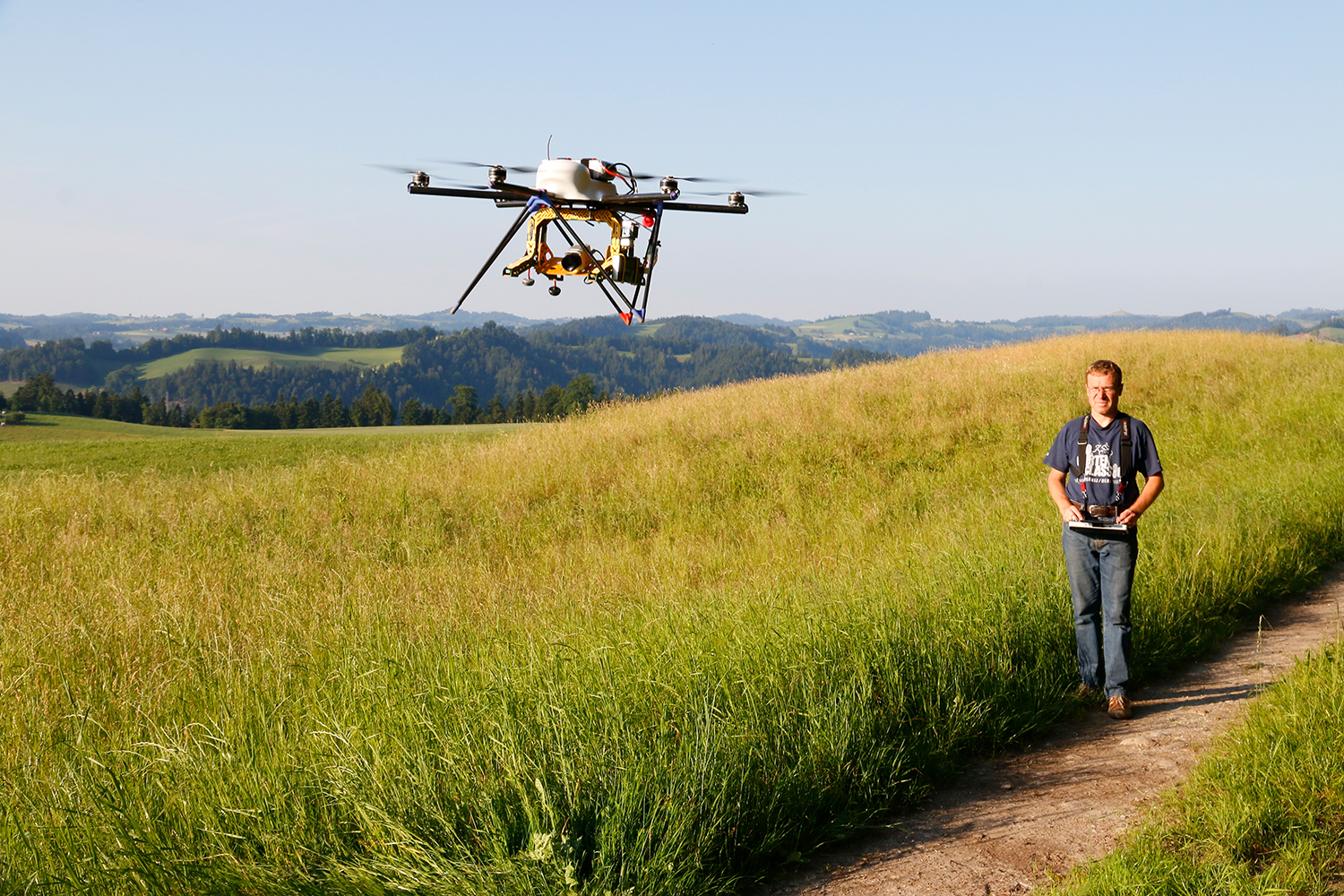
With just two weeks to go, preparations for the thirteenth edition of the Animal-Computer Interaction International Conference (ACI 2026) are entering their final stage. The event will take place from December 2 to 5, 2026, at the FHNW Campus Brugg-Windisch in Switzerland – marking the first time ACI will be held in continental Europe. The General Chair is Prof. Dr. Oliver Bendel, author of „Tier-Maschine-Interaktion“ („Animal-Machine Interaction“). ACI 2026 brings together researchers and practitioners working in Animal-Computer Interaction (ACI), Animal-Machine Interaction (AMI), animal welfare, robotics, interaction design, and related fields. The conference will open on December 2 with three workshops exploring different aspects of ACI. On December 3, a doctoral consortium will provide an opportunity for early-career researchers to present and discuss their work. The program will also include an excursion to Zoo Zurich and a panel discussion featuring Dr. Leyla Davis, Curator of Research at Zoo Zurich. December 4 and 5 will be dedicated to presentations of accepted papers and two keynote lectures. Dr. iur. Dr. h.c. Antoine F. Goetschel will speak on „Lights and Shadows in Animal-Computer Interaction (ACI) from an Animal’s Perspective in Law and Ethics“ – examining the opportunities and challenges of ACI from the perspective of animal law and ethics. Dr. Arianna Ferrari will deliver a keynote entitled „Technology, Ethics, and the Normative Dimensions of Human-Animal Relations“ – addressing fundamental ethical questions surrounding technological interventions in human-animal relationships. The conference will also feature demonstrations of technologies that illustrate how machines can support the observation, monitoring, and protection of animals. Three Swiss organizations – Octanis, NOCTUA, and Synature – will present their technologies at exhibition stands in the Studiensaal. Octanis will showcase its intelligent bird weighing system, demonstrating how technology can contribute to the monitoring and study of birds. NOCTUA will present an impressive drone with a wingspan of five metres and a length of three metres, designed for nature observation. Synature will demonstrate its AI-powered intelligent microphones and data analysis solutions, which enable the acoustic monitoring of animals and provide insights into their presence and activities through sound. Together, the three exhibits offer concrete examples of the possibilities emerging at the intersection of artificial intelligence, sensor technology, animal research, and environmental monitoring. While the conference sessions themselves are reserved for registered participants, the exhibition stands in the Studiensaal will be open to all members of FHNW. This provides an opportunity for the wider university community to discover these technologies and engage with their developers. ACI 2026 is pleased to receive support from the City of Brugg, the Municipality of Windisch, and Rehkitzrettung Schweiz. The latter will also conduct a live demonstration on campus, using a drone equipped with a thermal imaging camera to locate and rescue an artificial fawn from a meadow. With its combination of scientific contributions, ethical reflection, practical demonstrations, and opportunities for exchange, ACI 2026 promises four stimulating days at the intersection of animals, humans, and technology. Further information on the program, workshops, and participation is available on the ACI 2026 website.
Fig.: Rehkitzrettung Schweiz (Photo: Verein Rehkitzrettung Schweiz/Rehkitzrettung.ch)
Dr. Arianna Ferrari, an ethicist and philosopher of science and technology at the AIT Austrian Institute of Technology, will deliver the keynote address „Technology, Ethics, and the Normative Dimensions of Human-Animal Relations“ at the Animal-Computer Interaction International Conference 2026 (ACI 2026) at the FHNW Campus Brugg-Windisch, Switzerland. Ferrari has extensive experience in technology assessment, the critical evaluation of technological futures, and human-animal studies. She earned her PhD in Philosophy from the Universities of Turin and Tübingen in 2006 and has held academic positions at several German universities and research institutions, including the Karlsruhe Institute of Technology (KIT). She has also worked at Futurium in Berlin and the environmental organization NABU. In her keynote, Ferrari will explore the deeply normative character of interactions between humans and nonhuman animals, emphasizing that technologies do not merely improve or worsen existing relationships but also shape which interests and values are recognized in the first place. Drawing on examples such as laboratory animal enrichment and robotic milking systems, she will demonstrate how technological innovations can introduce new forms of freedom and welfare while leaving fundamental ethical assumptions unquestioned. A robotic milking system, for instance, may appear to grant cows greater autonomy, yet their choices remain constrained by the demands of dairy production. Ferrari argues that technologies both shape our perception of animals and expose tensions and contradictions within established human-animal practices. By making previously unquestioned assumptions visible, they can open up opportunities for critical ethical reflection on the goals and conditions of human-animal interaction. Further information is available at www.aciconf.org.
Dr. iur. Dr. h.c. Antoine F. Goetschel, a world-renowned specialist in animal welfare law and former Attorney for Animal Welfare in Criminal Matters for the Canton of Zurich, will deliver his keynote address, „Lights and Shadows in Animal-Computer Interaction (ACI) from an Animal’s Perspective in Law and Ethics“, on December 5, 2026, the fourth and final day of the Animal-Computer Interaction International Conference 2026 (ACI 2026) at the FHNW Campus Brugg-Windisch, Switzerland. For more than three decades, he has worked at the intersection of law, ethics, and public policy, representing the interests of animals within legal systems and contributing to the development of animal protection standards at both national and international levels. The speaker emphasizes that „animal dignity“ is a constitutional concept in Switzerland that must also be respected in ACI interactions with animals. The intrinsic value of the animal must be considered, as must its protected interest in not being unduly exploited – even if ACI is aimed at the well-being of that animal or its conspecifics. Likewise, national animal welfare legislation must be taken into account, which requires that animals be protected from unnecessary pain, harm, fear, and suffering even in animal experiments that may require authorization or, at the very least, notification. The well-being and dignity of animals must not be unnecessarily or excessively restricted simply because of the researchers‘ well-intentioned enthusiasm for ACI. The keynote will take place in the morning in the Forumsraum/FutureHub (5.0B16). Further information is available at www.aciconf.org.
The ACI International Conference 2026 (ACI 2026) will be hosted at the University of Applied Sciences and Arts Northwestern Switzerland’s FHNW School of Business, Brugg-Windisch campus, in cooperation with the Association for Computing Machinery (ACM)’s Special Interest Group on Computer-Human Interaction (SIGCHI). This year’s General Chair is Oliver Bendel, who has been a professor at FHNW since 2009. On December 2, 2026, the first day of the conference, the half-day afternoon workshop „Animal Centered Research (ACR) Framework: Integrating Animal-Centered Principles into the Ethical Review of Animal Research“ will take place in room 6.3A06, with hybrid participation available. Organized by Patrizia Paci and Clara Mancini from The Open University in the United Kingdom and Eleonora Nannoni from the University of Bologna in Italy, the workshop will introduce an animal-centered ethical review framework designed to strengthen the consideration of animal welfare and agency in research involving animals. Participants from disciplines such as animal-computer interaction, veterinary medicine, farming, conservation, and animal welfare will be invited to apply the framework to their own completed, ongoing, or planned research projects. Through individual exercises, group discussions, and plenary sessions, they will assess its feasibility, usefulness, and potential integration into existing ethical review processes. The workshop is part of the broader Animal-Centered Research project, which aims to advance ethical standards across research disciplines. Participants will also have the opportunity to express their interest in contributing a case study to an edited volume to be published by CABI. Attendance is included for registered on-site conference participants, while those wishing to join online should contact Patrizia Paci in advance. Further information about the workshop and online participation is available at www.animalcenteredresearch.org/workshop2026.
Fig.: Towards an animal-centered research framework
The ACI International Conference 2026 (ACI 2026) will be hosted at the University of Applied Sciences and Arts Northwestern Switzerland’s FHNW School of Business, Brugg-Windisch campus, in cooperation with the Association for Computing Machinery (ACM)’s Special Interest Group on Computer-Human Interaction (SIGCHI). This year’s General Chair is Oliver Bendel, who has been a professor at FHNW since 2009. On December 2, 2026, the first day of the conference, the three-hour morning workshop „Speculative Design for AI-Enabled Animal-Robot Interaction: Exploring Cross-Category Design Dimensions in Multispecies Futures“ will take place in room 6.3A06. Organized by Haruka Kasuga, Masashi Takeshita, Sonia Zhang, Hayate Shimizu, Yuichiro Kasuga, and Dohjin Miyamoto, the workshop will explore possible relationships between animals and robots through speculative design. Participants will examine the needs and values that shape animal-robot encounters, consider ethical questions and potential tensions, and imagine desirable multispecies futures. The workshop takes a cross-category approach, comparing different animal species, robot types, and settings while considering the opportunities and challenges associated with AI-enabled robotic systems. A special guest will be Tilk Kasuga, a Siberian cat with animal-assisted therapy training and experience participating in educational activities, who will attend as the workshop’s Visiting Cat. Further information about the workshop and registration is available at animal-robot-futures-workshop.com.
With just over one month to go, preparations for the thirteenth edition of the Animal-Computer Interaction International Conference (ACI 2026) are entering their final stage. The event will take place from December 2 to 5, 2026, at the FHNW Campus Brugg-Windisch in Switzerland – marking the first time ACI will be held in continental Europe. The General Chair is Prof. Dr. Oliver Bendel, author of „Tier-Maschine-Interaktion“ („Animal-Machine Interaction“). ACI 2026 brings together researchers and practitioners working in Animal-Computer Interaction (ACI), Animal-Machine Interaction (AMI), animal welfare, robotics, interaction design, and related fields. This year’s conference will also feature demonstrations of technologies that illustrate how machines can support the observation and protection of animals. Two organizations, Octanis and NOCTUA, will present their technologies at exhibition stands in the Studiensaal. Octanis will showcase its intelligent bird weighing system, demonstrating how technology can contribute to the monitoring and study of birds. NOCTUA will present an impressive drone with a wingspan of five metres and a length of three metres, designed for nature observation. Both exhibits offer concrete examples of the possibilities emerging at the intersection of technology, animal research, and environmental monitoring. While the conference sessions themselves are reserved for registered participants, the exhibition stands in the Studiensaal will be open to all members of FHNW. This provides an opportunity for the wider university community to discover these technologies and engage with their developers. ACI 2026 is pleased to receive support from the City of Brugg, the Municipality of Windisch, and Rehkitzrettung Schweiz, whose work with thermal imaging drones to protect young deer illustrates a practical application of Animal-Machine Interaction. Further information on the program, workshops, and participation is available on the ACI 2026 website.
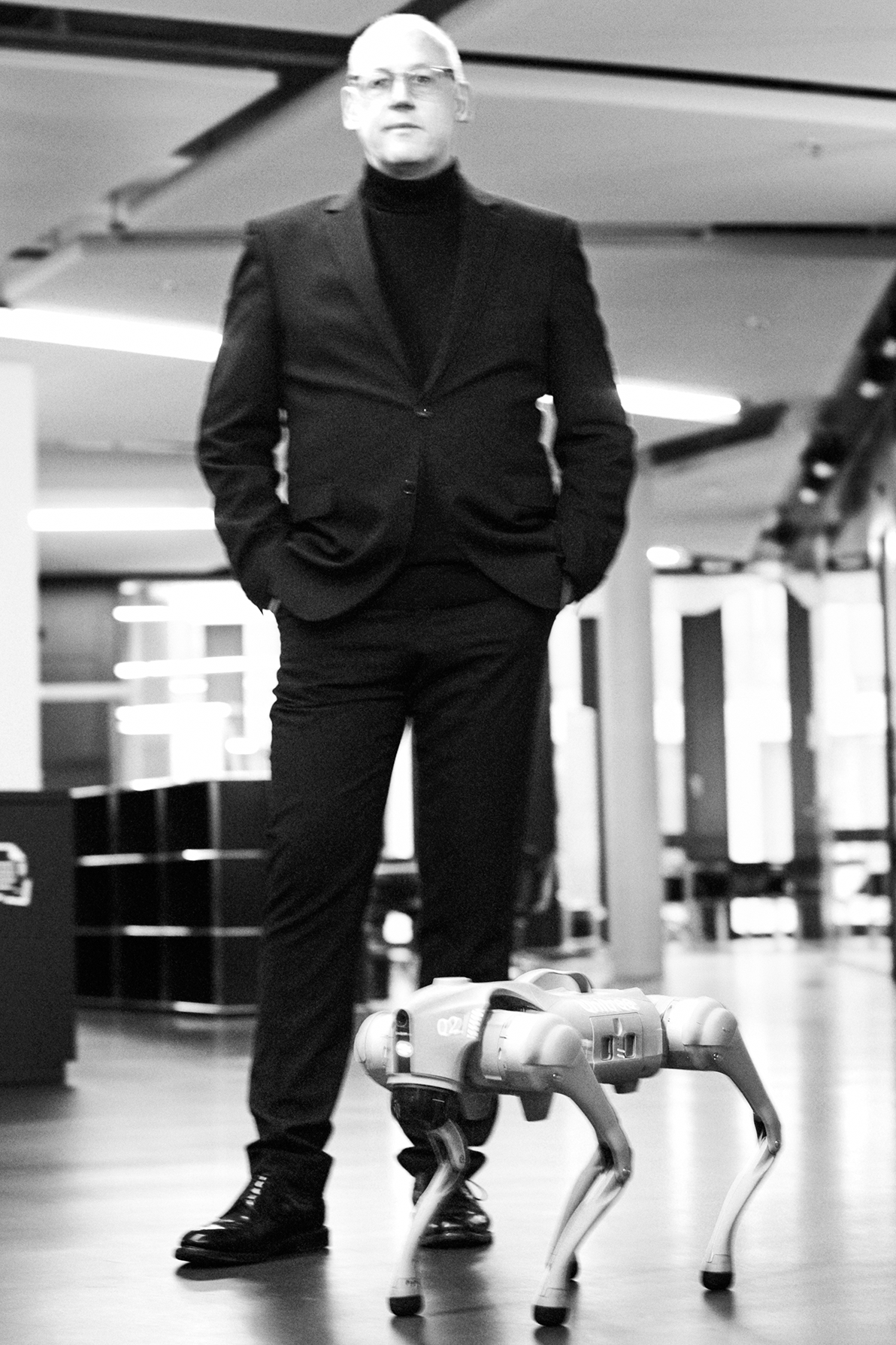
Abb.: Oliver Bendel mit seinem Unitree Go2 (Foto: Jork Weismann)
With just over two months to go, preparations for the thirteenth edition of the Animal-Computer Interaction International Conference (ACI 2026) are entering their final phase. The conference will take place from December 2 to 5, 2026, at the FHNW Campus Brugg-Windisch in Switzerland – the first ACI conference to be held in continental Europe. Participants can still benefit from the Early-Bird registration rate until September 30, 2026. Researchers and practitioners interested in Animal-Computer Interaction (ACI), Animal-Machine Interaction (AMI), animal welfare, robotics, interaction design, and related fields are encouraged to register soon. ACI 2026 is pleased to receive support from the City of Brugg, the Municipality of Windisch, and Rehkitzrettung Schweiz. Their involvement underlines the strong connection between the international conference and its host region. Rehkitzrettung Schweiz will also be present at the conference. The organization’s work is particularly relevant to this year’s focus on Animal-Machine Interaction. Its activities demonstrate in a very concrete way how humans, animals, and machines can interact for the benefit of animals: drones equipped with thermal imaging cameras are used to locate young deer hidden in fields before agricultural mowing takes place, helping to prevent injuries and deaths. This practical application provides an excellent example of questions at the heart of ACI 2026: How can technologies and autonomous systems interact with animals and their environments? How can such systems support animal welfare? And how should they be designed and deployed responsibly? Further information on registration, the program, workshops, and participation is available on the ACI 2026 website.
Fig.: The Haller Building on the FHNW Brugg-Windisch Campus
In exactly three months, the thirteenth edition of the Animal-Computer Interaction International Conference (ACI 2026) will begin. The conference will take place from December 2 to 5, 2026, at the FHNW Campus Brugg-Windisch in Switzerland. For the first time in its history, the ACI conference will be held in continental Europe. Registration has been open since the end of July, and preparations for the conference are well underway. All submitted papers have now been peer-reviewed, and acceptance and rejection notifications have been sent to the authors. General Chair Oliver Bendel is pleased to see the conference program taking shape and looks forward to welcoming the ACI community to Brugg-Windisch in December. This year’s conference will also feature three workshops, providing opportunities for focused discussion, exchange, and collaboration on topics relevant to Animal-Computer Interaction and related fields. ACI 2026 brings together perspectives from computer science, informatics, engineering, interaction design, animal behavior and welfare science, veterinary science, ecology, sociology, philosophy, and related disciplines. The conference provides a forum for theoretical, methodological, empirical, and ethical work that advances dialogue around animal-centered research and the design of computing-enabled systems. In an increasingly networked world shaped by pervasive technologies, animals – both human and nonhuman – are entangled in complex webs of interaction. ACI 2026 will explore how technology shapes human-animal relationships, how large-scale technological deployments affect animals, and how future systems can be designed responsibly and ethically. The conference also includes work in Animal-Machine Interaction (AMI), exploring interaction and communication between animals and machines, including autonomous systems such as drones and robots. All information about the conference, program, workshops, and participation is available on the ACI 2026 website: www.aciconf.org.
Abb.: A view from the conference hall toward the iconic Haller Building
The ACI 2026 International Conference will take place from December 2–5, 2026, on the FHNW campus in Brugg-Windisch, Switzerland, marking the first time the event is held in continental Europe. Registration is now open, with Early Bird rates available until September 30, 2026. The conference continues a tradition that has brought the Animal-Computer Interaction community to Glasgow, North Carolina, Newcastle, Bloomington, Milton Keynes, Haifa, and Atlanta, reinforcing its position as a leading venue for research at the intersection of animals and technology. As the field continues to grow, researchers and practitioners explore how technology shapes animals’ lives, welfare, cognition, and social dynamics while developing animal-centered systems and methods that embrace multispecies perspectives. The conference maintains its commitment to interdisciplinary collaboration across biology, technology, and cultural studies, supporting work that seeks to design ethically grounded, welfare-enhancing, and inclusive technological futures for all animals, humans included. ACI 2026 also features a Special Issue on Animal-Machine Interaction. The proceedings will be published in the ACM library. The conference will be hosted by Prof. Dr. Oliver Bendel, FHNW School of Business.
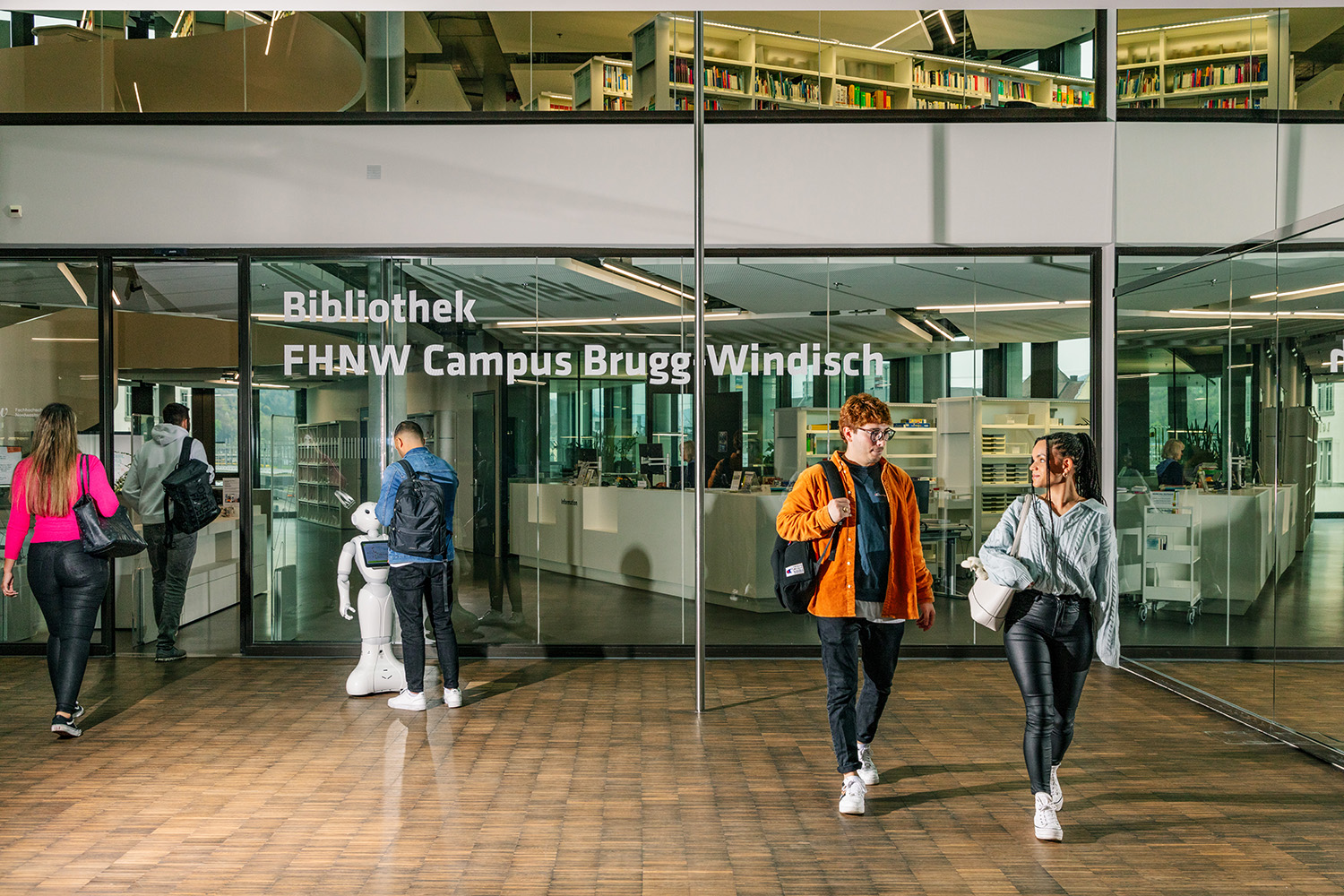
Fig.: At Campus Brugg-Windisch (Photo: Pati Grabowicz)
The Animal-Computer Interaction International Conference 2026 (ACI 2026) invites contributions for its thirteenth edition. The conference seeks theoretical, methodological, empirical, and ethical work that advances dialogue around animal-centered research and the design of computing-enabled systems. ACI brings together perspectives from computer science, informatics, engineering, interaction design, animal behavior and welfare science, veterinary science, ecology, sociology, philosophy, and related disciplines, with the aim of further developing Animal-Computer Interaction as a field. In an increasingly networked world shaped by pervasive technologies, animals – both human and nonhuman – are entangled in complex webs of interaction. These interactions may be direct or indirect, physical or cognitive, distributed or dyadic, synchronous or asynchronous. Contributions are encouraged that critically examine how technology shapes human-animal relationships, how large-scale technological deployments affect animals, and how future systems can be designed responsibly and ethically. The conference also welcomes submissions in Animal-Machine Interaction (AMI), which explores interaction and communication between animals and machines, including autonomous systems such as drones and robots. AMI focuses on designing machines that benefit animals and safeguard their interests, supporting survival and well-being. The submission deadline for Research Papers and Emerging Work Papers has been extended by one week and is now May 22, 2026. The deadline for Workshop Proposals remains unchanged at June 1, 2026. All submissions will be peer-reviewed. Further information is available at www.aciconf.org, and submission details can be found at www.aciconf.org/call-for-contributions.
Fig.: Extension of the submission deadline for ACI 2026
The Animal-Computer Interaction International Conference 2026 (ACI 2026) invites contributions for its thirteenth edition. The conference seeks theoretical, methodological, empirical, and ethical work that advances dialogue around animal-centered research and the design of computing-enabled systems. ACI brings together perspectives from computer science, informatics, engineering, interaction design, animal behavior and welfare science, veterinary science, ecology, sociology, philosophy, and related disciplines, with the aim of further developing Animal-Computer Interaction as a field. In an increasingly networked world shaped by pervasive technologies, animals – both human and nonhuman – are entangled in complex webs of interaction. These interactions may be direct or indirect, physical or cognitive, distributed or dyadic, synchronous or asynchronous. Contributions are encouraged that critically examine how technology shapes human-animal relationships, how large-scale technological deployments affect animals, and how future systems can be designed responsibly and ethically. The conference also welcomes submissions in Animal-Machine Interaction (AMI), which explores interaction and communication between animals and machines, including autonomous systems such as drones and robots. AMI focuses on designing machines that benefit animals and safeguard their interests, supporting survival and well-being. The submission deadline for Research Papers and Emerging Work Papers has been extended by two weeks and is now May 15, 2026. The deadline for Workshop Proposals remains unchanged at June 1, 2026. All submissions will be peer-reviewed. Further information is available at www.aciconf.org, and submission details can be found at www.aciconf.org/call-for-contributions.
Arianna Ferrari, PhD, and Dr. iur. Dr. h.c. Antoine F. Goetschel will deliver the conference keynote addresses at the Animal-Computer Interaction International Conference 2026 (ACI 2026) at the FHNW Campus Brugg-Windisch, Switzerland. Arianna Ferrari, PhD, is based at the AIT Austrian Institute of Technology, Austria’s largest research and technology organization. She is an ethicist and philosopher of science and technology with extensive experience in technology assessment, the critical evaluation of visions of technological futures (vision assessment), foresight, and human-animal studies. Dr. iur. Dr. h.c. Antoine F. Goetschel is a lawyer and former official animal lawyer for the Canton of Zurich in Switzerland. For more than three decades, he has worked at the intersection of law, ethics, and public policy, representing the interests of animals within legal systems and contributing to the development of animal protection standards at both national and international levels. The ACI International Conference is the leading conference in the field of animal-computer interaction. This year, the conference, hosted by Prof. Dr. Oliver Bendel, will include a dedicated call for contributions on animal-machine interaction. Further information is available at www.aciconf.org.
Fig.: The FHNW Campus Brugg-Windisch (Foto: WEISSWERT C. Morin & M. Indermaur)
The Animal-Computer Interaction International Conference 2026 (ACI 2026) invites contributions for its thirteenth edition. The conference seeks theoretical, methodological, empirical, and ethical work that advances dialogue around animal-centered research and the design of computing-enabled systems. ACI brings together perspectives from computer science, informatics, engineering, interaction design, animal behavior and welfare science, veterinary science, ecology, sociology, philosophy, and related disciplines, with the aim of further developing Animal-Computer Interaction as a field. In an increasingly networked world shaped by pervasive technologies, animals – both human and nonhuman – are entangled in complex webs of interaction. These interactions may be direct or indirect, physical or cognitive, distributed or dyadic, synchronous or asynchronous. Contributions are encouraged that critically examine how technology shapes human-animal relationships, how large-scale technological deployments affect animals, and how future systems can be designed responsibly and ethically. The conference also welcomes submissions in Animal-Machine Interaction (AMI), which explores interaction and communication between animals and machines, including autonomous systems such as drones and robots. AMI focuses on designing machines that benefit animals and safeguard their interests, supporting survival and well-being. Research Papers and Emerging Work Papers are due May 1, 2026, and Workshop Proposals are due June 1, 2026. All submissions will be peer-reviewed. Further information is available at www.aciconf.org, and submission details can be found at www.aciconf.org/call-for-contributions.
Prof. Dr. Oliver Bendel will host the next ACI Conference, bringing the event to continental Europe for the first time as it convenes on the FHNW campus in Brugg-Windisch, Switzerland, from December 2-5, 2026. The conference website is already online at www.aciconf.org, where the most important information is available; individual deadlines may still change. In the meantime, the website has been updated and expanded. It now includes visual elements that reference both the animal world of Switzerland and the thematic focus of the conference, strengthening its visual identity and contextual framing. Building on a tradition that has taken the community from Glasgow to North Carolina, Newcastle, Bloomington, Milton Keynes, Haifa, and Atlanta, this edition continues the conference’s role as a leading venue for advancing Animal-Computer Interaction. As the field grows, researchers and practitioners explore how technology shapes animals’ lives, welfare, cognition, and social dynamics while developing animal-centered systems and methods that embrace multispecies perspectives. The conference maintains its commitment to interdisciplinary collaboration across biology, technology, and cultural studies, supporting work that seeks to design ethically grounded, welfare-enhancing, and inclusive technological futures for all animals, humans included. ACI 2026 will also feature a Special Issue on Animal-Machine Interaction, a research field shaped in important ways by Oliver Bendel. The conference proceedings will be published in a volume of a renowned organization, ensuring wide visibility and long-term accessibility for the contributions presented.
Prof. Dr. Oliver Bendel will host the next ACI Conference, bringing the event to continental Europe for the first time as it convenes on the FHNW campus in Brugg-Windisch, Switzerland, from December 2–5, 2026. The conference website is already online, and the most important information is available at www.aciconf.org; individual deadlines may still change. Building on a tradition that has taken the community from Glasgow to North Carolina, Newcastle, Bloomington, Milton Keynes, Haifa, and Atlanta, this edition continues the conference’s role as a leading venue for advancing Animal-Computer Interaction. As the field grows, researchers and practitioners explore how technology shapes animals’ lives, welfare, cognition, and social dynamics while developing animal-centered systems and methods that embrace multispecies perspectives. The conference maintains its commitment to interdisciplinary collaboration across biology, technology, and cultural studies, supporting work that seeks to design ethically grounded, welfare-enhancing, and inclusive technological futures for all animals, humans included. ACI 2026 will also feature a Special Issue on Animal-Machine Interaction, a research field shaped in important ways by Oliver Bendel. The proceedings will be published in a volume of a renowned organization.