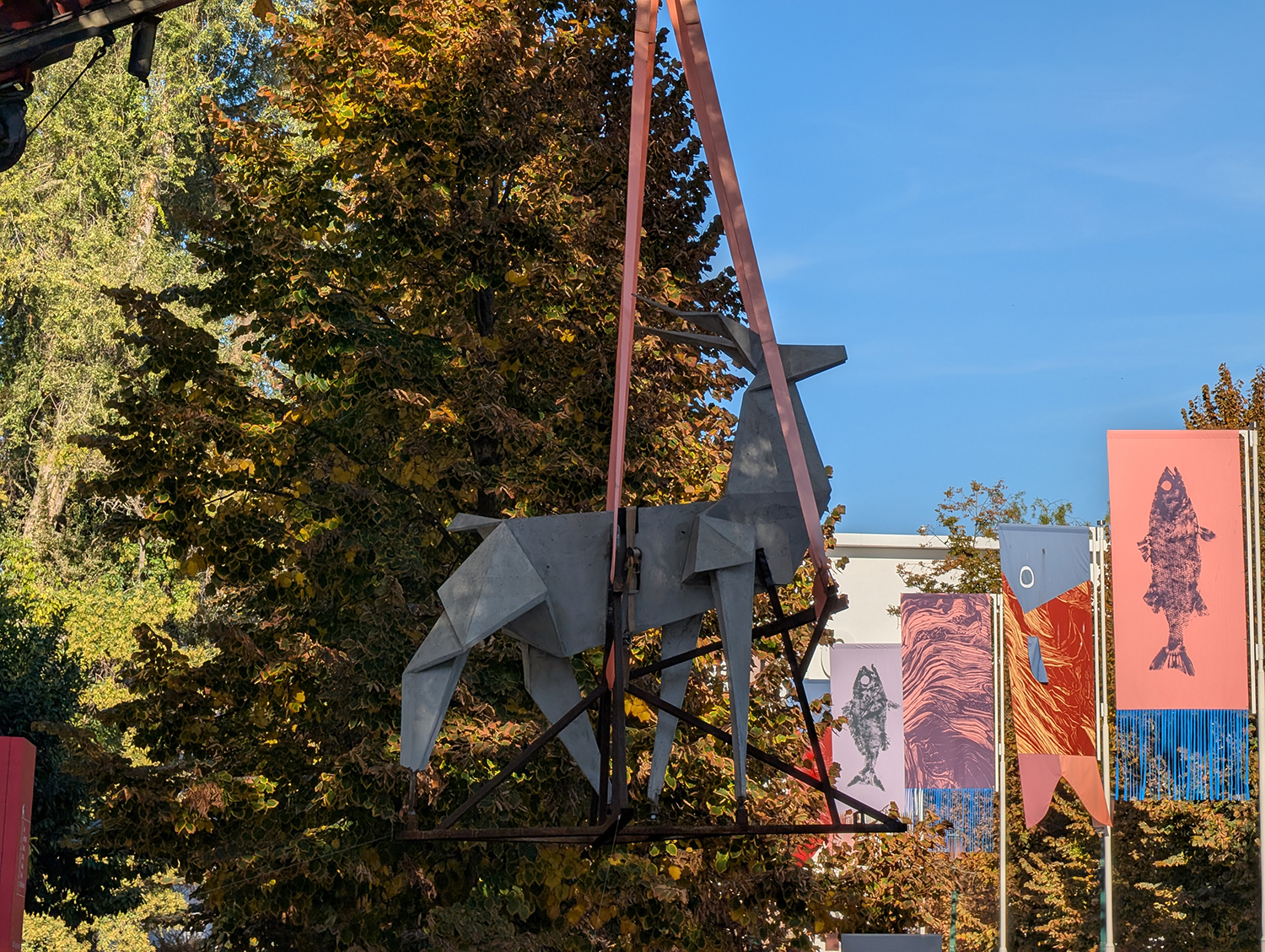
Die 61. Internationale Kunstausstellung La Biennale di Venezia, die Biennale Arte 2026, findet vom 9. Mai bis 22. November 2026 in den Giardini, im Arsenale und an weiteren Orten in Venedig statt. Besonders eindrucksvoll ist der „Origami Deer“ der ukrainischen Künstlerin Zhanna Kadyrova, der im Zentrum des ukrainischen Beitrags „Security Guarantees“ steht. Der kantige Hirsch, der wie eine überdimensionale Origamifigur wirkt, wurde 2019 aus Beton geschaffen und im Yuvileynyi-Park in Pokrowsk in der Region Donezk aufgestellt – auf einem Sockel, auf dem zuvor ein sowjetisches Militärflugzeug gestanden hatte, das Atomwaffen tragen konnte. Als sich im August 2024 die Front der Stadt näherte und die Bevölkerung evakuiert wurde, demontierten Kadyrova, der Kurator Leonid Marushchak und weitere Helfer die eigentlich für einen dauerhaften Verbleib geschaffene Skulptur und brachten sie in Sicherheit. Auf dem Weg zur Biennale reiste der Hirsch über Warschau, Wien, Prag, Berlin, Brüssel und Paris durch Europa und wurde selbst zu einem Vertriebenen. In Venedig hängt das schwere Tier an einem Kran an der Riva Ca‘ di Dio vor den Giardini in der Luft, während im ukrainischen Pavillon im Arsenale seine Evakuierung und seine Reise dokumentiert werden. Der von Ksenia Malykh und Leonid Marushchak kuratierte Beitrag verweist mit seinem Titel auf das Budapester Memorandum von 1994, in dessen Zusammenhang die Ukraine auf die auf ihrem Territorium verbliebenen sowjetischen Atomwaffen verzichtete und im Gegenzug Sicherheitszusicherungen erhielt. So verbindet „The Origami Deer“ mehrere Widersprüche miteinander: Der Hirsch sieht aus wie gefaltetes Papier, besteht aber aus schwerem Beton; er war als dauerhaftes Kunstwerk gedacht und wurde zur Flucht gezwungen; und er steht zugleich für die Zerbrechlichkeit von Sicherheit und die Widerstandsfähigkeit eines Kunstwerks, das Krieg und Vertreibung überdauert hat. Letztlich geht es darum, dass manche Verträge das Papier nicht wert sind, auf das sie geschrieben wurden.
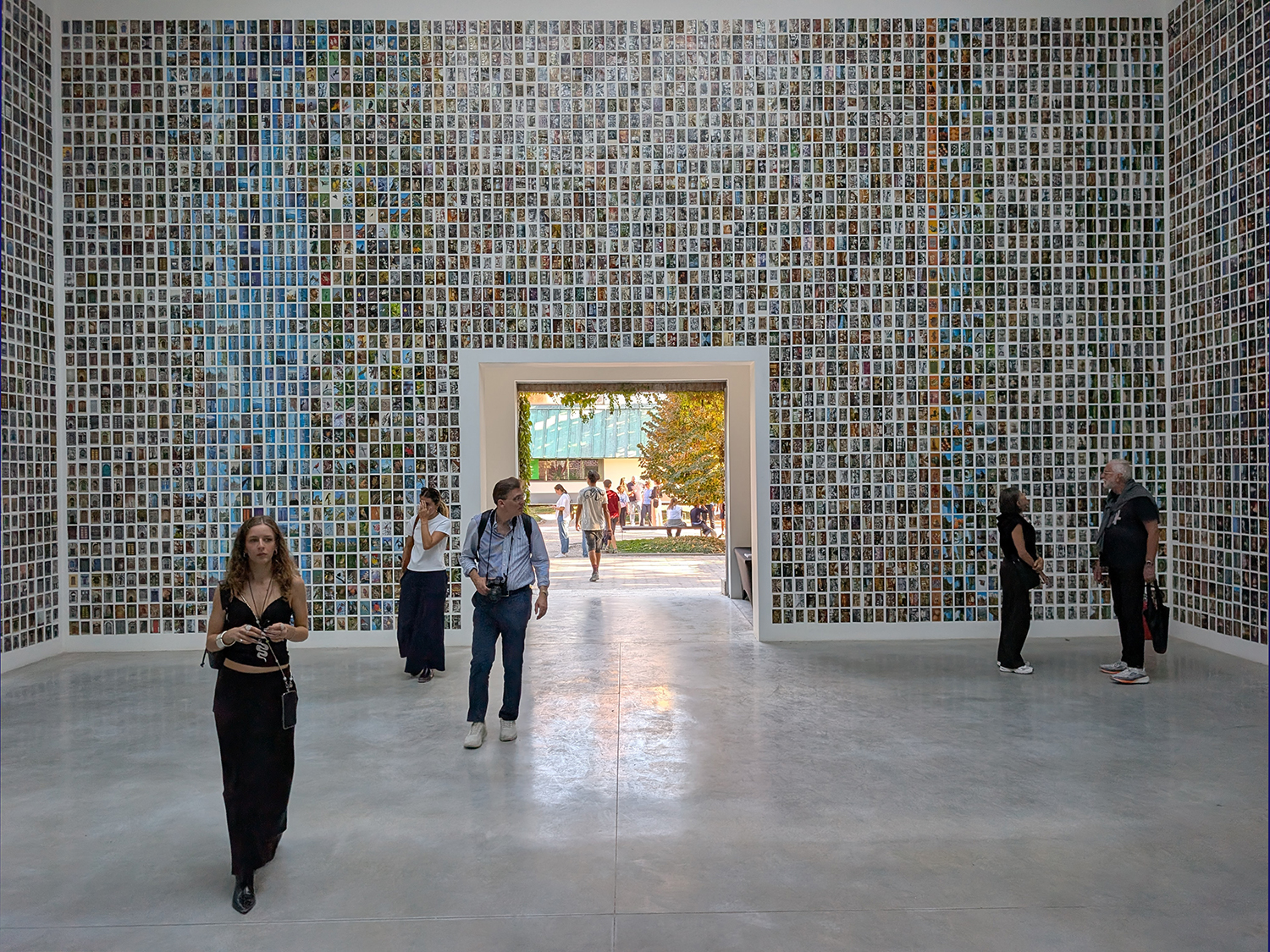
Die 61. Internationale Kunstausstellung La Biennale di Venezia, die Biennale Arte 2026, findet vom 9. Mai bis 22. November 2026 in den Giardini, im Arsenale und an weiteren Orten in Venedig statt. Im spanischen Pavillon in den Giardini zeigt der katalanische Künstler Oriol Vilanova unter dem Titel „Los restos“ eine ebenso einfache wie beeindruckende Installation. Die Wände der Ausstellungsräume sind vom Boden bis zur Decke mit rund 50.000 gebrauchten Bildpostkarten bedeckt, die Vilanova über mehr als zwei Jahrzehnte auf Flohmärkten und in Antiquariaten gesammelt hat. Aus der Entfernung verbinden sich die dicht angeordneten und nach chromatischen und thematischen Gesichtspunkten gruppierten Karten zu großen Farbfeldern, Mosaiken und Wellen. Aus der Nähe treten einzelne Motive hervor, Menschen und Tiere, aber auch Städte, Landschaften und Strände oder Sehenswürdigkeiten und Kunstwerke. Die Postkarten, einst verschickt, beschrieben, aufbewahrt und schließlich aussortiert, werden so zu Fragmenten eines kollektiven Gedächtnisses. Die von Carles Guerra kuratierte Installation verwandelt den Pavillon in ein Museum des Vergessenen und Übriggebliebenen und stellt Fragen nach Erinnerung und Verlust, Massentourismus und Bilderflut sowie danach, was von den unzähligen Bildern bleibt, mit denen Menschen ihre Welt festhalten und miteinander teilen.
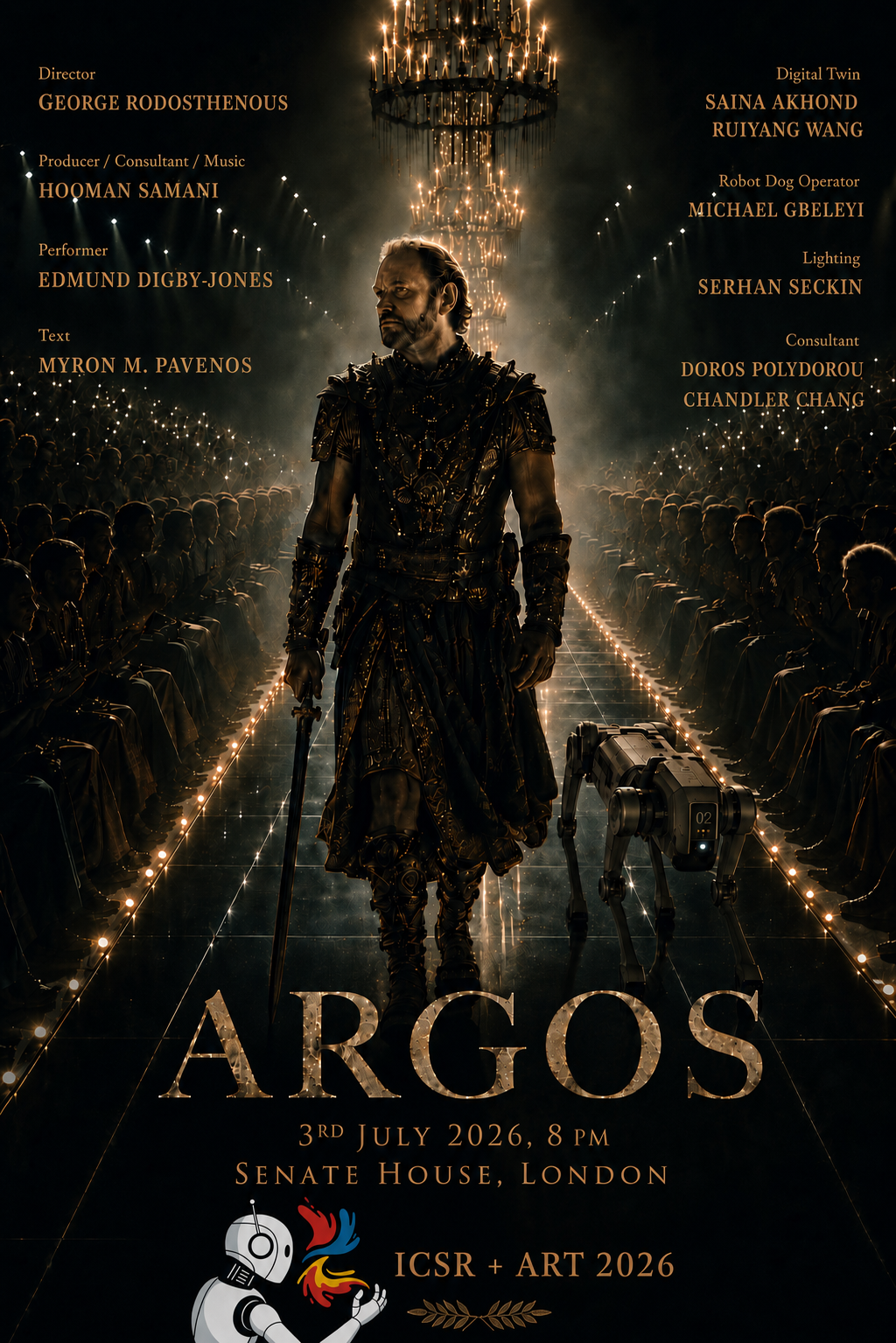
The 18th International Conference on Social Robotics (ICSR + Art 2026) will take place in London, UK, from 1–4 July 2026. ICSR is the leading international forum that brings together researchers, academics, and industry professionals from across disciplines to advance the field of social robotics. This year’s conference combines cutting-edge research in social robotics with a unique focus on artistic and creative applications of robotics. One of the highlights of the conference will be ARGOS, a performance staged on 3 July 2026 at Senate House in London. Rooted in Homer’s „Odyssey“, ARGOS reimagines the return of Odysseus after twenty years of war, recognized only by his faithful dog, here embodied by a real robot dog. The performance explores trust, intimacy, error, vulnerability, and the ethics of human-robot relationships. Developed as part of the Creative Robotics Theatre research initiative, ARGOS is a collaboration between the University of the Arts London, the University of Leeds, the Cyprus University of Technology, and CYENS. Directed by George Rodosthenous and produced by Hooman Samani, the project demonstrates how robotics and theatre can come together to inspire new reflections on technology and human connection. Further information is available at hoomansamani.com/creative-robotics/creative-robotic-theatre/argos/.
The 18th International Conference on Social Robotics (ICSR + Art 2026) will take place in London, UK, from 1–4 July 2026. ICSR is the leading international forum that brings together researchers, academics, and industry professionals from across disciplines to advance the field of social robotics. The preliminary programme, now available, offers four days of scientific exchange, artistic exploration, and community building, featuring keynote lectures, paper presentations, special sessions, workshops, debates, a Grand Challenge, exhibitions, and a variety of networking opportunities. Reflecting the conference theme ICSR + Art, the programme highlights the growing intersections between social robotics and creative practice through events such as the Robot Fringe Festival, the Rising Stars in Social Robotics event, the premiere performance of Quantwin by Silke Grabinger, the 1001 Nights with Robots Show, Argos, and the Robot Fashion Show, while also covering the full breadth of contemporary social robotics research. Participants will have opportunities to engage with leading experts from academia, industry, healthcare, design, the arts, and other fields. Full details of the programme are available at icsr2026.uk/programme/.
The 18th International Conference on Social Robotics (ICSR + Art 2026) will take place in London, UK, from 1–4 July 2026. ICSR is the leading international forum that brings together researchers, academics, and industry professionals from across disciplines to advance the field of social robotics. The finalists of the ICSR 2026 Grand Challenge have now been announced, showcasing an exciting and diverse range of innovative projects from researchers, artists, and interdisciplinary teams across the globe. This year’s finalists represent institutions from Europe, Asia, North America, and Australia, reflecting the international and creative spirit of the competition. The selected teams will present their work during the first day of the conference on 1 July 2026, with the results and awards to be announced on 3 July 2026. Finalists will also have the optional opportunity to demonstrate their projects during the conference. To support participation in the competition, ICSR offers a special reduced registration rate through the Grand Challenge Competition Finalists Pass, which grants access to the full conference; at least one registration per team is required, and each attendee must hold an individual registration. Further details regarding presentations and demonstrations will be communicated directly to finalists via email. For questions related to the ICSR Grand Challenge, participants may contact Prof. Laura Fiorini at laura.fiorini@unifi.it. A full list of finalists and additional information can be found at: icsr2026.uk/competition-finalists/.
Die Ausstellung mit Gemälden des afroamerikanischen Künstlers Kerry James Marshall im Kunsthaus Zürich ist sehenswert – lesenswert ist sie nicht. Die deutschen Texte sind manipulativ auf mehreren Ebenen. So steht in einem Begleittext neben den Bildern: „Jahrhundertelang widerstanden Schwarze Amerikaner:innen Bedingungen von Unterdrückung und schufen trotz Versklavung und Ungleichheit eine reiche Kultur. In der Serie hier gezeigter Porträts zollt Marshall Sklavenrebell:innen, Poet:innen, Künstler:innen, Abolitionist:innen und Aktivist:innen Tribut.“ Es handelt sich um dysfunktionale, aktivistische, ideologische, diskriminierende, moralisierende Sprache, die den Besucher nicht ernst nimmt, ihn erziehen, umerziehen, ihm eine Meinung und eine Sichtweise aufzwingen will, sich zwischen ihn und die Werke schiebt und die Werke ihrer Autonomie beraubt. Dabei folgt die Sprache der Verantwortlichen einem klaren Plan. An anderer Stelle heißt es nämlich: „Einige Sklavenbesitzer förderten nicht die Ehe …“. Wo überall Doppelpunkte im Wortinneren erscheinen, um die Wortstruktur zu zerstören und die -bedeutung aufzulösen, kann eine solche Form nicht mehr generisch sein – sie muss männlich sein. Die Bösen, das ist hier die Auskunft, sind die Männer, und nur diese haben in diesem Zusammenhang gefehlt. Allerdings gibt es zahlreiche weibliche Sklavenhalter in der Geschichte. Martha Washington ist ein Beispiel für den amerikanischen Süden. Im Römischen Reich konnten wohlhabende Frauen ganz selbstverständlich Sklaven besitzen, ebenso in verschiedenen afrikanischen Gesellschaften. Auf diese Weise wird Sprache ebenso manipuliert wie der Besucher – und die Geschichte. Das Kunsthaus ist nicht nur durch seine NS-Kunst auf Abwege geraten.
The 18th International Conference on Social Robotics (ICSR + Art 2026) will take place in London, UK, from July 1–4, 2026. ICSR is the leading international forum that brings together researchers, academics, and industry professionals from across disciplines to advance the field of social robotics. For its 18th edition, the conference will feature the special theme ICSR + Art, exploring how robots can transcend their traditional roles to become tools and collaborators in creative practices. At the same time, the conference remains fully open to the entire spectrum of social robotics research, including human–robot interaction, medical and assistive robotics, AI and machine learning, ethics, design, education, cultural applications, and beyond. Accepted papers will be published in Springer’s Lecture Notes in Artificial Intelligence (LNAI) series and indexed in major databases. In addition to regular and short papers, the program will include workshops and special sessions designed to foster exchange across disciplines and communities. Paper submissions are due by February 15, 2026, with notifications on April 15, 2026, and camera-ready papers due May 15, 2026. Proposals for workshops and special sessions are welcome until December 1, 2025. Further information is available at icsr2026.uk.
The book „Tender Digitality“, edited by Charlotte Axelsson from the Zurich University of the Arts, will be published in early February 2024. From the publisher’s website: „Tender Digitality introduces an aesthetically oriented concept that intricately intertwines binary systems in a complex manner, setting them in motion. The concept responds to the human desire for sensuality, interpersonal connection, intuition, and well-being in digital environments. It explores ways to (re)transmit these experiences into the analog world of a book, developing its own distinct vocabularies. Readers are guided through the various perspectives of this kaleidoscope, encouraging them to delve into different play-forms of ‚tender digitality‘ and develop their own approach. Assuming the role of researchers, they discover phenomena of extraordinary beauty or bizarreness within the spectrum spanning analogue and digital, social, and technological domains. Through exploration, learning, and the cultivation of ‚tender digitality,‘ readers can envision their own version of a community where individuals and artificial intelligences, avatars and cyborgs, humans and computers navigate digital landscapes with agency, intuition, and sensitivity.“ (Website Slanted) Contributors include Charlotte Axelsson, Oliver Bendel, Dana Blume, Marisa Burn, Alexander Damianisch, Léa Ermuth, Hannah Eßler, Barbara Getto, Leoni Hof, Marcial Koch, Mela Kocher, Friederike Lampert, Gunter Lösel, Francis Müller, Marie-France Rafael, Oliver Ruf, Sascha Schneider, and Grit Wolany. More information at www.slanted.de/product/tender-digitality/.
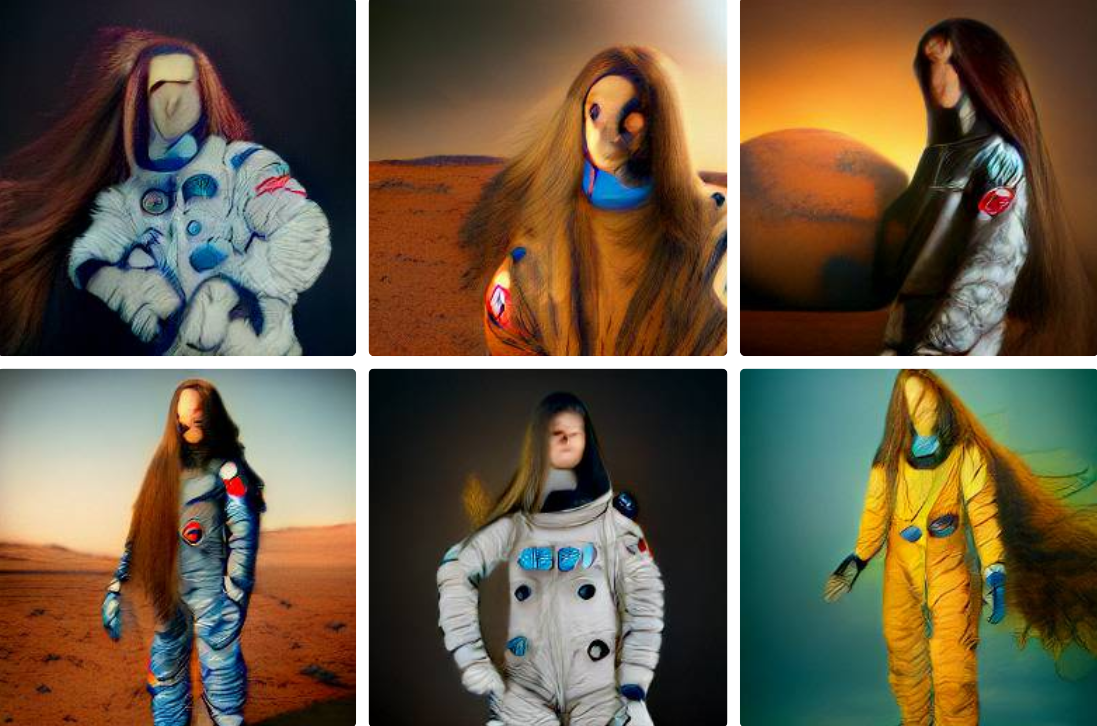
DALL·E 2 is a new AI system that can create realistic images and art from a description in natural language. It was announced by OpenAI in April 2022. The name is a portmanteau of „WALL-E“ and „Salvador Dalí“. The website openai.com says more about the program: „DALL·E 2 can create original, realistic images and art from a text description. It can combine concepts, attributes, and styles.“ (Website openai.com) Moreover, it is able to „make realistic edits to existing images from a natural language caption“ and to „add and remove elements while taking shadows, reflections, and textures into account“ (Website openai.com). Last but not least, it „can take an image and create different variations of it inspired by the original“ (Website openai.com). The latter form of use is shown by variations of the famous painting „Girl with a Pearl Earring“ by Johannes Vermeer. The website says about the principle of the program: „DALL·E 2 has learned the relationship between images and the text used to describe them. It uses a process called ‚diffusion,‘ which starts with a pattern of random dots and gradually alters that pattern towards an image when it recognizes specific aspects of that image.“ (Website openai.com) DALL·E mini is a slimmed down version of the powerful program, with which you can gain a first insight. The six images below were automatically generated by DALL·E mini from the text „A young female astronaut with long hair on the flight to Mars“. In total, 9 suggestions were made in a few seconds. Overall, this is a fascinating and valuable project. From the perspective of information ethics and the philosophy of technology, many questions arise.
Fig.: A young female astronaut with long hair on the flight to Mars (Photo: DALL·E mini)