Robophilosophy 2026 kicked off on August 11, 2026, at University College Dublin (UCD) in Dublin, Ireland. Held under the theme „Connected Futures – Nature, Robots, and Society“, the conference runs from August 11–14 and brings together researchers from a wide range of disciplines to explore how robotics and artificial intelligence are transforming human societies and the natural world. On the first day, Prof. Dr. Oliver Bendel from the FHNW School of Business presented his paper „Towards a Discipline of Animal-Machine Interaction: Ethical and Design Challenges of Machines in Animal Habitats“ in the session „Environmental Robotics and Society“. From the abstract: „As autonomous and semi-autonomous machines such as robots and drones increasingly enter animal habitats, new ethical and conceptual challenges emerge. This article proposes animal-machine interaction (AMI) as a distinct discipline concerned with the design and governance of technologies operating in relation to animals. After clarifying core concepts and delineating AMI from related fields, the article highlights the role of machine ethics in developing animal-friendly systems. Selected application examples illustrate how machines can reduce negative impacts on animals and, in some cases, support animal survival through animal-friendly design. The ethical discussion addresses both opportunities and risks of technological intervention in animal habitats. It is becoming clear that AMI is an increasingly important field of research, but one that must remain open to critical reflection and reorientation.“ The proceedings, containing all conference papers, will be available in late 2026. For those who don’t want to wait: Oliver Bendel recently published a short book on animal-machine interaction with Springer.
The Robophilosophy Conference 2026 (RP2026) opened on August 11, 2026, at University College Dublin (UCD) in Dublin, Ireland. Held under the theme „Connected Futures – Nature, Robots, and Society“, the conference runs from August 11–14 and brings together researchers from a wide range of disciplines to explore how robotics and artificial intelligence are transforming human societies and the natural world. RP2026 is the seventh installment in the international Robophilosophy conference series. University College Dublin (UCD) is Ireland’s largest university and one of the country’s leading research institutions. Located in Dublin, the capital of Ireland, UCD is home to more than 34,000 students and has a strong international profile. As robotic systems become increasingly embedded in everyday life, RP2026 seeks to foster dialogue across fields including social robotics, computer science, human-robot interaction, the humanities, social sciences, law, economics, and environmental research. Key questions include how robotic technologies can uphold human dignity, autonomy, and social justice; how legal systems need to adapt to autonomous decision-making; and whether robots can contribute to sustainability rather than accelerate ecological decline. The conference also addresses the impact of automation on labor markets and economic inequality, the changing meaning of work and human care, and the responsibilities humans may have toward the artificial agents they create. The first day of the conference featured keynote presentations by Lynne Baillie and Arno Klein. The program also included two sessions: „Environmental Robotics and Society“ (chaired by Oliver Bendel) and „Responsible Technology Development“ (chaired by Sun Park). Several workshops complemented the program, offering additional perspectives on the social, ethical, and environmental dimensions of robotics and artificial intelligence. The Robophilosophy Conference 2026 provides a space for dialogue between technological, philosophical, social-scientific, and environmental perspectives. At its core is the question of how technological innovation can be shaped not only to create new possibilities, but also to contribute to a humane, just, and sustainable future. Further details are available at www.ucd.ie/robophilosophy2026/.
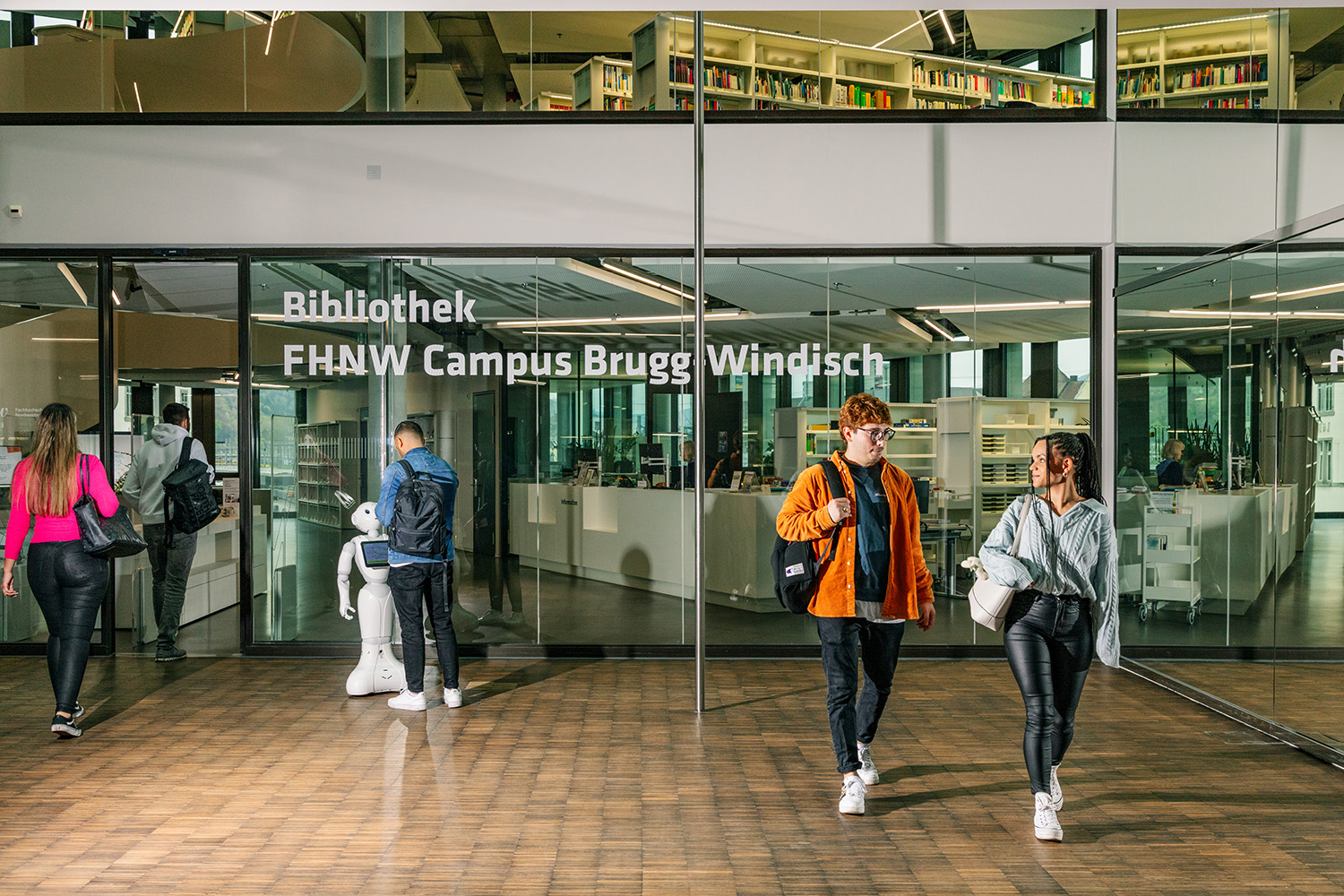
The ACI 2026 International Conference will take place from December 2–5, 2026, on the FHNW campus in Brugg-Windisch, Switzerland, marking the first time the event is held in continental Europe. Registration is now open, with Early Bird rates available until September 30, 2026. The conference continues a tradition that has brought the Animal-Computer Interaction community to Glasgow, North Carolina, Newcastle, Bloomington, Milton Keynes, Haifa, and Atlanta, reinforcing its position as a leading venue for research at the intersection of animals and technology. As the field continues to grow, researchers and practitioners explore how technology shapes animals’ lives, welfare, cognition, and social dynamics while developing animal-centered systems and methods that embrace multispecies perspectives. The conference maintains its commitment to interdisciplinary collaboration across biology, technology, and cultural studies, supporting work that seeks to design ethically grounded, welfare-enhancing, and inclusive technological futures for all animals, humans included. ACI 2026 also features a Special Issue on Animal-Machine Interaction. The proceedings will be published in the ACM library. The conference will be hosted by Prof. Dr. Oliver Bendel, FHNW School of Business.
Fig.: At Campus Brugg-Windisch (Photo: Pati Grabowicz)
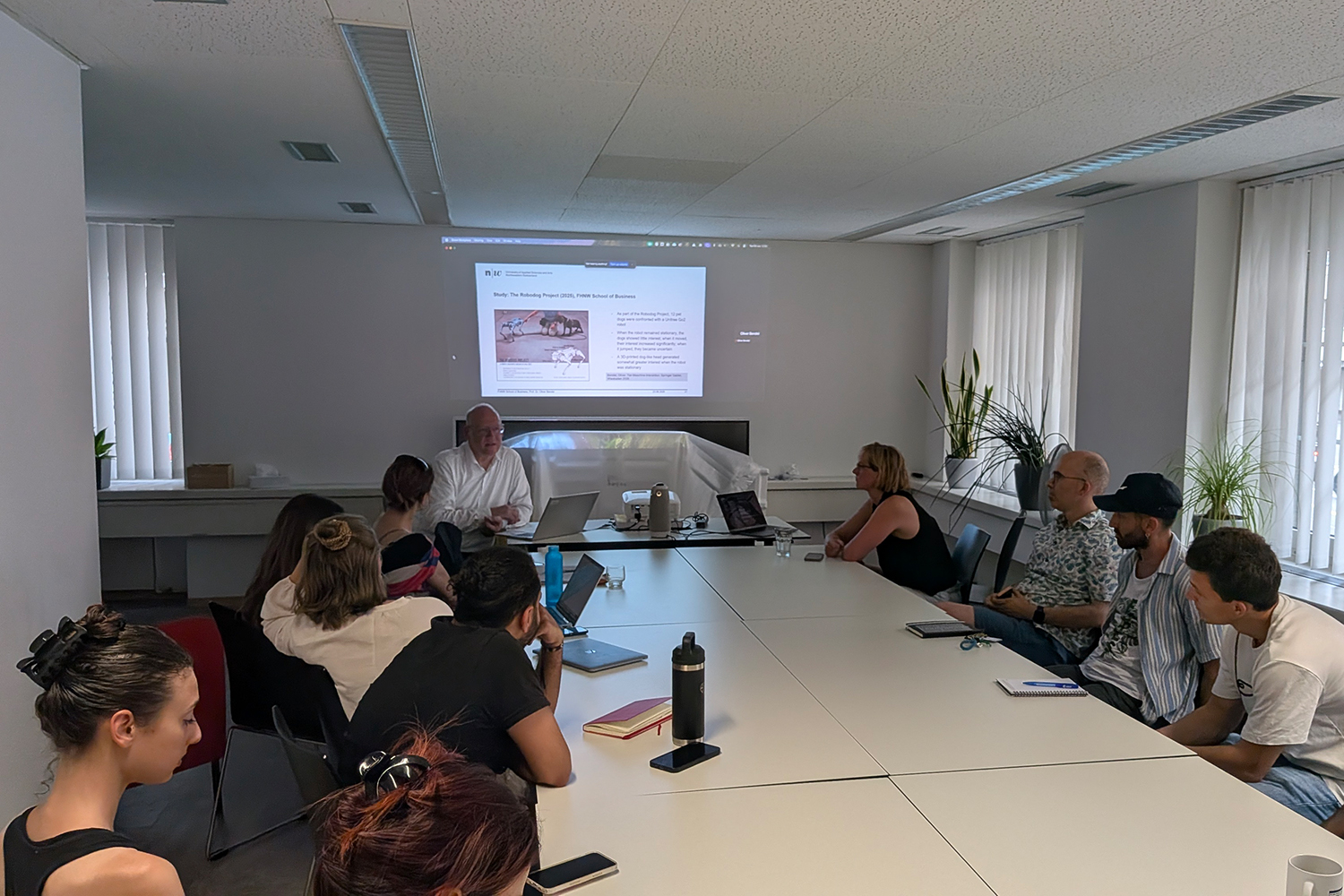
On June 23, 2026, Oliver Bendel gave a presentation on animal-machine interaction to Prof. Dr. Emily Cross’s research group at ETH Zurich. He had been invited by Dr. Amol Deshmukh, whom he had met at the ICSR in Qatar and had seen several times since then. From the announcement text of „Fundamentals and Examples of Animal-Machine Interaction“: „Animal-Machine Interaction (AMI) explores encounters and interactions between animals and machines – from traditional devices, vehicles, aircraft, and agricultural machinery to networked autonomous robots and AI systems. At its core are perception through sensors and senses, interaction and communication between animals and machines, and the question of how these encounters can be designed from technical, organizational, and ethical perspectives to reduce risks for animals while unlocking benefits for both animals and humans. In his lecture, Prof. Dr. Oliver Bendel presents the fundamentals of Animal-Machine Interaction and describes prototypes and research projects in the field. He also outlines what may become possible and what can be expected in this area of research over the coming years.” The participants were very interested and asked several questions about this new and fascinating field. Springer Gabler recently published a slim volume titled „Tier-Maschine-Interaktion (Animal-Machine Interaction)“ by Oliver Bendel.
Fig.: Oliver Bendel during his talk (Photo: Amol Deshmukh)
The Animal-Computer Interaction International Conference 2026 (ACI 2026) invites contributions for its thirteenth edition. The conference seeks theoretical, methodological, empirical, and ethical work that advances dialogue around animal-centered research and the design of computing-enabled systems. ACI brings together perspectives from computer science, informatics, engineering, interaction design, animal behavior and welfare science, veterinary science, ecology, sociology, philosophy, and related disciplines, with the aim of further developing Animal-Computer Interaction as a field. In an increasingly networked world shaped by pervasive technologies, animals – both human and nonhuman – are entangled in complex webs of interaction. These interactions may be direct or indirect, physical or cognitive, distributed or dyadic, synchronous or asynchronous. Contributions are encouraged that critically examine how technology shapes human-animal relationships, how large-scale technological deployments affect animals, and how future systems can be designed responsibly and ethically. The conference also welcomes submissions in Animal-Machine Interaction (AMI), which explores interaction and communication between animals and machines, including autonomous systems such as drones and robots. AMI focuses on designing machines that benefit animals and safeguard their interests, supporting survival and well-being. The submission deadline for Research Papers and Emerging Work Papers has been extended by one week and is now May 22, 2026. The deadline for Workshop Proposals remains unchanged at June 1, 2026. All submissions will be peer-reviewed. Further information is available at www.aciconf.org, and submission details can be found at www.aciconf.org/call-for-contributions.
Fig.: Extension of the submission deadline for ACI 2026
Oliver Bendel’s paper „Towards a Discipline of Animal-Machine Interaction“ has been accepted for presentation at Robophilosophy 2026. The renowned conference on the philosophical aspects of social robotics has been held since 2014 and will take place in Dublin this year. Autonomous and semi-autonomous machines such as robots and drones are increasingly moving into natural and urban environments, leading to a growing number of interactions between animals and machines and raising corresponding new ethical and conceptual challenges. This article proposes animal-machine interaction (AMI) as a distinct discipline concerned with the design and governance of machines that encounter animals. After clarifying core concepts and delineating AMI from related fields, the article highlights the role of machine ethics in developing animal-friendly systems. Selected application examples illustrate how machines can support animal survival and well-being, while the ethical discussion addresses both opportunities and risks of technological intervention in animal habitats. It is becoming clear that AMI is an increasingly important field of research, but one that must be constantly reoriented and questioned. Oliver Bendel has participated in the biennial conference series since 2018. That year, he delivered a keynote speech in Vienna alongside Hiroshi Ishiguro, Guy Standing, and Joanna Bryson. His book „Tier-Maschine-Interaktion“ („Animal-Machine Interaction“) was recently published by Springer Gabler.
Seit 20. Dezember 2025 ist das Buch „Tier-Maschine-Interaktion“ von Prof. Dr. Oliver Bendel bei Springer Nature Link verzeichnet. Laut Verlag erscheint es im März 2026. Am Anfang wird der Inhalt skizziert: „Dieses essential gibt eine kompakte Einführung in die Disziplin bzw. das Forschungs- und Anwendungsfeld der Tier-Maschine-Interaktion (TMI). Es zeigt, wie Tiere und Maschinen in unterschiedlichen Kontexten zusammentreffen und miteinander bestehen, welche Chancen und Risiken sich daraus ergeben und welche Perspektiven sich für Wissenschaft, Wirtschaft und Politik eröffnen. Ziel ist es, die Leser für die Potenziale und Herausforderungen der Tier-Maschine-Interaktion zu sensibilisieren, Orientierung im interdisziplinären Diskurs zu geben und Anregungen für Forschung, Entwicklung und Entscheidungsprozesse zu liefern.“ Es ist das erste Buch zu diesem Forschungsfeld. Es enthält zwei Abbildungen, drei Tabellen und mehrere Boxen mit Definitionen und Hintergrundinformationen.
The edited volume „Animals, Ethics, and Engineering: Intersections and Implications“ will be published by Jenny Stanford in August 2025. It can already be pre-ordered via online stores. These provide the following information: „‚Animals, Ethics, and Engineering: Intersections and Implications‘ is a seminal work that explores the intricate relationship between technology, ethics, and the welfare of nonhuman animals. Edited by Rosalyn W. Berne, this volume brings together leading scholars and practitioners to examine the ethical responsibilities inherent in technological progress and its impact on animal well-being.“ (Information Publisher) The authors include Clara Mancini, Fiona French, Abraham Gibson, Nic Carey, Kurt Reymers, and Oliver Bendel. Rosalyn W. Berne is the Anne Shirley Carter Olsson Professor of Applied Ethics and Chair of the Department of Engineering and Society, School of Engineering and Applied Sciences, University of Virginia, where she has been a faculty member since 1999 and co-directs the Online Ethics Center for Engineering and Science (OEC).
Parallel zu seiner Arbeit in der Maschinenethik versucht Oliver Bendel, die Tier-Maschine-Interaktion (AMI) als Disziplin zu etablieren. Er war sehr beeindruckt von Clara Mancinis Beitrag „Animal-Computer Interaction (ACI): A Manifesto“ zur Interaktion zwischen Tier und Computer. In seiner AMI-Forschung beschäftigt er sich hauptsächlich mit Robotern und Geräten und deren Verhalten gegenüber Tieren. Es gibt nicht nur moralische Fragen, sondern auch Fragen zur Gestaltung der äußeren Erscheinung und zur Sprechfähigkeit. Der allgemeine Hintergrund für seine Überlegungen ist, dass sich immer mehr Maschinen und Tiere in geschlossenen, halboffenen und offenen Welten treffen. Er ist der Ansicht, dass teilautonome und autonome Systeme Regeln haben sollten, damit sie Tiere gut behandeln. Sie sollten sie nicht stören, erschrecken, verletzen oder töten. Beispiele sind Spielzeugroboter, Haushaltsroboter, Serviceroboter in Einkaufszentren und Landwirtschaftsroboter. Die Medien haben mehrere Artikel zu seiner Forschung zu tierfreundlichen Maschinen gebracht, zuletzt Zeitschriften in den USA und in China.
Abb.: Auch Giraffen sollten ihre Ruhe haben, beispielsweise vor Drohnen