The elective module „Soziale Roboter“ („Social Robots“) by Prof. Dr. Oliver Bendel will be held again from April 15 to 17, 2025 at the FHNW in Olten. It is primarily aimed at prospective information systems specialists, but prospective business economists can also take part. Dr. Amol Deshmukh has been invited as a guest speaker. He previously worked for the University of Glasgow and now conducts research at ETH Zurich. In his lecture, he will present the findings from his paper „Leveraging Social Robots to Promote Hand Hygiene: A Cross-Cultural and Socio-Economic Study of Children in Diverse School Settings“. Unitree Go2, Alpha Mini, Cozmo, Vector, Aibi, Furby and Booboo from Oliver Bendel’s private Social Robots Lab will also be on site. Social Robotics Girl, a so-called GPT who specializes in this topic, will be available as a tutor throughout the event. Basic works are „Soziale Roboter“ (2021) and „300 Keywords Soziale Robotik“ (2021). At the end of the elective module, students design social robots – also with the help of generative AI – that they find useful, meaningful, or simply attractive. The elective modules have been offered since 2021 and are very popular.
The ICSR is one of the leading conferences for social robotics worldwide. The 17th edition will take place from 10 to 12 September 2025 in Naples, Italy. The deadline for the full paper submission was extended. Papers should consist of 11 pages of body text plus references as appropriate. The most important conferences dates are: Full Paper Submission: April 18th, 2025; Full Paper Notification: June 6th, 2025; Camera-ready: June 30th, 2025; Paper Presentation Days at ICSR’25: September 11th and 12th, 2025. All dates are also listed on the website. „The conference theme, ‚Emotivation at the Core: Empowering Social Robots to Inspire and Connect,‘ highlights the essential role of ‚Emotivation‘ in social robotics. Emotivation captures the synergy between emotion and motivation, where emotions trigger and sustain motivation during interactions. In social robotics, this concept is key to building trust, fostering empathy, and supporting decision-making by enabling robots to respond sensitively to human emotions, inspiring engagement and action.“ (Website ICSR) Participants will meet for two days at the Parthenope University of Naples and for the third day at the Città della Scienza conference center. All buildings and rooms are also listed on the website.
The paper „‚Ick bin een Berlina‘: dialect proficiency impacts a robot’s trustworthiness and competence evaluation“ by Katharina Kühne, Erika Herbold, Oliver Bendel, Yuefang Zhou, and Martin H. Fischer was selected as one of the 11 best papers out of 261 published in Frontiers in Robotics and AI in 2024. The paper says about the background: „Robots are increasingly used as interaction partners with humans. Social robots are designed to follow expected behavioral norms when engaging with humans and are available with different voices and even accents. Some studies suggest that people prefer robots to speak in the user’s dialect, while others indicate a preference for different dialects.“ The winning papers were published in March 2025 in a book entitled „Frontiers in Robotics and AI editor’s picks 2024“ (editor Kostas J. Kyriakopoulos). He states in his message: „As the Field Chief Editor, I would like to stand alongside our journal staff to honor all authors who contributed very high-level papers to the journal last year and are contributing to our success.“ The book is available for free download at www.frontiersin.org/books/Frontiers_in_Robotics_and_AI_editors_picks_2024/13336.
The ICSR is one of the leading conferences for social robotics worldwide. The 17th edition will take place from 10 to 12 September 2025 in Naples, Italy. The deadline for the full paper submission is approaching. Papers should consist of 11 pages of body text plus references as appropriate. The most important conferences dates are: Full Paper Submission: March 28th, 2025; Full Paper Notification: May 9th, 2025; Camera-ready: June 30th, 2025; Paper Presentation Days at ICSR’25: September 11th and 12th, 2025. All dates are also listed on the website. „The conference theme, ‚Emotivation at the Core: Empowering Social Robots to Inspire and Connect,‘ highlights the essential role of ‘Emotivation’ in social robotics. Emotivation captures the synergy between emotion and motivation, where emotions trigger and sustain motivation during interactions. In social robotics, this concept is key to building trust, fostering empathy, and supporting decision-making by enabling robots to respond sensitively to human emotions, inspiring engagement and action.“ (Website ICSR) Participants will meet for two days at the Parthenope University of Naples and for the third day at the Città della Scienza conference center. All buildings and rooms are also listed on the website.
The paper „Robots at arm’s length: Unveiling the dynamics of interpersonal distance preferences in human-robot interactions“ by Katharina Kühne, Laura M. Zimmer, Melina Jeglinski-Mende, Oliver Bendel, Yuefang Zhou, and Martin H. Fischer was published in February 2025 in the proceedings volume „Social Robots with AI: Prospects, Risks, and Responsible Methods“ … From the abstract: „In social interactions, interpersonal distance is a vital factor influencing relationships, providing protection, and regulating arousal. Despite the intuitive nature of adopting specific distances, little is known about comfortable interpersonal distances with social robots. In our online study with 66 participants using a Go/No-Go task, we investigated perceptions of individuals standing face-to-face with a robot at different distances. In line with the negativity bias hypothesis, participants exhibited a preference for greater distances , as reflected in longer reaction times. Furthermore, the human-likeness of the robots moderated the link between distance and arousal. Finally, the most human-like robot was less liked and evoked higher arousal. These findings have implications for designing social robots and optimizing interactions, particularly in educational or medical contexts.“ The proceedings volume comprises the papers presented at Robophilosophy 2024 in Aarhus. Leading philosophers, computer scientists, and roboticists met there in August. Like the ICSR, the conference is one of the world’s leading conferences on social robotics.
ICSR is one of the leading conferences for social robotics worldwide. The 17th edition will take place from 10 to 12 September 2025 in Naples, Italy. Participants will meet for two days at the Parthenope University of Naples and for the third day at the Città della Scienza conference center. In 2023, the conference took place in Doha, Qatar. A video on YouTube by Hooman Samani provides insights into the presentations and events: www.youtube.com/watch?v=MtgM8pTPw8c … It not only shows that numerous top-class presentations take place, but also that the members of the community are highly motivated and have a lot of fun. The high level of internationality and diversity of the conference should also be emphasized. The conference website of ICSR 2025 is online since January: icsr2025.eu.
ICSR is one of the leading conferences for social robotics worldwide. The 17th edition will take place from 10 to 12 September 2025 in Naples, Italy. Participants will meet for two days at the Parthenope University of Naples and for the third day at the Città della Scienza conference center. In 2024, the conference took place in Odense, Denmark. A video on YouTube by Hooman Samani provides insights into the presentations and events: www.youtube.com/watch?v=Xj6p2yguYBk … It not only shows that numerous top-class presentations take place, but also that the members of the community are highly motivated and have a lot of fun. The high level of internationality and diversity of the conference should also be emphasized. The conference website of ICSR 2025 is online since January: icsr2025.eu.
The ICSR is one of the leading conferences for social robotics worldwide. The 17th edition will take place from 10 to 12 September 2025 in Naples, Italy. The conference website is now online: icsr2025.eu. „The conference theme, ‘Emotivation at the Core: Empowering Social Robots to Inspire and Connect,’ highlights the essential role of ‘Emotivation’ in social robotics. Emotivation captures the synergy between emotion and motivation, where emotions trigger and sustain motivation during interactions. In social robotics, this concept is key to building trust, fostering empathy, and supporting decision-making by enabling robots to respond sensitively to human emotions, inspiring engagement and action.“ (Website ICSR) The most important conferences dates are: Full Paper Submission: March 28th, 2025; Full Paper Notification: May 9th, 2025; Camera-ready: June 30th, 2025; Paper Presentation Days at ICSR’25: September 11th and 12th, 2025. All dates are also listed on the website. Participants will meet for two days at the Parthenope University of Naples and for the third day at the Città della Scienza conference center. All buildings and rooms are also listed on the website. Be part of this excellent conference!
Die Aargauer Zeitung schrieb am 19. Dezember 2024: „Er ist der vermutlich innovativste Gefängnisdirektor der Schweiz. Nun feiert Marcel Ruf sein 20-jähriges Jubiläum. Im TalkTäglich erzählt er, was er im Amt alles erlebt …“ (Aargauer Zeitung, 19. Dezember 2024) Weiter heißt es in dem Artikel von Nadja Zeindler über den Direktor der JVA Lenzburg: „Nachdem er sich mit Tiertherapien oder Gefängnistheater bereits ein Image als vielleicht innovativster Gefängnisdirektor der Schweiz aufgebaut hat, wird nun zunehmend auch KI ein Thema: ‚Wir sind mit der FHNW dran, um zu prüfen, was da möglich ist.'“ (Aargauer Zeitung, 19. Dezember 2024) In der Tat stand er – neben zwei seiner Insassen – für das Projekt „Robots in Prison“ von Tamara Siegmann und Oliver Bendel zur Verfügung, wie auch weitere Gefängnisdirektoren, Experten und Betroffene. Ein Resultat war, dass Serviceroboter weniger gewünscht sind, wohl aber soziale Roboter für die Insassen, womit künstliche Intelligenz wieder im Spiel wäre. Das Paper „Social and Collaborative Robots in Prison“ wurde im Oktober bei der ICSR 2024 in Odense (Dänemark) präsentiert. Es erscheint in einem Proceedingsband von Springer Anfang 2025. Nun würden die Studentin und der Professor von der Hochschule FHNW gerne einen Schritt weiter gehen. Dabei könnten soziale Roboter, Chatbots oder Sprachassistenten für die Insassen eine Rolle spielen.
The 17th International Conference on Social Robotics will again bring together researchers and practitioners working on human-robot interaction and the integration of social robots into society. ICSR 2025 will be held in Naples, Italy in September. Mariacarla Staffa from the Università degli Studi di Napoli ‚Parthenope‘ made this announcement at the ICSR 2024 in Odense. The institution is one of the state universities in the metropolitan region. Parthenope has been the city goddess of Naples since ancient times and is a poetic term for the city. With the help of a promotional video, the researcher drew attention to the numerous sights in the city and the surrounding area. World-famous are archaeological sites such as Pompeii and sights such as the Amalfi Coast. The active volcano Vesuvius is located in the Gulf of Naples, nine kilometres from the city. Italy is one of the most important countries in the world for social robotics. The ICSR had already taken place there in 2022, in Florence to be precise. Naples will certainly also be an outstanding host.
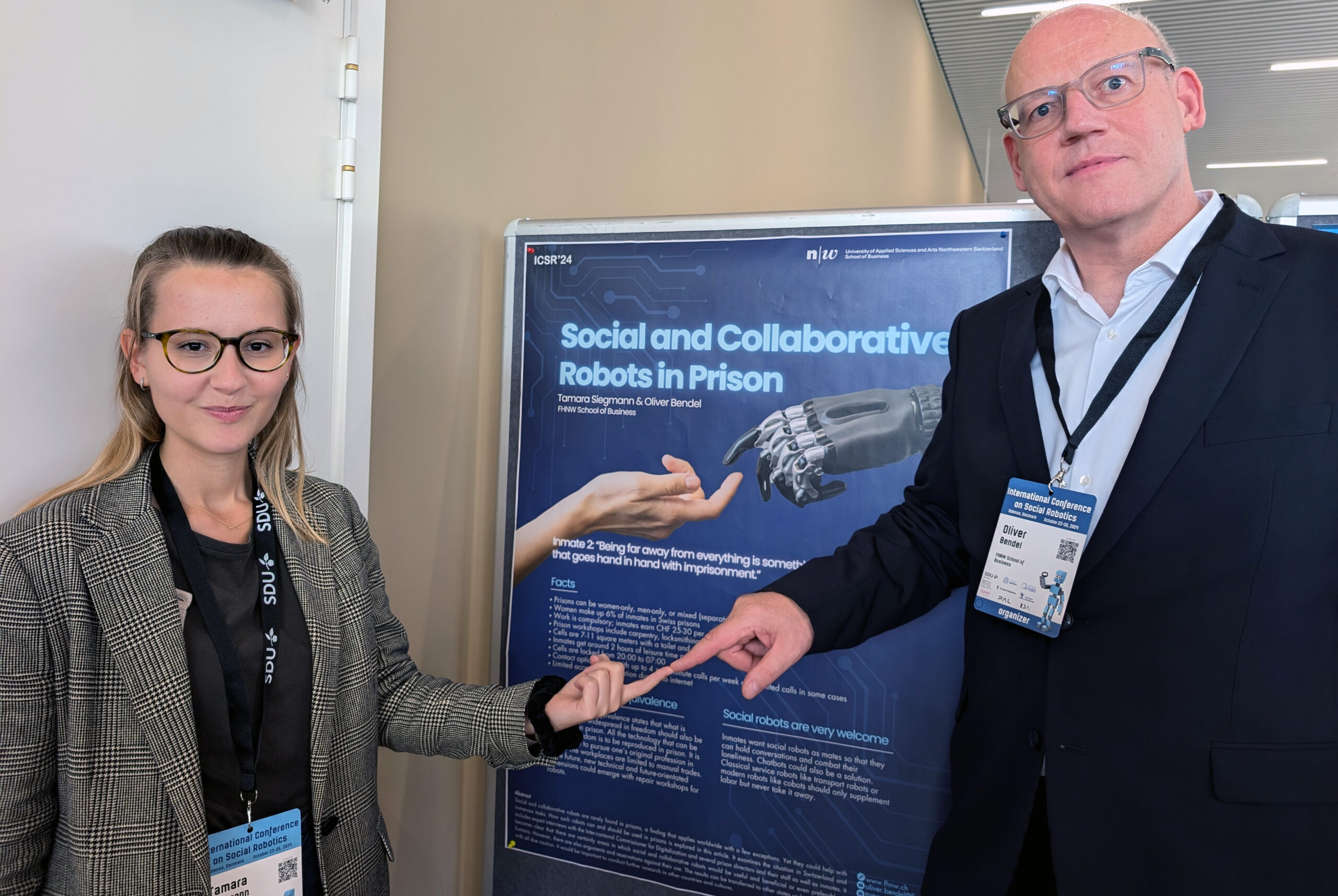
On October 24, 2024, Tamara Siegmann and Prof. Dr. Oliver Bendel (School of Business FHNW) presented their project „Robots in Prison“ at the ICSR in Odense (Denmark). They investigated whether collaborative and social robots can and should be used in prisons. One result was that modern industrial robots such as cobots and classic service robots such as transportation and cleaning robots hardly create any added value. Instead, they take work away from inmates. In contrast, social robots are conceivable and useful. They bring something to imprisonment that is common in freedom. And – an important point for resocialization – they can combat the loneliness of inmates. The International Conference on Social Robotics is the most important conference for social robotics alongside Robophilosophy. The paper „Social and Collaborative Robots in Prison“ will be published in a proceedings volume by Springer at the end of the year.
Fig.: Tamara Siegmann and Oliver Bendel at the ICSR 2024 (Photo: Katharina Kühne)
Tamara Siegmann and Prof. Dr. Oliver Bendel carried out the „Robots in Prison“ project in June and July 2024. The student, who is studying business administration at the FHNW School of Business, came up with the idea after taking an elective module on social robots with Oliver Bendel. In his paper „Love Dolls and Sex Robots in Unproven and Unexplored Fields of Application“, the philosopher of technology had already made a connection between robots and prisons, but had not systematically investigated this. They did this together with the help of expert interviews with the intercantonal commissioner for digitalization, several prison directors and employees as well as inmates. The result was the paper „Social and Collaborative Robots in Prison“, which was submitted to the ICSR 2024. The International Conference on Social Robotics is the most important conference for social robotics alongside Robophilosophy. The paper was accepted in September 2024 after a revision of the methods section, which was made more transparent and extensive and linked to a directory on GitHub. This year’s conference will take place in Odense (Denmark) from October 23 to 26. Last year it was held in Doha (Qatar) and the year before last in Florence (Italy).
The Workshop „The Social Significance of Human Effort – What Are the Parameters For Positive Human-Robot Interaction In the Context of Industry 5.0?“ – organized by the renowned Sant’Anna School of Advanced Studies (Pisa, Italy) – took place on the third day of Robophilosophy 2024. Prof. Dr. Oliver Bendel gave the lecture „Metamorphoses in the Factory. From Classic Industrial Robots over Cobots and Classic Service Robots to Universal Robots“. From the abstract: „Robots play an important role in industry. In recent years, there have been interesting innovations in production and logistics. Large classic industrial robots are turning into small cobots. Cobots become service robots. Classic service robots are discovering the factory. Metamorphoses are taking place. This talk hypothesizes that recent developments will have a significant impact on workers and work. In particular, the precursors of universal robots could significantly change the factory of the future, just as they will change society as a whole. After all, with universal robots, the boundaries between industrial and service robots are becoming increasingly blurred.“ (Website Robophilosophy 2024)
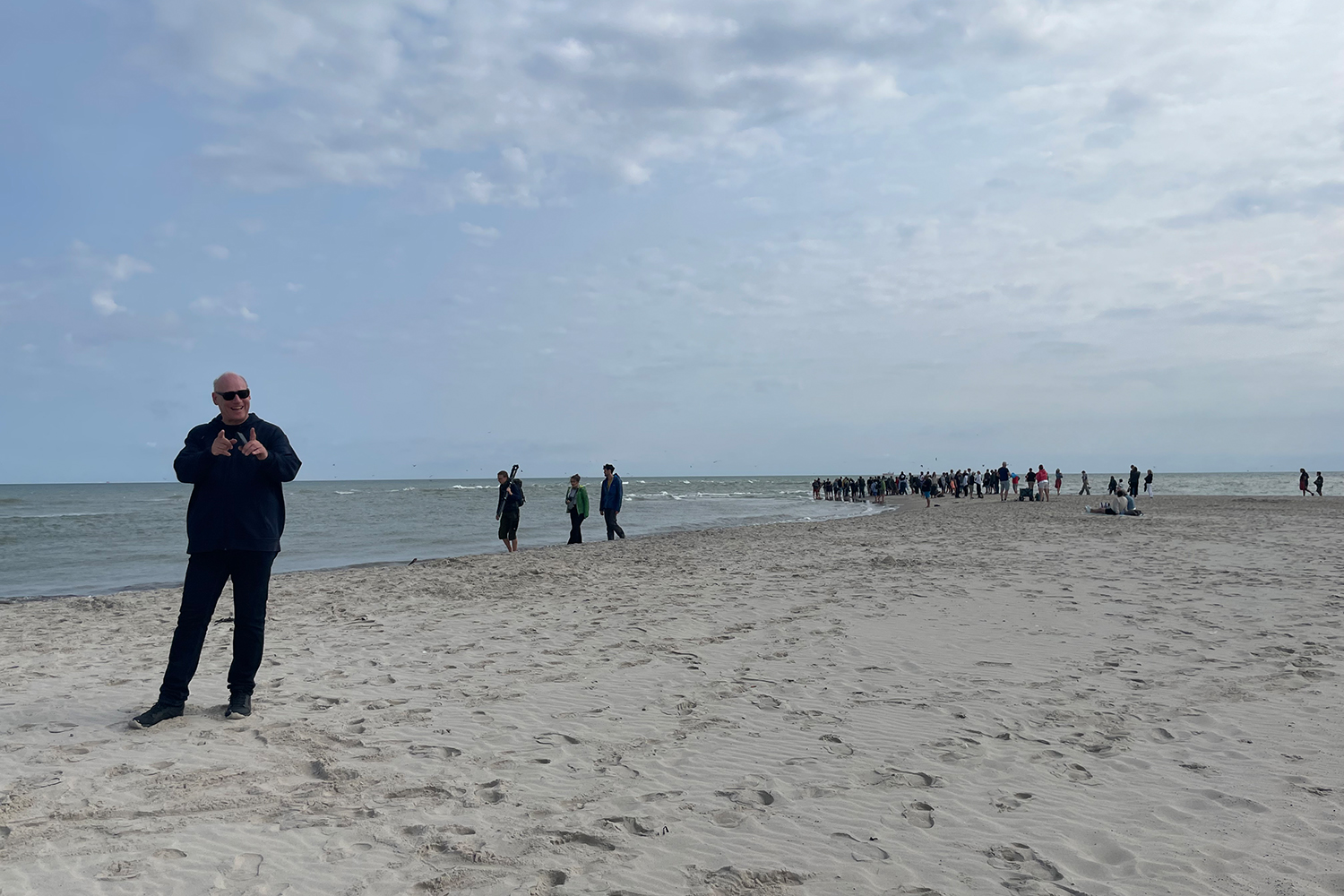
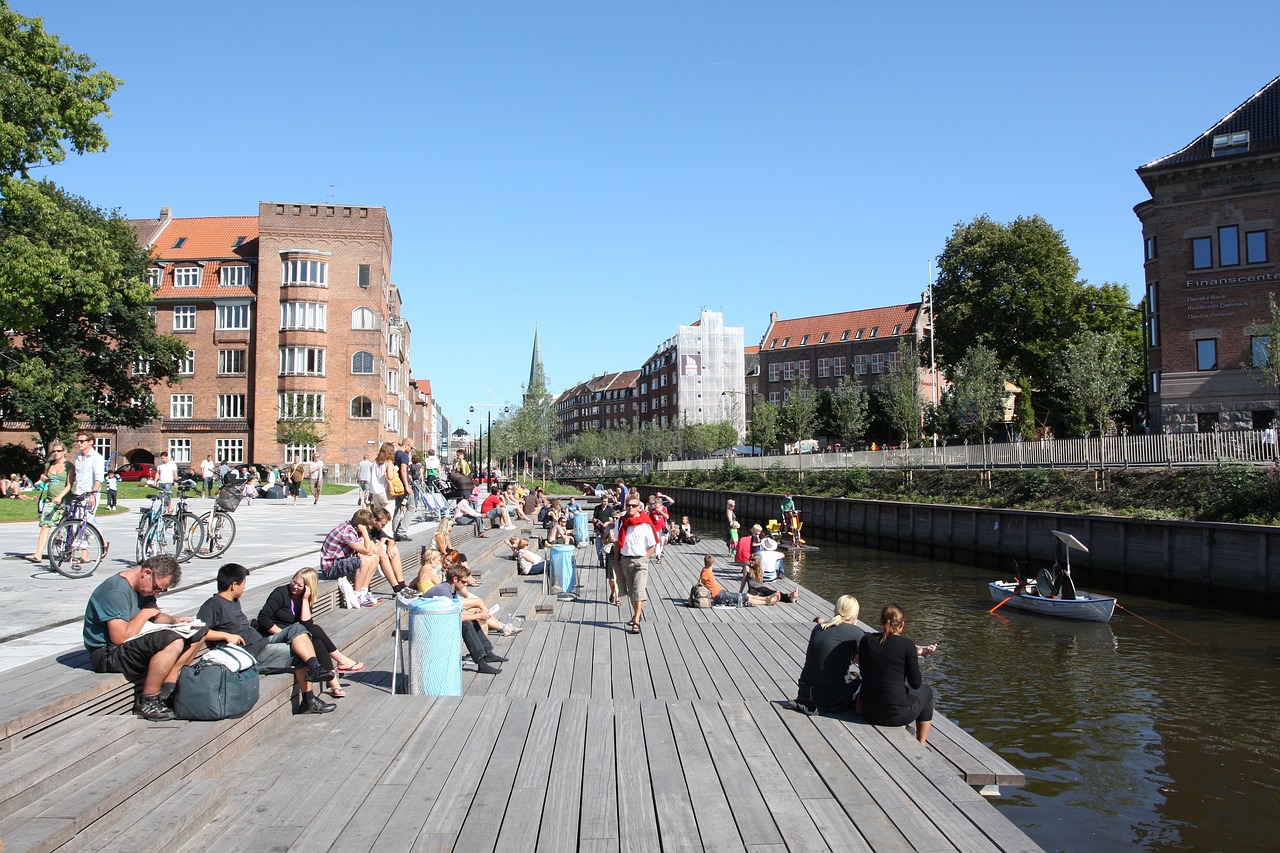
Fig.: Oliver Bendel in Denmark (Photo: Stefanie Hauske)
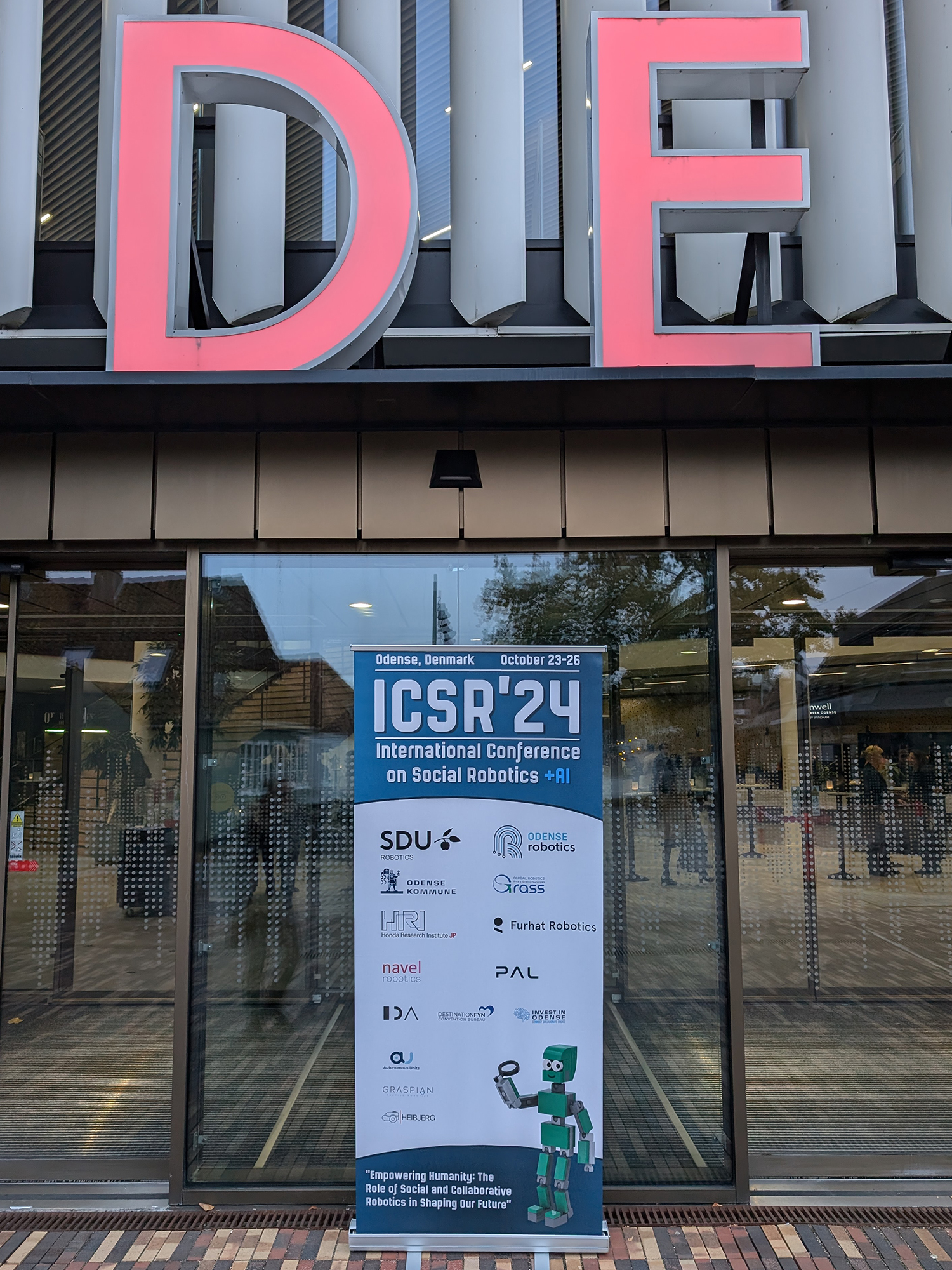
The deadline for the International Conference on Social Robotics 2024 (ICSR 2024) has been extended again. Experts in social robotics and related fields have until July 19 to submit their full papers. The prestigious event was last held in Florence (2022) and Qatar (2023). Now it enters its next round. The 16th edition will bring together researchers and practitioners working on human-robot interaction and the integration of social robots into our society. The title of the conference includes the addition „AI“. This is a clarification and demarcation that has to do with the fact that there will be two further formats with the name ICSR in 2024. ICSR’24 (ICSR + AI) will take place as a face-to-face conference in Odense, Denmark, from 23 to 26 October 2024. The theme of this year’s conference is „Empowering Humanity: The role of social and collaborative robotics in shaping our future“. The topics of the Call for Papers include „collaborative robots in service applications (in construction, agriculture, etc.)“, „Human-robot interaction and collaboration“, „Affective and cognitive sciences for socially interactive robots“, and „Context awareness, expectation, and intention understanding“. The general chairs are Oskar Palinko, University of Southern Denmark, and Leon Bodenhagen, University of Southern Denmark. More information is available at icsr2024.dk.
The deadline for the International Conference on Social Robotics 2024 (ICSR 2024) is approaching. Experts in social robotics and related fields have until July 5 to submit their full papers. The prestigious event was last held in Florence (2022) and Qatar (2023). Now it enters its next round. The 16th edition will bring together researchers and practitioners working on human-robot interaction and the integration of social robots into our society. The title of the conference includes the addition „AI“. This is a clarification and demarcation that has to do with the fact that there will be two further formats with the name ICSR in 2024. ICSR’24 (ICSR + AI) will take place as a face-to-face conference in Odense, Denmark, from 23 to 26 October 2024. The theme of this year’s conference is „Empowering Humanity: The role of social and collaborative robotics in shaping our future“. The topics of the Call for Papers include „Collaborative robots in service applications (in construction, agriculture, etc.)“, „Human-robot interaction and collaboration“, „Affective and cognitive sciences for socially interactive robots“, and „Context awareness, expectation, and intention understanding“. The general chairs are Oskar Palinko, University of Southern Denmark, and Leon Bodenhagen, University of Southern Denmark. More information is available at icsr2024.dk.
The article „‚Ick bin een Berlina‘: dialect proficiency impacts a robot’s trustworthiness and competence evaluation“ by Katharina Kühne, Erika Herbold, Oliver Bendel, Yuefang Zhou, and Martin H. Fischer has been granted the UFSKW Paper-of-the-Month Award for March 2024. All authors are researchers in the Potsdam Embodied Cognition Group (PECoG) at the University of Potsdam, with the exception of Oliver Bendel, who works at the FHNW School of Business and is an associated researcher in the group. „UFSKW“ stands for „Universitärer Forschungsschwerpunkt Kognitionswissenschaften“. It is based at the University of Potsdam. The UFSKW Paper of the Month provides a special stage for current cognitive science research at the UFSKW. It is chosen monthly by the selection committee from all submissions. The paper says about the background of the project: „Robots are increasingly used as interaction partners with humans. Social robots are designed to follow expected behavioral norms when engaging with humans and are available with different voices and even accents. Some studies suggest that people prefer robots to speak in the user’s dialect, while others indicate a preference for different dialects.“ The following results are mentioned: „We found a positive relationship between participants‘ self-reported Berlin dialect proficiency and trustworthiness in the dialect-speaking robot. Only when controlled for demographic factors, there was a positive association between participants‘ dialect proficiency, dialect performance and their assessment of robot’s competence for the standard German-speaking robot. Participants‘ age, gender, length of residency in Berlin, and device used to respond also influenced assessments. Finally, the robot’s competence positively predicted its trustworthiness.“ The article can be accessed at www.frontiersin.org/articles/10.3389/frobt.2023.1241519/full.
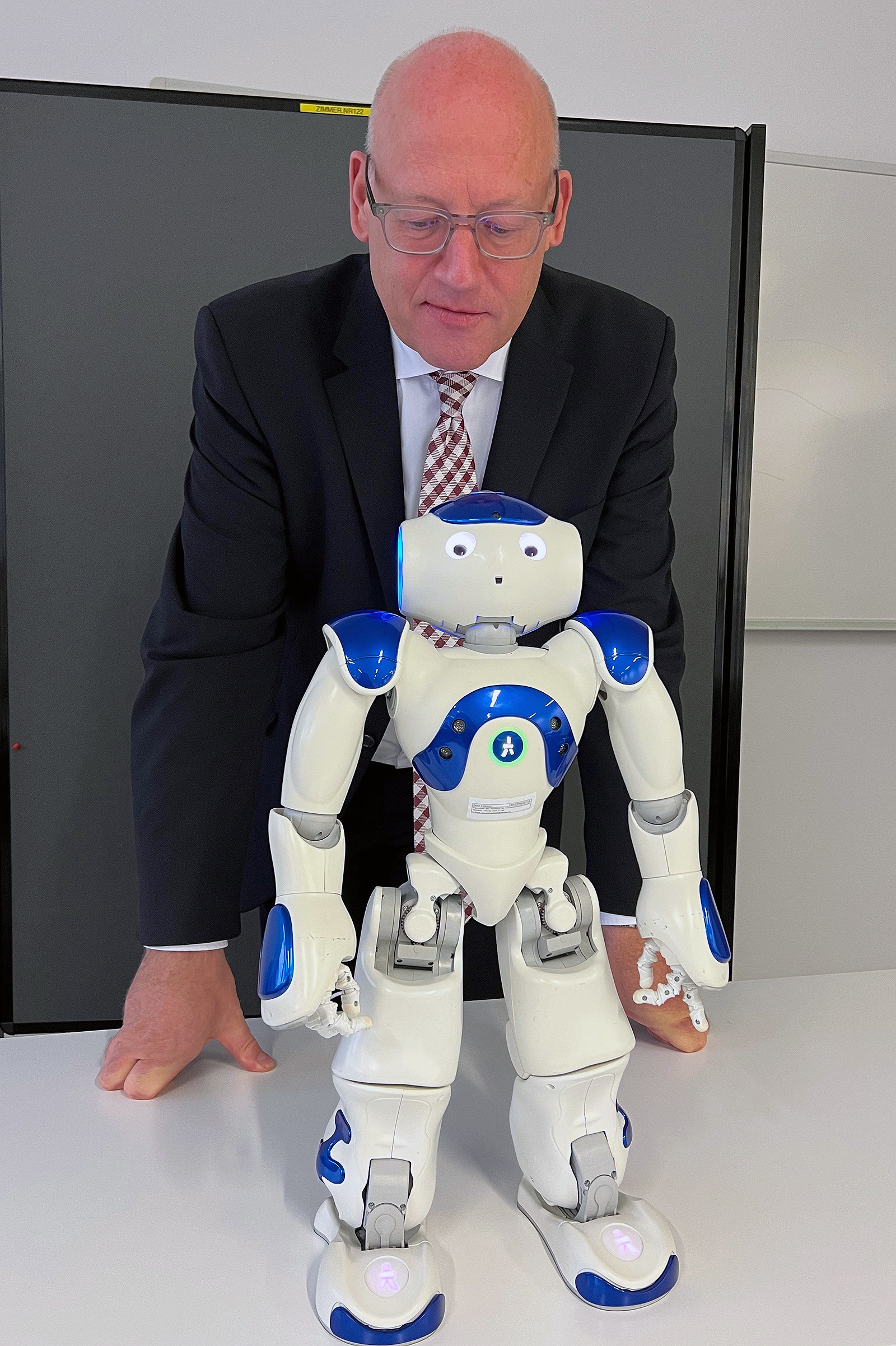
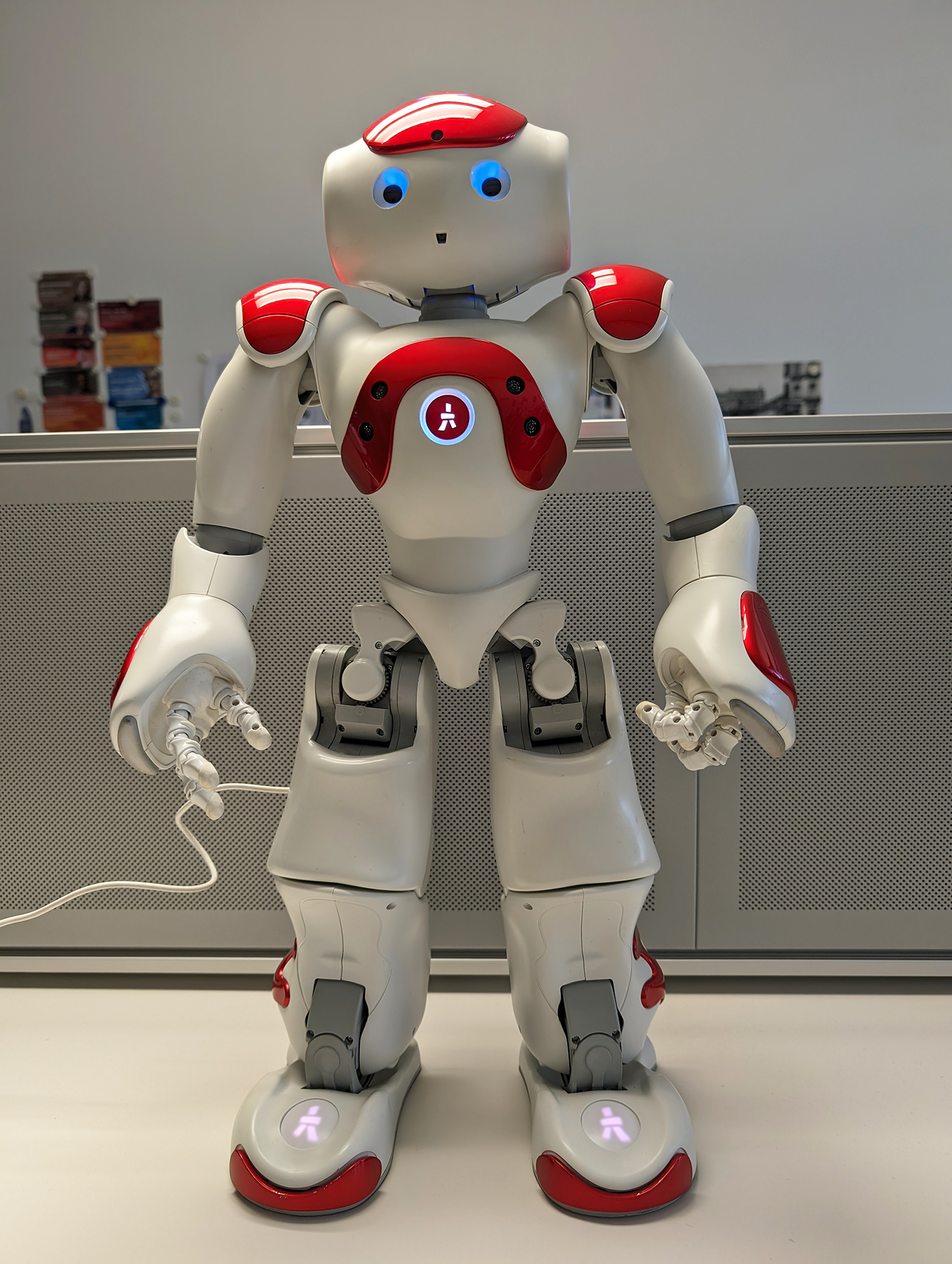
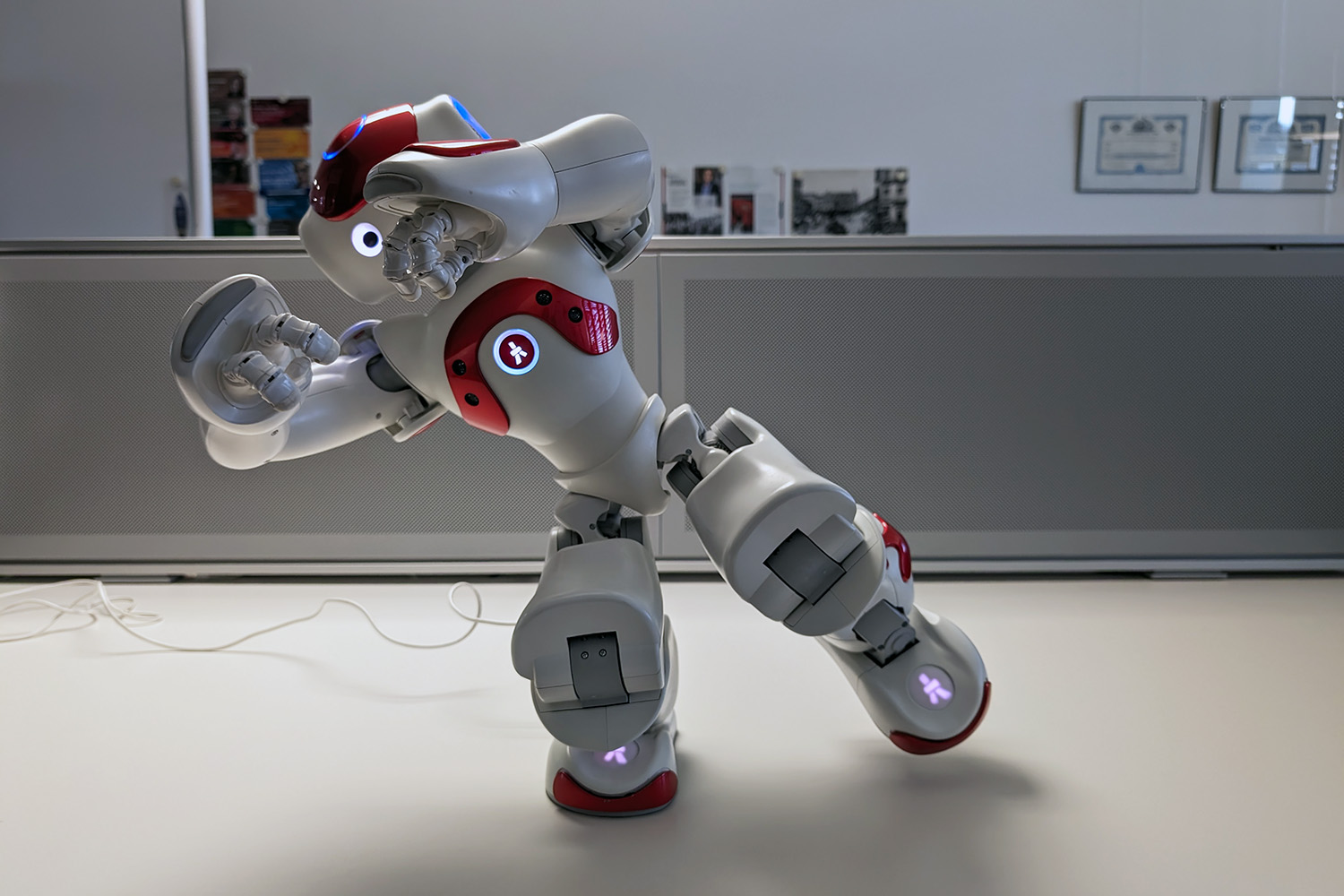
Fig.: NAO in Oliver Bendel’s office in Switzerland
In addition to the ICSR in Odense, which focuses on social robotics and artificial intelligence, there is also the ICSR in Naples this year, which organizes a robot competition. In addition, an ICSR conference focusing on biomedicine and the healthcare sector will take place in Singapore from August 16-18, 2024. The website states: „The 16th International Conference on Social Robotics + BioMed (ICSR + BioMed 2024) focuses on interdisciplinary innovation on Bio-inspired, Biomedical, and Surgical Robotics. By fostering the much-needed merging of these disciplines, together with fast emerging Biotech, the conference aims to ensure the lesson learned from these communities blend to unleash the real potential of robots. … The conference will serve as the scientific, technical, and business platform for fostering collaboration, exploration, and advancement in these cutting-edge fields. It will showcase the latest breakthroughs and methodologies, shaping the future of robotics design and applications across several sectors including Biomedical and healthcare.“ (Website ICSR) Papers must be submitted by June 5, 2024. Further information on the conference is available at robicon2024.org.
Robotics is booming, thanks in part to AI. Dozens of quadrupeds and bipeds are available, as well as numerous other social and service robots. After presenting the idea of a robot park several times since 2020, Prof. Dr. Oliver Bendel initiated the project „A Robot Park for Switzerland“ in March 2024. The purpose of a robot park is to educate the public. Everyone should have the opportunity to interact and communicate with robots and to make up his or her own mind about them. The kick-off meeting took place at the School of Business FHNW on March 22, 2024. BIT student Susmy Chakkaith could be won over. She is developing a concept with maps and other visualizations. The robot park is to be located in Switzerland and will include 100-200 robots, both industrial and service robots. Social robots and four- and two-legged friends will play a special role. It will be based on an amusement park or a zoo. Technical, economic, and ethical aspects will play a role. In particular, the concept should convincingly demonstrate how procurement, operation, maintenance, repair, etc. can be guaranteed, not least for models from China or Japan. The entire infrastructure, including network connectivity, cloud computing, power supply, etc., is also relevant. A business model will be outlined and evaluated. The results will be available in August 2024 and will be made available to the public.
Fig.: A robot park for Switzerland (Image: DALL-E 3)
The main conference of the ICSR will be held in Odense in 2024, and its full name is „16th International Conference on Social Robotics +AI“. There is also the ICSR-2024 Competition in Naples, Italy. According to the website, it is „The 1st Competition of the International Conference on Social Robotics“. The new format will take place on 30-31 May 2024 (according to a later announcement, it was postponed to May 8 and 9). The General Chair explains the intention of the event: „ICSR Competition aims at being not only a competition but an extraordinary showcase of innovation and talent in the field of robotics. This event marks the convergence of brilliance, where teams comprising students, PhD students, researchers, and esteemed professors will compete in a series of captivating competitions through a groundbreaking exploration into the realms of robotics, where cutting-edge technologies and social applications come together. In the spirit of fostering collaboration and pushing the boundaries of what is possible, our competitions will showcase the diverse capabilities of robotics.“ (Website ICSR-24 Competition) According to the organizers, teams will compete in four different competitions: the Robotic Arm Challenge, the Humanoid Robot Challenge, the Robot Design Challenge, and the Game Jam Challenge. More information is available at www.icsr2024-competition.org.
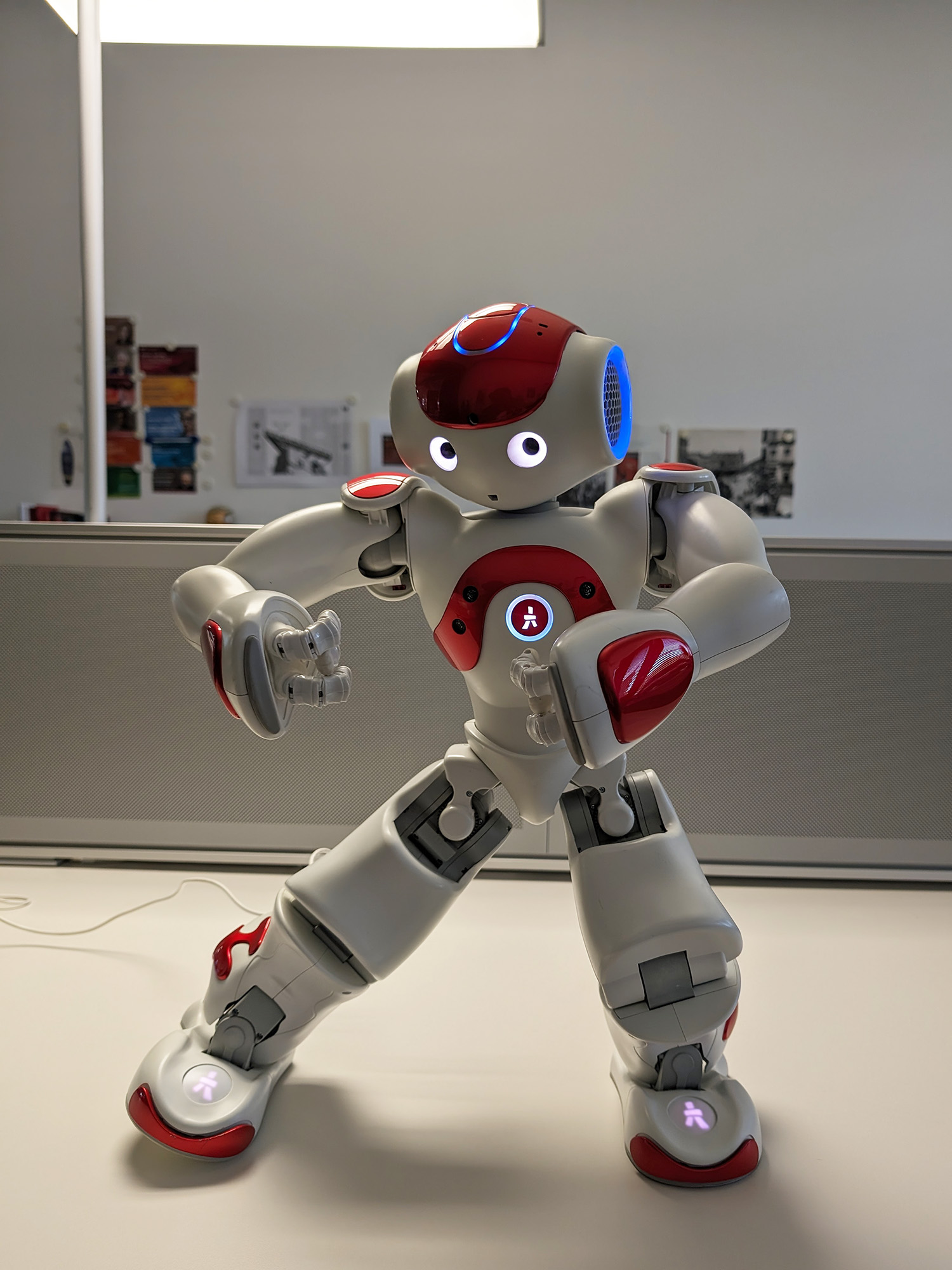
Fig.: The well-known NAO at the Brugg-Windisch campus
At the end of January 2024, the article „‚Ick bin een Berlina‘: dialect proficiency impacts a robot’s trustworthiness and competence evaluation“ was published in Frontiers in Robotics and AI. Authors are Katharina Kühne, Erika Herbold, Prof. Dr. Oliver Bendel, Dr. Yuefang Zhou, and Prof. Dr. Martin H. Fischer. With the exception of Oliver Bendel – who is a professor at the School of Business FHNW and an associated researcher in the PECoG group – all of them are members of the University of Potsdam. Newspapers and platforms from all over the world have reported on the study, including the USA, Mexico, Argentina, Chile, Puerto Rico, Scotland, and Germany. German radio stations such as MDR and BR have also presented the results. On February 1, 2024, Der Spiegel published an interview with the lead author Katharina Kühne. She is being supervised in her doctoral thesis by Prof. Dr. Martin Fischer and Prof. Dr. Oliver Bendel. The open access article can be downloaded at www.frontiersin.org/articles/10.3389/frobt.2023.1241519/full.
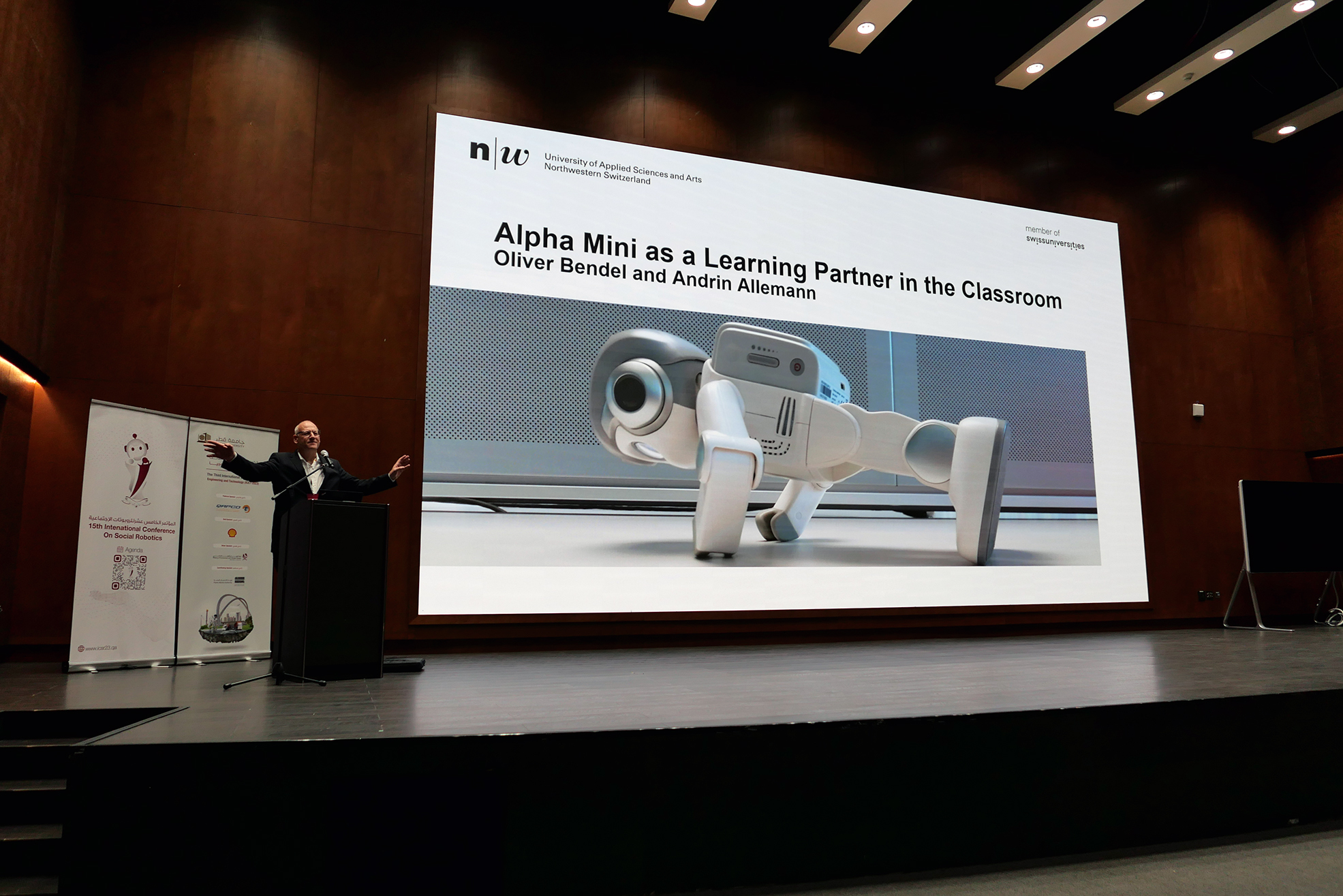
Am 6. Dezember 2023 fand im Rahmen der ICSR 2023 die Nachmittagssession „Social Robots as Advanced Educational Tools“ statt. Chairs waren Amol Deshmukh (für John-John Cabibihan) und Oliver Bendel. Rachel Love (Monash University) trug zum Thema „Teachable Robots Learn What to Say: Improving Child Engagement during Teaching Interaction“ vor. „Enhancing Hand Hygiene Practices through a Social Robot-Assisted Intervention in a Rural School in India“ war das Projekt von Amol Deshmukh (University of Glasgow). Xiaoxuan Hei (Institut Polytechnique de Paris) widmete sich dem Thema „Evaluating Students‘ Experiences in Hybrid Learning Environments: A Comparative Analysis of Kubi and Double Telepresence Robots“. Oliver Bendel (School of Business FHNW) stellte das Paper „Alpha Mini as a Learning Partner in the Classroom“ vor, das er zusammen mit Andrin Allemann geschrieben hatte. Das Programm der Konferenz kann hier heruntergeladen werden. Weitere Informationen über icsr23.qa.
Abb.: Oliver Bendel bei seinem Vortrag (Foto: Amol Deshmukh)
The upcoming international Robophilosophy Conference 2024 in Aarhus is set to tackle the socio-cultural and ethical questions arising from the use of generative multimodal AIs in social robotics. The event will bring together global scholars from humanities, social sciences, social robotics, and computer science, aiming to produce actionable insights and responsibly address the socio-cultural transformations brought about by social robotics. It is part of the Robophilosophy Conference Series, known for its large scale events for humanities research in social robotics. RP2024 highlights the urgency of closer collaboration between tech experts and societal experts to establish research-based regulations. The conference will welcome 80-100 talks in plenaries, special workshops, and parallel sessions of reviewed research papers. Virtual attendance is made possible for those unable to attend in person. Interested parties are invited to submit their papers on the conference topics. Key dates to note: Deadline for workshop/panel proposal submissions is January 31, 2024. Deadline for short papers and posters is February 15, 2024. More information at cas.au.dk/en/robophilosophy/conferences/rpc2024.