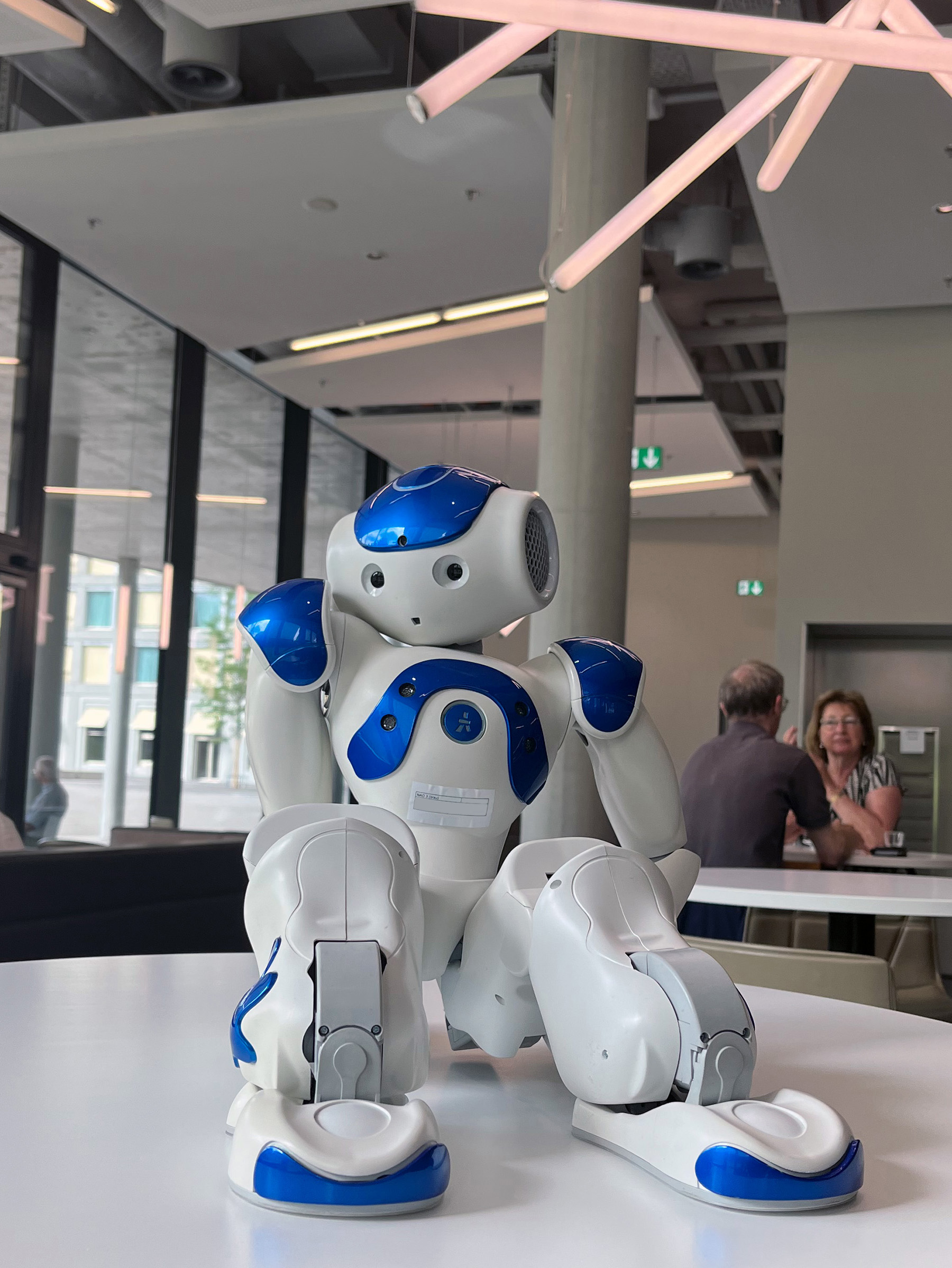
„‚Nao‘, wie die Maschine heißt, tanzt und singt mit den Kindern der inklusiven Kita im Lebenshilfehaus in Karlsruhe. Das geschieht im Rahmen eines Forschungsprojektes des Karlsruher Instituts für Technologie (KIT), das Künstliche Intelligenz und Robotik im Alltag ausprobiert. ‚Wir haben mehrere Experimente in Karlsruhe, weil wir unterschiedliche Gruppen von Nutzenden adressieren, von klein bis groß‘, erklärte KIT-Professor Tamim Asfour am Mittwoch. Bei dem Forschungsprojekt kämen Roboter unter anderem in der Kita, in der Schule, im Museum oder auch im Seniorenheim zum Einsatz.“ (Badische Zeitung, 7. Juni 2023) Mit diesen Worten beginnt ein Artikel von Valeria Nickel, der am 7. Juni 2023 in der Badischen Zeitung erschienen ist. Zu Wort kommt auch Prof. Dr. Oliver Bendel von der Hochschule für Wirtschaft FHNW, der sich seit vielen Jahren mit sozialen Robotern befasst. In einem Gespräch mit der Redakteurin von der dpa erklärte er, dass Smartphones und Tablets kleinen Kindern in ihrer Entwicklung schaden können, soziale Roboter hingegen alle Sinne ansprechen und trainieren. Den Einsatz von NAO, Moxie, QTrobot und anderen Modellen in der Kita hält er für unproblematisch, sofern sie entsprechend programmiert und Bestimmungen des Datenschutzes eingehalten werden. Insbesondere autistische Kinder können nach seiner Meinung von sozialen Robotern profitieren. Der Artikel ist über www.badische-zeitung.de/wie-roboter-in-inklusiven-kitas-helfen-koennen–266860715.html verfügbar.
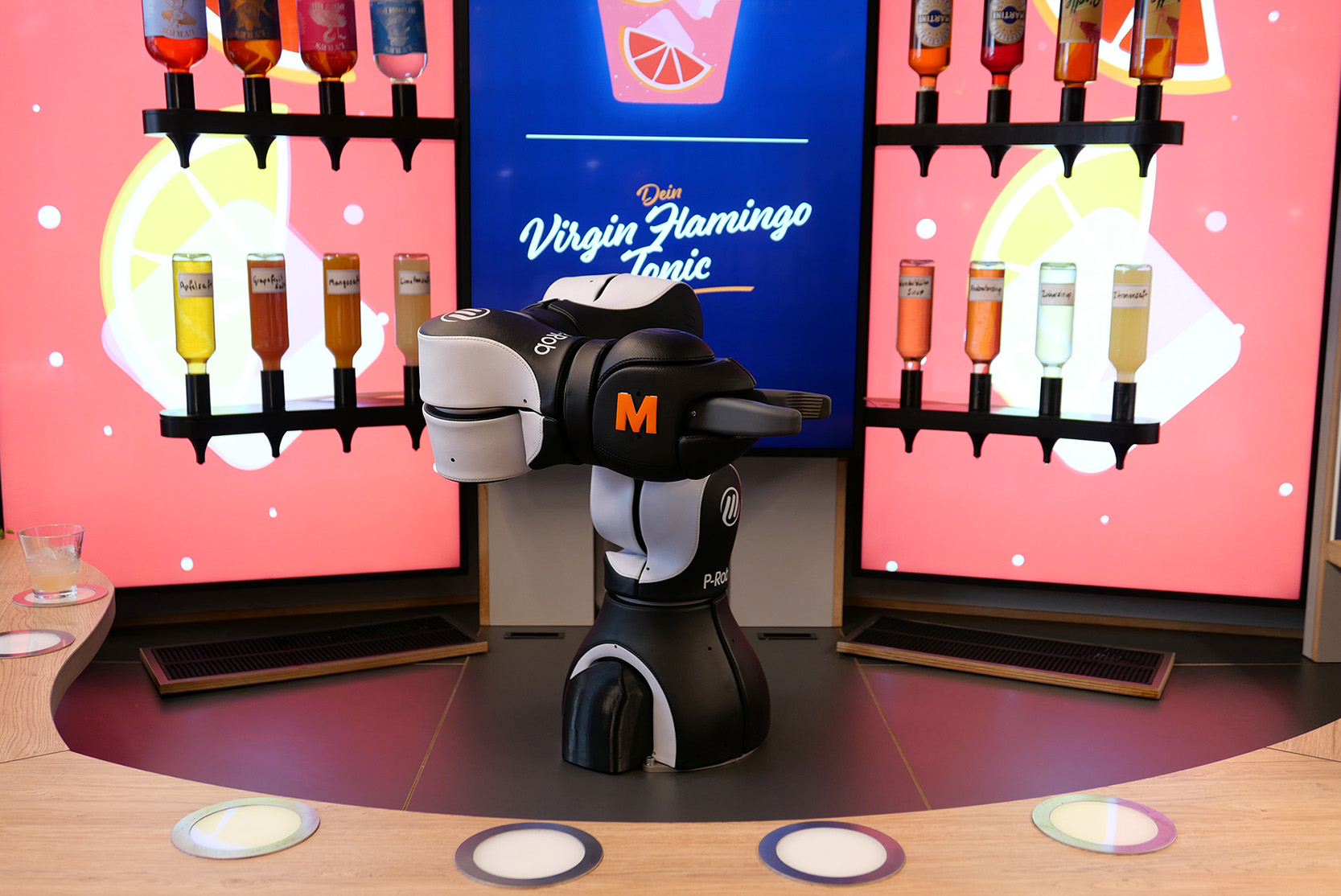
Bar robots are mostly cobots, housed in a kiosk or behind the counter. They prepare coffee, as barista robots, or cocktails, as cocktail robots. Daily Mail Online reported on May 11, 2023: „New York City’s first coffee shop run by robot baristas is coming to Greenpoint, where a two-armed robot called ADAM will serve up potentially hundreds and hundreds of cups of coffee a day at Botbar.“ (Daily Mail Online, 11 May 2023) Two-armed bar robots are the exception so far. One of them is Toni from Makr Shakr. It accesses 158 different bottles hanging from the ceiling of the open bar and shakes and stirs the liquids. ADAM looks like an egg with a head. It has two extra-long arms with many degrees of freedom. „Beyond coffee-making, ADAM will have several other skills, including dancing for and waving at customers. The technological feat can produce up to 50 espresso drinks per hour. The new neighbor-hood haunt will also serve food.“ (Daily Mail Online, 11 May 2023) One of the few researchers investigating bar robots and other robots in the hospitality industry is Oliver Bendel. Together with Lea Peier, he presented the paper „How Can Bar Robots Enhance the Well-being of Guests?“ at the AAAI 2023 Spring Symposia in San Francisco. In it, two models developed and used in Switzerland were presented. A preprint is available here.
Am 20. Juni 2023 hält Prof. Dr. Oliver Bendel einen Onlinevortrag für LeLa, das Lernlabor Hochschuldidaktik für Digital Skills, ein Kooperationsprojekt der fünf Zürcher Hochschulen ETH Zürich, PHZH, UZH, ZHAW und ZHdK. „Ethische Implikationen generativer KI“ sind das Thema. Zunächst klärt der Technikphilosoph den Begriff der generativen KI (engl. „generative AI“). Dann stellt er aus Sicht von Informations- und Maschinenethik verschiedene Überlegungen zu diesem Bereich an, wobei er vor allem auf ChatGPT fokussiert. So ist die Frage, woher die Daten für das zugrunde liegende Sprachmodell kommen und unter welchen Bedingungen das Reinforcement Learning from Human Feedback abläuft. Zudem dürfte relevant sein, welche Daten man beim Prompt preisgibt und welche Prompts auf welche Art und Weise zurückgewiesen werden. Ein weiteres Problemfeld ist das Halluzinieren der Sprachmodelle bzw. der darauf basierenden Anwendungen. Diese verdrehen Fakten und erfinden Referenzen. Mit Visual ChatGPT soll man über Texteingaben Bilder generieren und dann einzelne Elemente editieren können. Solche und andere Bildgeneratoren wie DALL-E, Stable Diffusion und Midjourney werfen wiederum zahlreiche ethische Fragen auf. GPT-3 und GPT-4 bzw. ChatGPT sind nicht nur für bzw. als Chatbots und Contentgeneratoren relevant, sondern auch für Industrie- und Serviceroboter. In diesem Bereich hat indes vor allem das Sprachmodell PaLM-E Aufmerksamkeit erregt. Indem Bilddaten und Daten zu Zuständen und Ereignissen integriert werden, werden Virtualität und Realität verbunden. Konkret kann der Benutzer mit Hilfe eines Prompts einem Roboter eine Anweisung geben, die dieser dann in seiner Umgebung ausführt, die er vorher beobachtet hat und weiter beobachtet. Dabei sind wiederum Herausforderungen vorhanden, etwa mit Blick auf Verlässlichkeit und Haftung. Weitere Informationen zur Reihe „AI or what the ChatGPT“ über dizh.ch/event/was-sind-die-ethische-implikationen-generativer-ki/.
Abb.: Mit Midjourney erstelltes Bild einer Schnorchlerin
DeepL gilt als eines der besten Übersetzungstools der Welt. Tatsächlich schneidet es in vielen Tests und Vergleichen besser ab als Google Translate und Co. Allerdings stellt sich die Frage, welche Regeln die Firma aus Köln im Deutschen umsetzt. Wenn man einen englischen Text hat, in dem der „user“ vorkommt, kann es sein, dass dieser mit „NutzerInnen“ übersetzt wird. Dieses Wort mit Binnen-I existiert aber nicht in der deutschen Sprache. Es handelt sich um gegenderte Sprache, um eine Fantasiesprache einer bestimmten Gruppe. Der Rechtschreibrat lehnt diese Schreibweise ebenso ab wie „Nutzer*innen“, „Nutzer:innen“ oder „Nutzer_innen“. Wenn aber ein Übersetzungstool nicht der amtlichen Rechtschreibung folgt, verfehlt es letztlich seinen Sinn und Zweck. Diejenigen, die es besser wissen, müssen den Text nachkorrigieren, und diejenigen, die es nicht besser wissen, bekommen eine falsche Sprache aufgedrängt. Ähnliches lässt sich bei DeepL Write beobachten, dem Redigiertool der gleichen Firma. „Die Ärzt*innen“ wurde bei einem Test als korrekt angesehen, obwohl diese Schreibweise in der amtlich fixierten Sprache nicht existiert. Erst als zweite Alternative wurde „Ärztinnen und Ärzte“ unterbreitet. Hier wäre übrigens „Ärzte und Ärztinnen“ vorzuziehen, wenn man zuerst die am wenigsten komplexe Form aufführen will. Ob sich das deutsche Unternehmen mit seiner politisch-moralischen Positionierung einen Gefallen tut, darf bezweifelt werden. Dass es alles andere als professionell verfährt, ist offensichtlich.
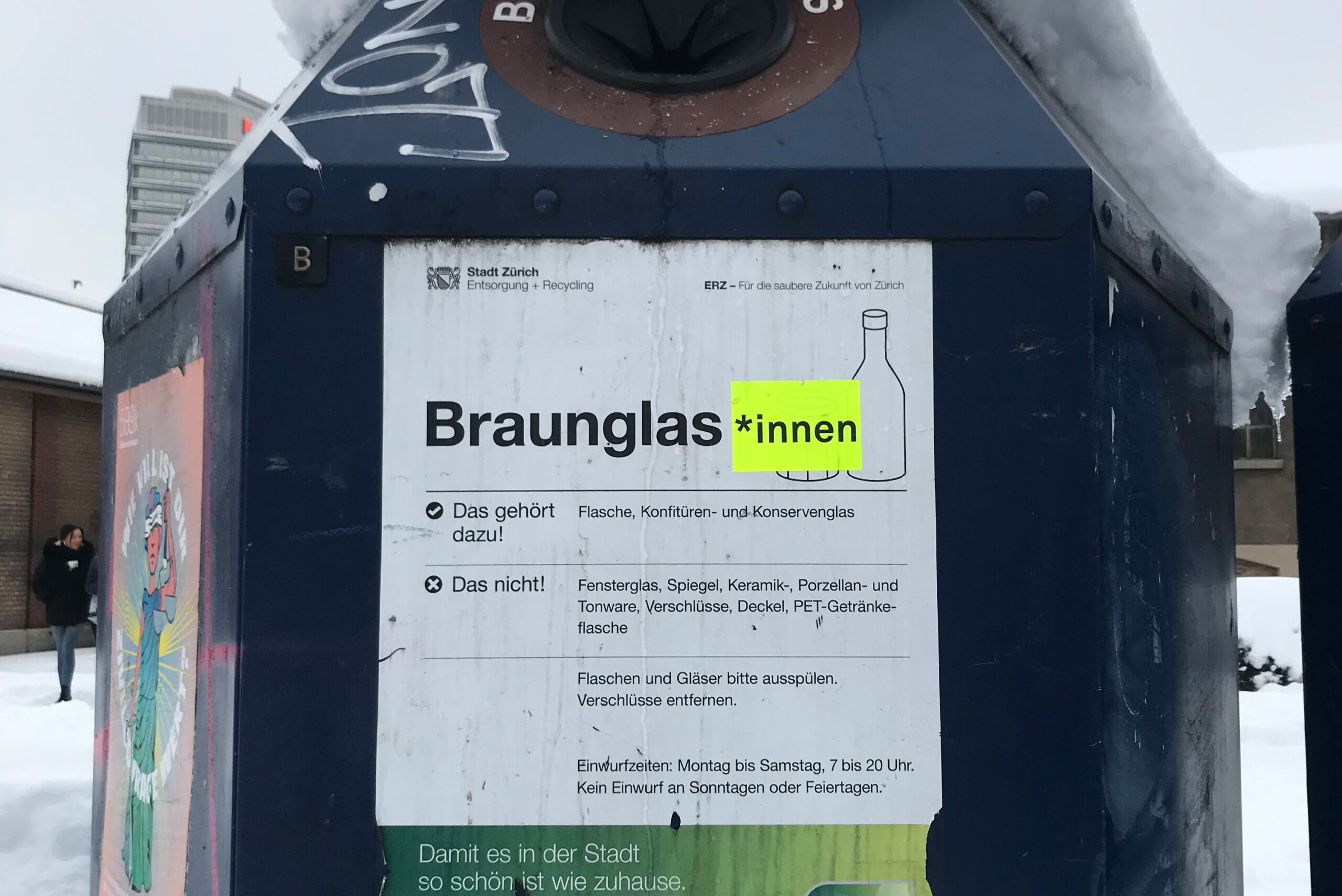
Abb.: Ein scherzhaft verwendeter Genderstern in Zürich
Stefan Sommer von der Süddeutschen Zeitung hat Prof. Dr. Oliver Bendel Fragen zu Hologrammen gestellt, die Tote auf Bühnen und in Filmen „lebendig“ machen sollen, und zu Apps, mit denen man sich und andere verewigen kann. Einführend bemerkte der Technikphilosoph zu den Hologrammen: „Meist handelt es sich um Projektionen, wobei man durchsichtige Vorhänge, Glas, Metall bzw. mit Metall beschichtete Oberflächen verwendet. Ich nenne sie auch Pseudohologramme oder Quasihologramme. Grundsätzlich hat man den Eindruck, dass sich ein Körper im Raum befindet. Sehr bekannt sind die Pseudohologramme von Tupac und Hatsune Miku. Der Unterschied ist, dass der Rapper verstorben war und durch die Technologie ‚wiederbelebt‘ wurde, Hatsune Miku aber nie gelebt hat – man hat zuerst ihre Stimme erfunden und später ergänzt durch das Pseudohologramm. Bei ABBA liegt der Fall wiederum anders. Die Mitglieder leben noch, haben sich aber unsterblich gemacht, wiederum mit Pseudohologrammen, die in einer speziell dafür konstruierten Bühne in London erscheinen. Ich habe eines der Konzerte besucht. Die Wirkung ist immens. Es sind alte Fans vor Ort, die spätestens bei ‚Dancing Queen‘ ihre Rollatoren wegwerfen und zu tanzen beginnen.“ Es folgten weitere Ausführungen zu den Apps und zum digitalen Nachlass. Mehrere Statements wurden für den Artikel „Jung, erfolgreich, tot.“ verwendet, der am 1. Juni 2023 im Onlinemagazin Jetzt der Süddeutschen Zeitung erschienen ist.
„In seiner Arbeit beschäftigt er sich mit dem Zusammenleben von sozialen Robotern mit Menschen und mit dem Potenzial von künstlicher Intelligenz. Auf seinem Gebiet ist er eine Autorität.“ (Website SRF) Mit diesen Worten wird vom Schweizer Radio und Fernsehen (SRF) eine Sendung mit Prof. Dr. Oliver Bendel aus Zürich angekündigt. Es geht darin um „Chancen und Grenzen von Pflege- und Sexrobotern“. „Der Professor für Maschinen- und Roboterethik an der Fachhochschule Nordwestschweiz, Oliver Bendel, erzählt im Gespräch ‚Gast am Mittag‘ um 13 Uhr, warum es Umarmungsroboter braucht, was junge Männer an Sexrobotern, die aussehen wie Feen, anzieht und warum er eine Patientenverfügung zum Einsatz von Therapierobotern erstellt hat. Das Gespräch führt Sandra Schiess.“ (Website SRF) „Gast am Mittag“ mit Prof. Dr. Oliver Bendel läuft am 29. Mai 2023 auf SRF 1. Zusätzlich erscheint an diesem Tag ein Interview mit ihm in schriftlicher Form auf der Website.
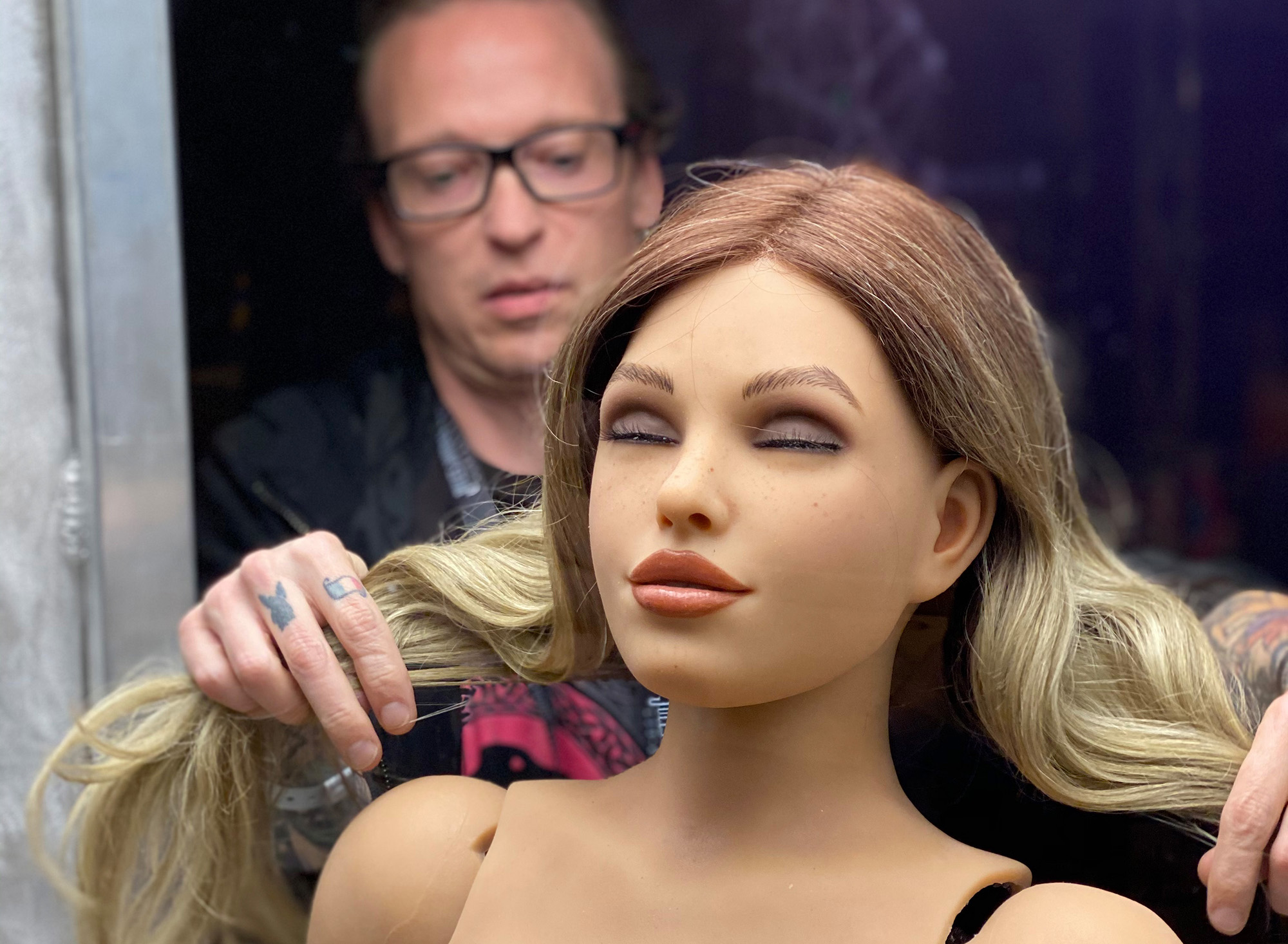
Abb.: Der Gründer von Abyss Creations mit seiner Harmony (Foto: Realbotix)
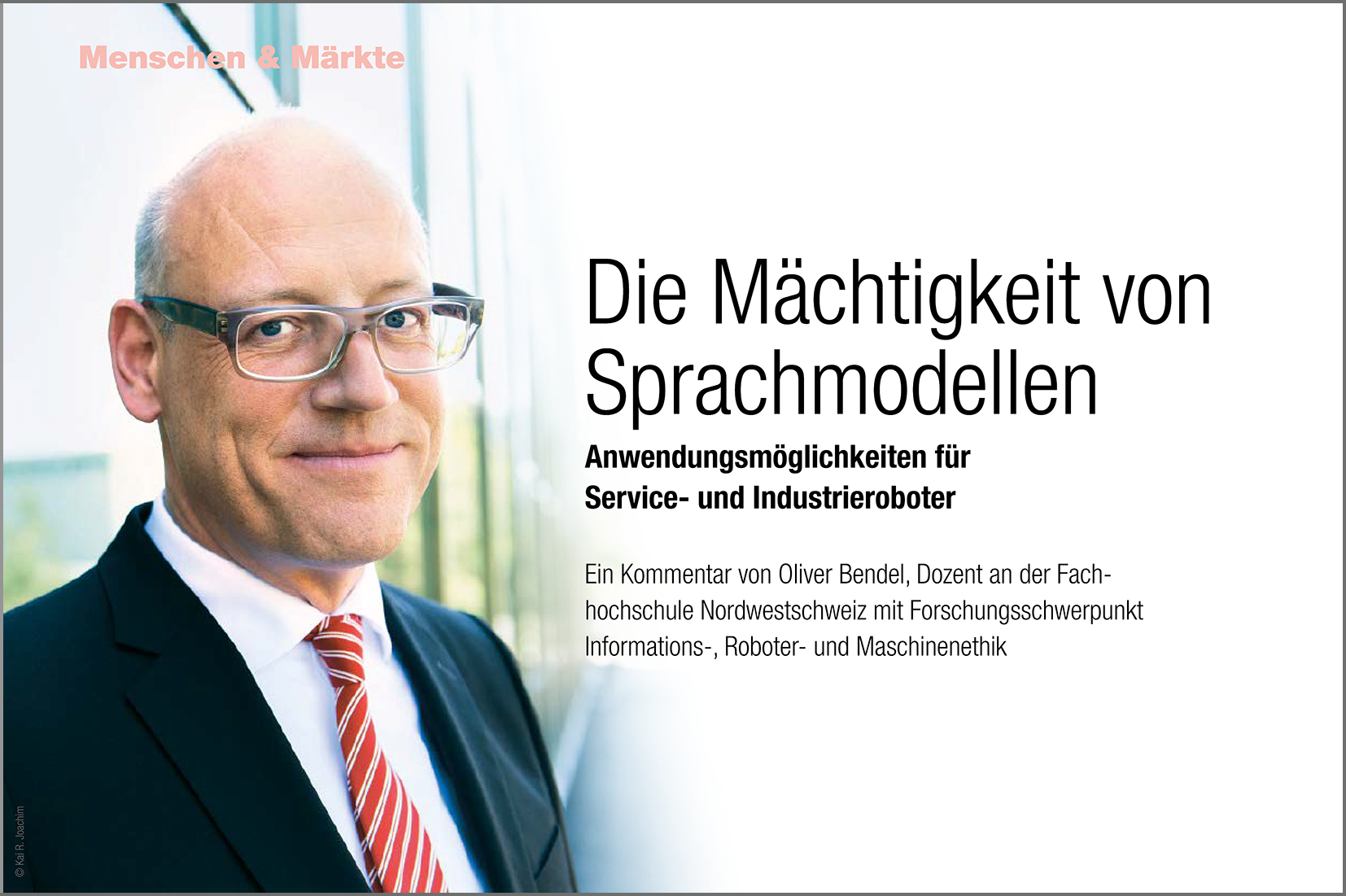
Am 26. Mai 2023 ist Heft 4/2023 der Zeitschrift messtec drives Automation erschienen. Darin enthalten ist der Beitrag „Die Mächtigkeit von Sprachmodellen“ von Prof. Dr. Oliver Bendel. Er geht auf Anwendungen ein, die man noch wenig kennt, die aber relevant sein werden für Service- und Industrieroboter und für Brain-Computer-Interfaces. In diesem Bereich hat vor allem das Sprachmodell PaLM-E für Aufmerksamkeit gesorgt. Indem Bilddaten und Daten zu Zuständen und Ereignissen integriert werden, werden Virtualität und Realität miteinander verbunden. Konkret kann der Benutzer mit Hilfe eines Prompts einem Roboter eine Anweisung geben, die dieser dann in seiner Umgebung ausführt, die er vorher beobachtet hat und weiter beobachtet. Aber nicht nur Google und TU Berlin forschen auf diesem Gebiet – in dem Paper „ChatGPT for Robotics“ hat auch Microsoft erste Ergebnisse vorgestellt. Sprachmodelle mit solchen Wahrnehmungs- und Steuerungsmöglichkeiten wären interessant für Lio und Optimus oder für soziale Roboter im Bildungsbereich, die nicht nur kommunizieren, sondern in vielfältiger Weise interagieren. Wichtig ist, dass den Fähigkeiten bei der Wahrnehmung und Steuerung entsprechende Fähigkeiten der Motorik gegenüberstehen. Der Zweiseiter kann über www.wileyindustrynews.com/messtec-drives-automation/messtec-drives-automation-04-23 heruntergeladen werden.
Abb.: Ein Ausschnitt aus der ersten Seite des Artikels
Conversational Agents sind seit einem Vierteljahrhundert ein Forschungsgegenstand von Prof. Dr. Oliver Bendel. Ihnen widmete er seine Doktorarbeit an der Universität St. Gallen. An der Hochschule für Wirtschaft FHNW entstanden sie von 2012 bis 2022 vor allem im Kontext der Maschinenethik und Sozialen Robotik. Der Technikphilosoph widmet sich nun verstärkt toten, ausgestorbenen und gefährdeten Sprachen. Nach @ve (2022), einem auf GPT-3 basierenden Chatbot für Latein, startete im März 2023 ein weiteres Projekt. Entwickelt wird der Chatbot @llegra von Dalil Jabou für das rätoromanische Idiom Vallader, das im Unterengadin zwischen Martina im Nordosten und Zernez im Südwesten sowie im Val Müstair auftritt und gefährdet ist. Der Benutzer kann Text eintippen und bekommt Text ausgegeben. Zudem spricht @llegra mit Hilfe eines Text-to-Speech-Systems der Firma SlowSoft, die das Projekt unterstützt. Das Sprachmodell GPT-3 brachte eher unbefriedigende Ergebnisse. Der Durchbruch kam dann mit der Verwendung von GPT-4. Die Wissensbasis wurde mit Hilfe von vier Kinderbüchern auf Vallader ergänzt. Das Projekt wird im August 2023 abgeschlossen. Die Ergebnisse werden danach veröffentlicht.
Die Shift, eine Tagung zu Fragen von Informations-, Roboter- und KI-Ethik, fand am 20. April 2023 zum fünften Mal statt. Initiatorin und Organisatorin ist Cornelia Diethelm. Moderatorin war wieder Patrizia Laeri. Die Keynote hielt Prof. Dr. Oliver Bendel aus Zürich. Das Video dazu ist am 19. Mai 2023 erschienen. Oliver Bendel ging zunächst auf soziale Roboter ein und auf die Disziplinen Künstliche Intelligenz, Maschinenethik und Maschinelles Bewusstsein. Dann beschrieb er mehrere soziale Roboter, die auch als Serviceroboter im engeren Sinne eingesetzt werden. Auf dieser empirischen Basis stellte er ethische Überlegungen an. Am Ende behandelte er Sprachmodelle wie GPT-3 bzw. GPT-4 und PaLM-E. Er zeigte, wie soziale Roboter und Serviceroboter von diesen profitieren können, in ihrer Sprachfähigkeit und bei ihrer Wahrnehmung der Welt. Auch Ansätze der Maschinenethik waren ein Thema, von der Einpflanzung moralischer Regeln bis hin zur Nutzung von Moralmenüs. Das Video kann hier aufgerufen werden.
Abb.: Oliver Bendel bei der Shift (Foto: Shift/Louis Rafael)
„Der Optimus ist wieder da: Tesla hat eine überarbeitete Version des humanoiden Roboters vorgestellt. Sie soll über mehr Fähigkeiten verfügen. Ein von Tesla zum Anleger-Meeting veröffentlichtes Video zeigt fünf der Roboter in Aktion. Die Roboter laufen deutlich sicherer als zuvor und sind auch zu feinfühligen Interaktionen fähig.“ (Golem, 17. Mai 2023) Dies berichtete Golem am 17. Mai 2023. Der Redakteur bezieht sich auf eine frühere Demonstration, wo Optimus sehr unsicher unterwegs war. Die Fortschritte werden mit der Verbesserung der Aktoren und mit der Unterstützung durch Menschen erklärt: „Diese lernen laut dem Video die Roboter mit Hilfe von Datenhandschuhen, Sensoren und Kameras an.“ (Golem, 17. Mai 2023) Das Design dürfte nach wie vor viele Benutzer abschrecken. Insbesondere der Kopf ohne Gesicht ist gewöhnungsbedürftig. Vielleicht werden Augen und Mund samt Mimik aber später digital umgesetzt. Das Video kann hier aufgerufen werden.
On 5 June 2023, Prof. Dr. Oliver Bendel will give a talk on „Care robots from an ethical perspective“ at the Institute of Ethics, History and Humanities (iEH2) of the University of Geneva. The event will take place in room A04.2910 (CMU). Care and therapy robots can be understood as service robots and in many cases also as social robots. In the talk by Professor Dr. Oliver Bendel from Zurich, the goals, tasks, and characteristics will be clarified and, based on this, considerations will be made from the perspective of ethics. In the end, it should become clear which types of robots and prototypes or products exist in the healthcare sector, what purposes they serve, what functions they assume, and what implications and consequences this has for individuals and society. Care robots may contribute to personal autonomy while weakening informational autonomy. Therapy robots may enhance personal performance and satisfaction, but in individual cases they may also violate human dignity. It is important to design service robots and social robots in the healthcare sector in such a way that they meet as many requirements and needs as possible and are useful tools for caregivers and those in need of care. Disciplines such as machine ethics can help in this regard. Prof. Dr. Oliver Bendel is the editor of several relevant standard works, including „Pflegeroboter“ („Care Robots“, 2018) and „Soziale Roboter“ („Social Robots“, 2021). He has also advised the German Bundestag on this topic. More information via www.unige.ch.
Fig.: Bendel as scientific director of the 23rd Berlin Colloquium (Photo: Daimler und Benz Stiftung)
Die Maschinenethik kennt ganz unterschiedliche Ansätze. Man kann moralische Regeln und Werte in Systeme und Maschinen einpflanzen. Sie können vom Entwickler stammen oder von einer Ethikkommission. Sie können auch in einem mehrstufigen Verfahren von verschiedenen Interessengruppen entwickelt worden sein. Die Maschinen halten sich strikt an die moralischen Regeln und Werte – dies ist der Normalfall und der Fall bei Maschinen wie GOODBOT, BESTBOT oder HAPPY HEDGEHOG – oder passen sie selbst an. Wenn sie sie selbst anpassen, kann Machine Learning zum Einsatz kommen. Eine Ergänzung der klassischen moralischen Maschinen ist das Moralmenü, das dem Benutzer oder Besitzer die Auswahl verschiedener Optionen erlaubt. Bei Sprachmodellen gibt es ebenfalls mehrere Umsetzungen. Dass sie bestimmte Prompts verweigern, wurde ihnen i.d.R. einprogrammiert. Dass sie in eine bestimmte Richtung tendieren, etwa was Atomkraft angeht, kann am Reinforcement Learning from Human Feedback (RLFH) liegen. Das Unternehmen Anthropic, gegründet von ehemaligen Open-AI-Mitarbeitern, trainiert laut The Verge seinen Chatbot Claude – der auf einem Sprachmodell basiert – mit Hilfe von ethischen Prinzipien. Es greift u.a. auf die Allgemeine Erklärung der Menschenrechte der Vereinten Nationen und die Nutzungsbedingungen von Apple zurück. Es handelt sich laut Mitgründer Jared Kaplan um Constitutional AI – im Grunde nichts anderes als eine spezifische Methode der Maschinenethik. Er gibt zur Auskunft: „The basic idea is that instead of asking a person to decide which response they prefer [with RLHF], you can ask a version of the large language model, ‚which response is more in accord with a given principle?'“ (The Verge, 9 May 2023) Im Paper „Constitutional AI: Harmlessness from AI Feedback“ erklärt eine Forschergruppe um Yuntao Bai: „We experiment with methods for training a harmless AI assistant through self-improvement, without any human labels identifying harmful outputs. The only human oversight is provided through a list of rules or principles, and so we refer to the method as ‚Constitutional AI‘. The process involves both a supervised learning and a reinforcement learning phase.“ Das Paper erwähnt Maschinenethik nicht einmal – aber diese Disziplin wird durch die Anwendung bei Sprachmodellen einen weiteren Aufschwung erleben.
Abb.: Anthropic sitzt in San Francisco (Foto: Stefanie Hauske)
In January 2023, Google announced MusicLM, an experimental AI tool that can turn text descriptions (text prompts) into music. From 10 May 2023, one can sign up to try it out in the so-called AI Test Kitchen. The company gives examples of how to use the programme on its blog: „Just type in a prompt like ’soulful jazz for a dinner party‘ and MusicLM will create two versions of the song for you. You can listen to both and give a trophy to the track you like better, which will help improve the model.“ (Google Blog, 10 May 2023) Not all types of music will be possible. TechCrunch wrote in an article: „The version of MusicLM in AI Test Kitchen won’t generate music with specific artists or vocals.“ (TechCrunch, 10 May 2023) This is certainly to avoid legal problems. An AI-generated song in the style of The Weeknd and Drake recently caused a stir. It is likely that AI-generated music will be heard around the world. Whether this will be to our advantage remains to be seen.
Fig.: AI-generated music will be heard around the world
Die interdisziplinäre Tagung „KI – Text und Geltung. Wie verändern KI-Textgeneratoren wissenschaftliche Diskurse?“ findet am 25. und 26. August 2023 an der TU Darmstadt statt. Der Call for Papers wirft Fragen dieser Art auf: „Worin unterscheiden sich menschengemachte und computergenerierte Texte und welche Geltungsansprüche können jeweils erhoben, bestritten oder eingelöst werden? Werden bestimmte Textverständnisse dadurch überlagert, dass Menschen der KI die Fähigkeit zur Textgenerierung zuschreiben? Produziert ein wissenschaftlicher Diskurs über KI-Textgeneratoren dieselbe Art von Texten wie die Generatoren selbst? Was erwarten, befürchten und erhoffen sich die einzelnen Wissenschaften, wenn in ihren Diskursen Texte rezipiert und berücksichtigt werden, die mit KI-gestützten Werkzeugen erstellt wurden? Und nicht zuletzt: Welche Konsequenzen ergeben sich daraus für die Kriterien von Wissenschaftlichkeit und Urheberschaft?“ (CfP) Abstracts zur Tagung bzw. zum Tagungsband sind in deutscher oder englischer Sprache im Umfang von max. 250 Wörtern zu verfassen und bis zum 15. Juni 2023 einzureichen. Eine Mitteilung über Annahme oder Ablehnung erfolgt bis zum 23. Juni 2023. Für die Präsentation auf der Tagung stehen jeweils 20 Minuten sowie 10 Minuten zur Diskussion zur Verfügung. Der CfP ist hier verfügbar.
Hawaiian Host is the largest manufacturer of chocolate-covered macadamias in the world, with millions of boxes of the treats distributed around the globe. According to its website, the company „combines premium ingredients – handcrafted milk chocolate, dark chocolate, Hawaiian honey, Kona coffee, to name a few – with dry-roasted macadamias to create its signature delights“ (Website Hawaiian Host). Hawaiian Host has now taken a big step forward in packaging. Watch a video of Chris Rabago getting his first look at Cama’s new equipment. The robot, which is protected by glass walls in the video, allows the chocolate-covered macadamias to be packaged at high speed in a small space. This is important because rental and construction costs in Honolulu are very high and factory expansions are difficult and expensive. It’s actually several robots working together – it’s very effective and looks fascinating. How many workers this new level of automation will replace is unknown.
Mauna Kea volcano is the highest mountain in the world, measured from the bottom of the sea. It is considered a sacred place in the culture of Hawai’i. In this context, the famous and important telescopes on the top are always the cause of bitter disputes. The operation of drones is also not allowed on the mountain. However, a small robot made it on it in 2008. This was reported by several media outlets, including Science Daily. „During the field experiment, Nov. 1-13, the robot called Scarab will simulate a lunar mission to extract water, hydrogen, oxygen and other compounds that could potentially be mined for use by future lunar explorers. The four-wheeled robot will trek to different sites, using a Canadian-built drill to obtain a one-meter geologic core at each site. Each core will be chemically analyzed by on-board instruments developed by NASA.“ (Science Daily, 14 October 2008) After that, it became increasingly difficult for robots to climb Mauna Kea. It is easier for scientists and tourists, who only need 4-wheel drive and robust health.
Fig.: Oliver Bendel on the top of Mauna Kea with a few snowflakes (Photo: Stefanie Hauske)
The west coast of the Big Island is known for its beautiful white sandy beaches and coral reefs, from Honomalino Beach in the south to Hapuna beach in the north. It is now threatened by climate change, drought, fire, invasive species, and human impact. The region of Hawai’i has been classified as a vulnerable ecosystem zone. A Boeing Company describes these dangers on its website and has developed technology to counteract the dangers. The Liquid Robotics Support Operations Test and Evaluation Facility in Kawaihae, Hawai’i is the main hub for Wave Glider development, ocean testing, and regional operations, as well as the birthplace of the Wave Glider. The Wave Glider sits on the surface and is connected to another device floating in the water eight meters below it. The two look like mother whale and baby whale, except baby whale is a little off. The Wave Glider is capable of collecting and communicating ocean data in real time through unpredictable conditions for up to a year. It connects and communicates undersea data to satellites and land, creating an ocean network. The Wave Glider is designed to support a wide variety of sensors and payloads. The modular and adaptable payload design is coupled with a powerful solar power system and on-board computing environment.
The K5, a security robot, comes from Knightscope in Silicon Valley. It can be seen there regularly. It provides, e.g., security at the Stanford Shopping Center. The conical robot is autonomous. It can see, hear, and even smell smoke and gas. The classic security robot also made it to Hawaii (Hawaiian: Hawai’i), for the first time in 2021, according to the Khon2 platform: „There is a new security guard getting a lot of attention at the Financial Plaza of the Pacific in downtown Honolulu, but it is not what you would think — it is actually a robot and the newest member of Bank of Hawaii’s security force. It looks like something out of a sci-fi movie – only it is actually real. Currently, the security robot is patrolling the busy area in and around the Bank of Hawaii’s Financial Plaza on Bishop and Merchant streets. For many people, the robot is a curiosity – attracting lots of odd looks – with some people capturing video and even posing for selfies. But many others, like Nasir Randall, are not quite sure what to make of it.“ (Khon2, 28 October 2021) Security robots, along with cleaning robots and transport robots, are among the service robots that are largely error-free and already saving money. Over the next few years, they are likely to become widely used and accepted around the world.
Fig.: The K5 could also guard the Kona Joe coffee plantation on the Big Island
Cleaning robots, along with security robots and transport robots, are among the service robots that work largely error-free and are already saving costs. The Hawaii Department of Transportation Airports Division continues to modernize Daniel K. Inouye International Airport (HNL) and give HNL an open, clean feel. The modernization includes the addition of two robotic floor scrubbers to supplement custodial services. This was reported by the Hawaii Department of Transportation. „The robotic scrubbers will help us keep HNL sanitary and sparkling,“ said Ross Higashi. He is the Hawaii Department of Transportation’s deputy director of airports. „Use of this technology will also allow us to maximize available staff in maintaining our busiest airport to standards.“ (Website Hawaii Department of Transportation) Without a doubt, cleaning robots are also an option for the other islands of Hawai’i, such as the Big Island and Kaua’i. On the Big Island, there are two airports that come into question. In addition, cleaning robots could be used in the streets of Hilo. Also other service robots are entering the market that can clear beaches and lawns of litter.
Surveying and collecting rare plant species that grow on steep cliffs has been a risky business for scientists and conservationists for centuries. The world’s first aerial sampling system, which uses a robotic arm suspended from a drone, is attempting to solve this problem in Hawai’i. An article published by Mongabay magazine back in November 2022 states: „In Hawai’i’s Kaua’i island, the world’s first aerial sampling system has successfully flown into high-altitude cliff faces to cut out samples from rare plants and bring them back to a nursery. Scientists call it ‚the Mamba,‘ a cutting mechanism on a remote-controlled robotic arm suspended from a drone. The system was developed by Hawai’i-based not-for-profit conservation organization National Tropical Botanical Garden (NTBG) and Quebec-based technology company Outreach Robotics and the University of Sherbrooke in Quebec.“ (Mongabay, 9. November 2023) Ben Nyberg, the NTBG’s geographic information system and drone program coordinator, told Mongabay in an interview: „It is really unlocking a lot of areas that have previously been completely inaccessible.“ (Mongabay, 9. November 2023) Of course, criminals could also adopt the technology. But it would be almost impossible to smuggle rare plants out of Hawai’i due to strict customs controls.
Ruby Tuesday is a popular restaurant in Hawaii (Hawaiian: Hawai’i), on the island of O’ahu. The location close to the airport is not one of the most beautiful ones. The food is also not praised by everyone. But the restaurant is known for its artificial staff. „Our KEENON DINERBOT is helping the staff here deliver trays and plates, so that they can pay more attention to improving customer satisfaction.“ This is the message in a promotional video from Keenon Robotics in Singapore. The robot is a classic transport and serving robot. It has large, square blue eyes. In Europe and Asia, BellaBot is best known. It has a cat face and cat ears and is controlled via user input and voice commands. The European model Plato is also shaking up the market. Khon2, a platform from Hawaii, first reported on the new employee at Ruby Tuesday in 2022. „Staffing is such a problem now. Everything from managers down to servers and kitchen help cooks so this really helps our servers out,“ Ruby Tuesday owner Rick Nakashima told Khon2 journalists. Indeed, robots of this kind seem to be at least a band-aid for the shortage of skilled workers. Customers‘ reactions vary. Some seem to find the robots entertaining. Others say that direct contact with waiters is important to them. The restaurant emphasises that the robot is not intended to replace waiters. Rather, the robot acts as a support.
Hawaii (Hawaiian: Hawai’i) is not necessarily associated with robots. But in the larger cities, you can be sure to encounter them. There are service robots such as the Keenon Dinerbot and surgical robots such as the da Vinci Surgical System. In addition, robots are used in the wild, for example for nature conservation. The hospital group in the east of the archipelago advertises with the following words: „East Hawaii Health Clinics is excited to introduce our fully operational robotic surgery center. This state-of-the-art equipment allows us to perform minimally invasive surgeries that would otherwise require greater surgery time and recovery time. We look forward to continuing to provide East Hawaii with exceptional surgical options.“ (Website East Hawaii Health Clinics) This type of care is available in Hilo, among other places. The small town on the Big Island has the latest medical technology, such as that used in Basel and Berlin. Hilo is surrounded by tropical rainforest. Nearby are Akaka Falls and Hawai’i Volcanoes National Park. In the city itself, giant banyan trees grow. One must not forget the many homeless people who are at the end of their tether. Like California, Hawai’i has not dealt with this problem. These people will never be able to afford treatment with a surgical robot.
Fig.: Oliver Bendel at the Akaka Falls (Photo: Stefanie Hauske)