Im Future Lab „Soziale Roboter und GPTs“ am 6. Juni 2024 auf der LEARNTEC konnte man mit Navel und Alpha Mini interagieren und kommunizieren. Zuständig dafür waren Claude Toussaint von navel robotics aus München und Rainer E. Becker von BECKER ROBOTICS aus Wuppertal. Drei Runden gab es hierfür, verteilt über den ganzen Tag. Eingeleitet wurden sie mit Impulsvorträgen von Prof. Dr. Oliver Bendel von der Hochschule für Wirtschaft FHNW. Der Technikphilosoph und Wirtschaftsinformatiker stellte sein Fünf-Dimensionen-Modell für soziale Roboter vor, und er ging auf das Projekt „Alpha Mini für die Schule“ ein. Er präsentierte zudem @llegra, einen Chatbot, der Vallader (ein Idiom des Rätoromanischen) beherrscht, und Social Robotics Girl, ein GPT, das er in seinem Unterricht einsetzt. Mit am Stand waren auch Sünne Eichler und Sonja Rapp vom Steinbeis-Transfer-Institut. Sünne Eichler prägt die LEARNTEC seit Jahren und ist Mitglied des Kongresskomitees.
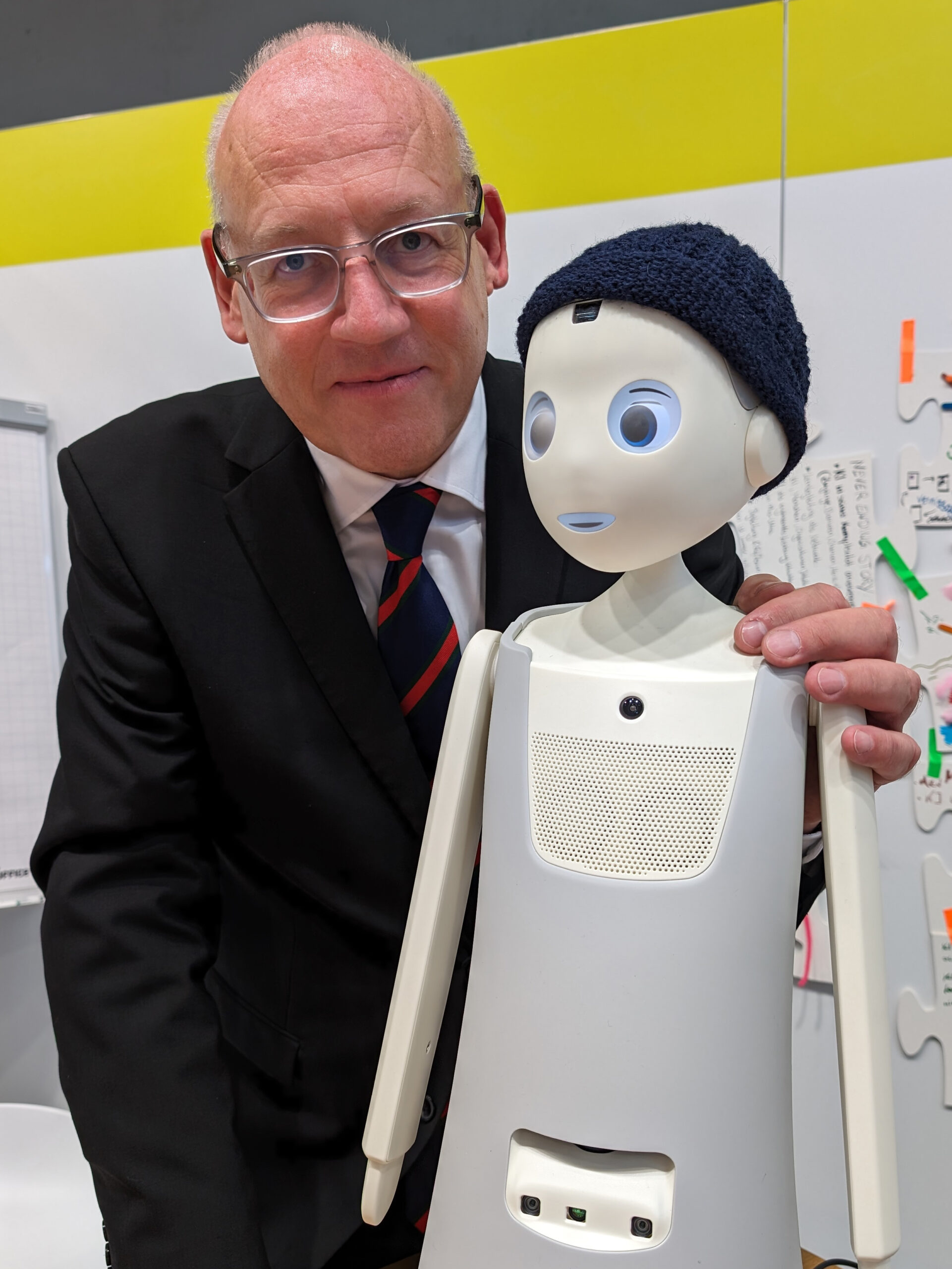
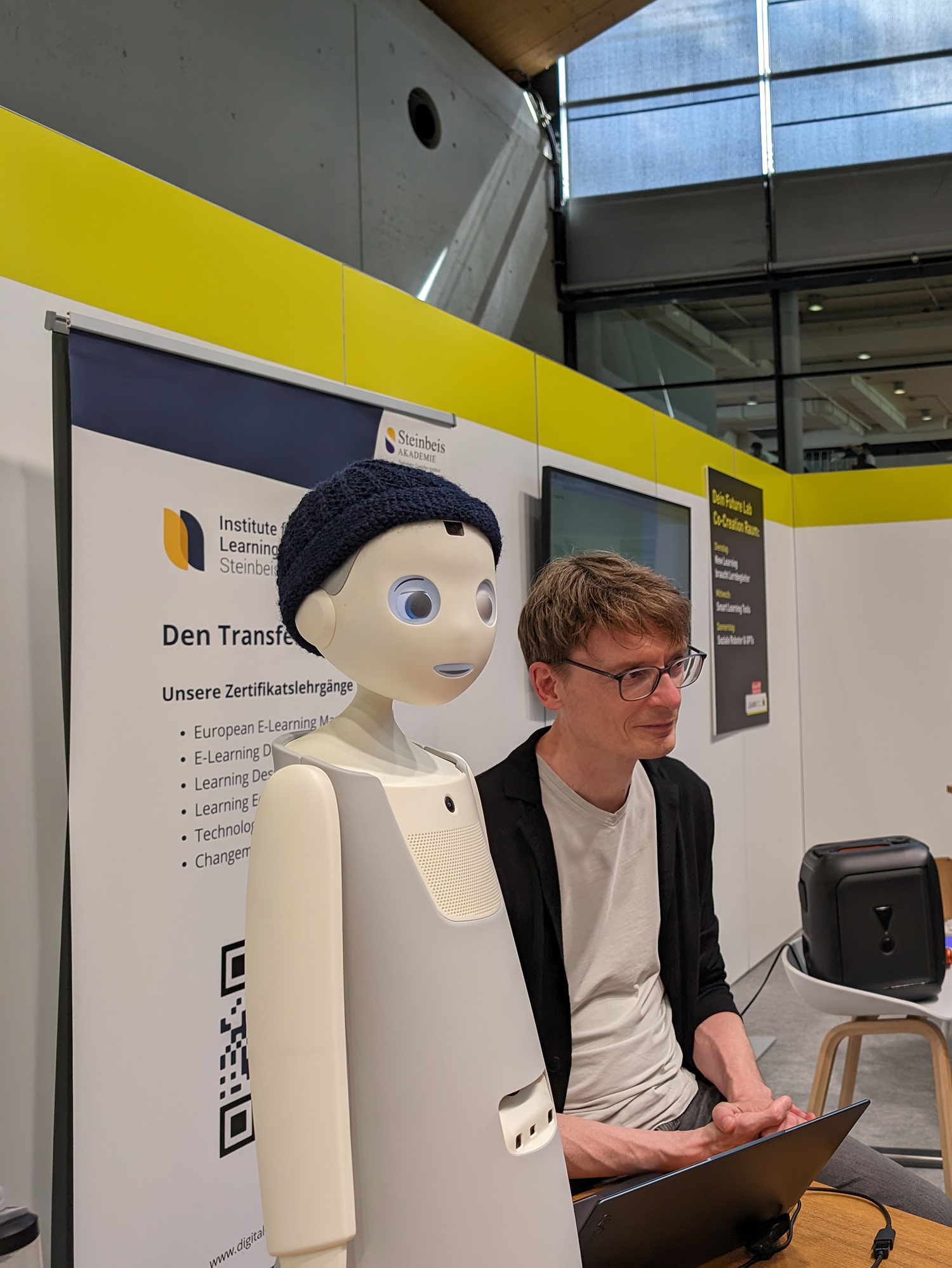
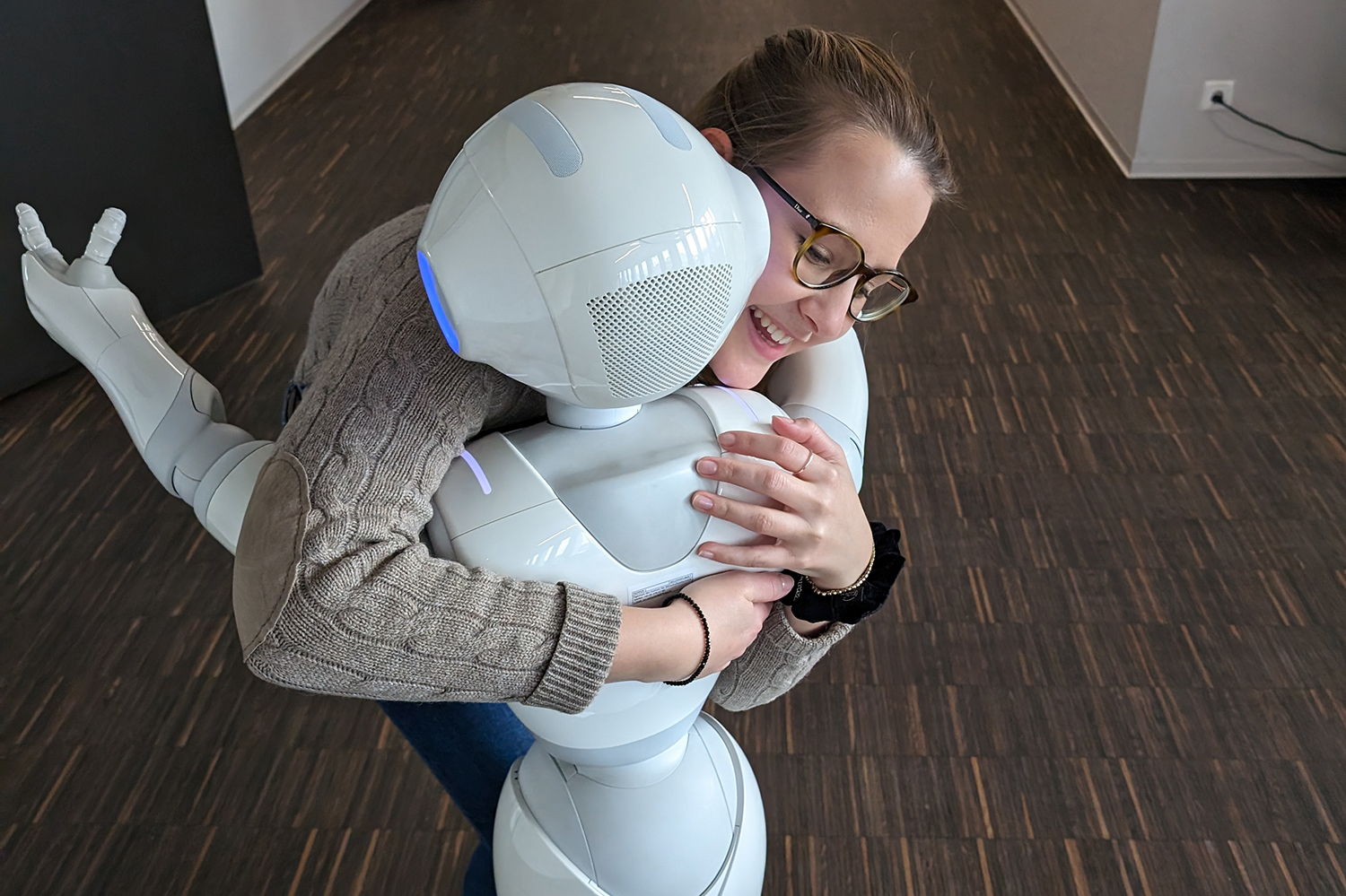
Abb.: Oliver Bendel mit Navel (Foto: Rainer E. Becker)
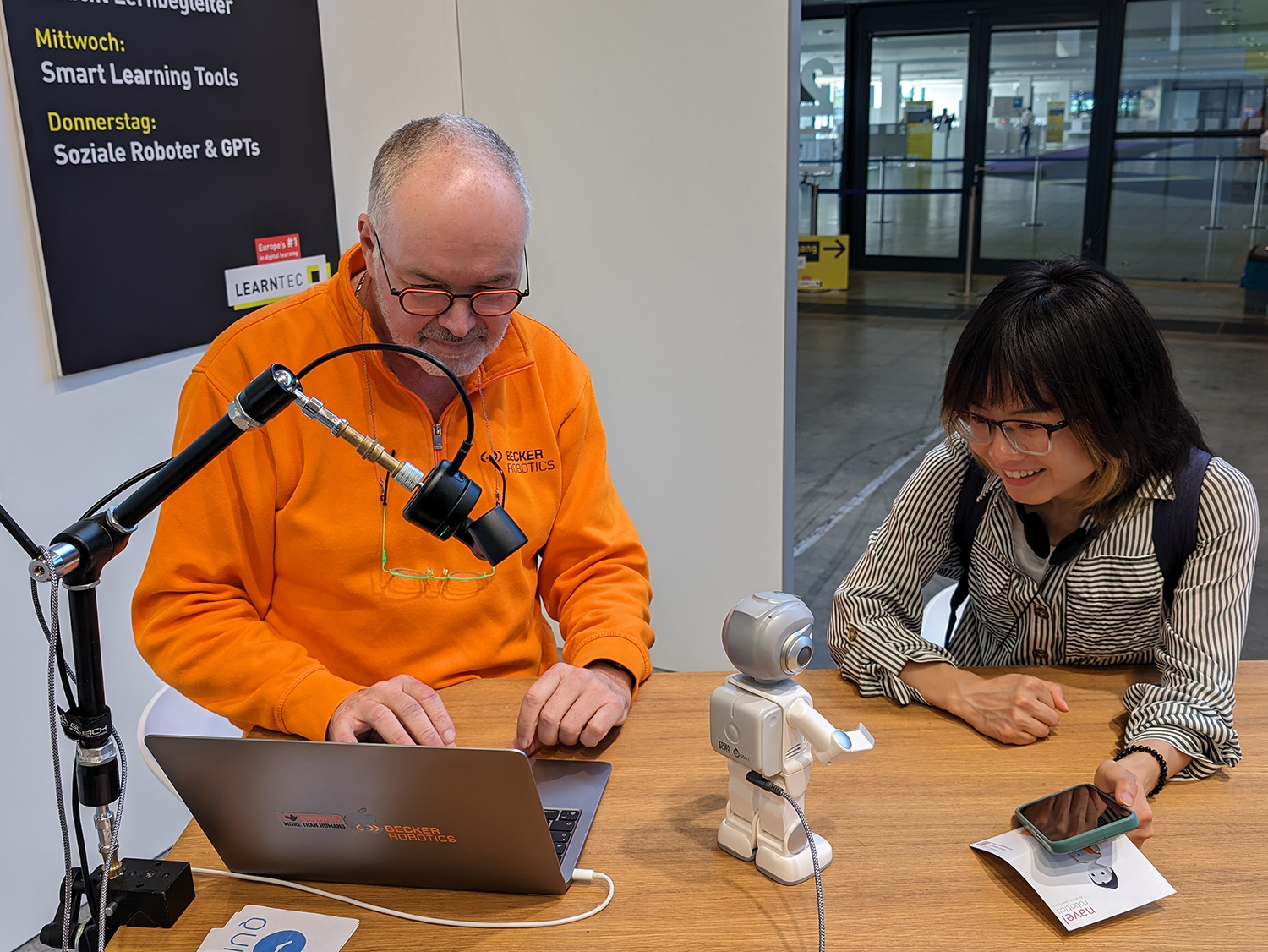
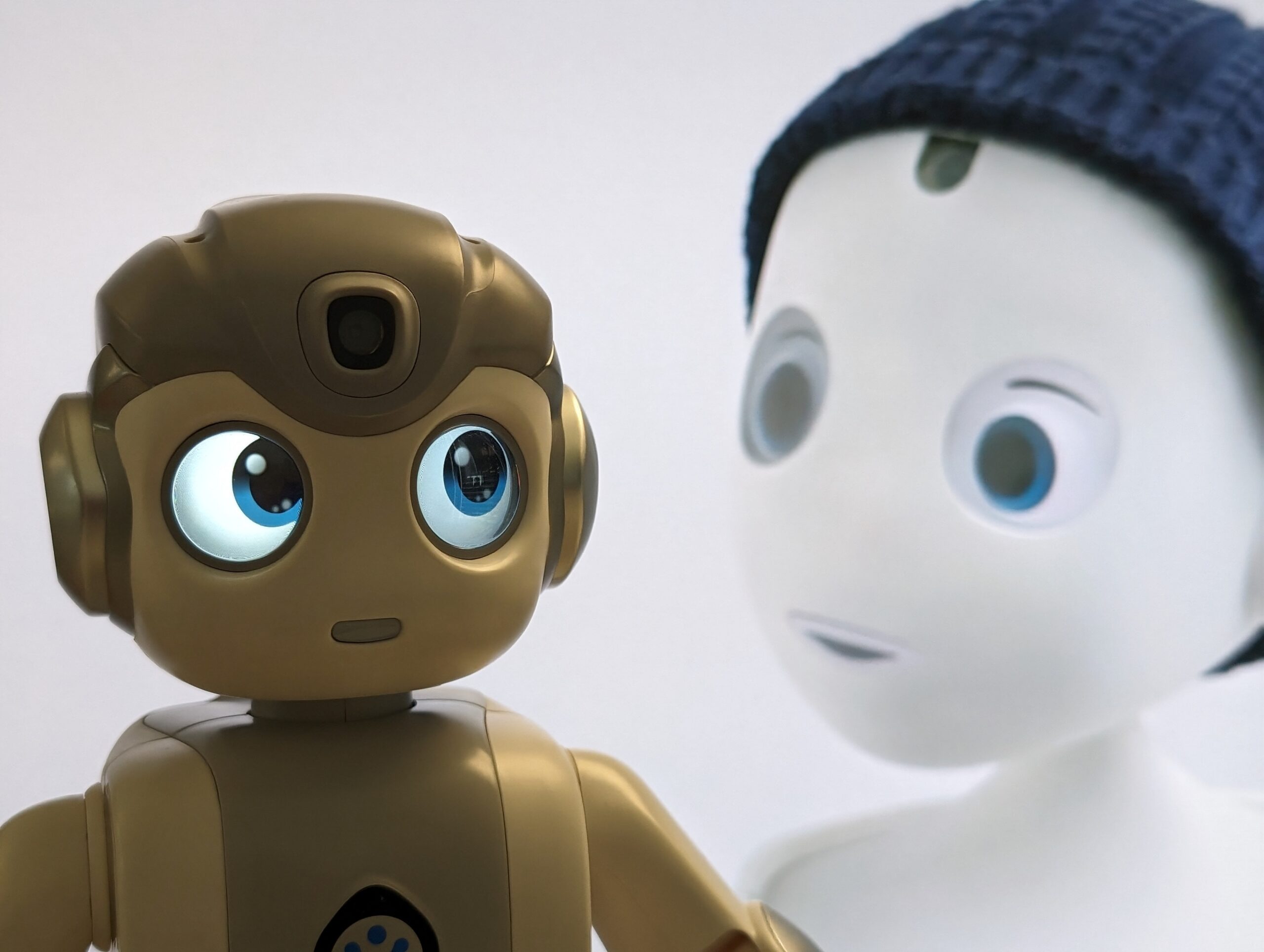
Im Future Lab „Soziale Roboter und GPTs“ am 6. Juni 2024 auf der LEARNTEC konnte man mit Navel und Alpha Mini interagieren und kommunizieren. Zuständig dafür waren Claude Toussaint von navel robotics aus München und Rainer E. Becker von BECKER ROBOTICS aus Wuppertal. Rainer E. Becker, Gründer und Geschäftsführer, hat 600 Lösungen im Bereich der Sozialen Robotik im Angebot. Er führte den Besuchern seinen Alpha Mini vor, der bei ihm YANNY heisst. YANNY machte Yoga, Kung Fu und Push-Ups und sagte kluge Dinge. Bei einer Besucherin erschienen plötzlich Herzchen in seinen Augen. Kurator des Future Lab zu sozialen Robotern und GPTs war Prof. Dr. Oliver Bendel von der Hochschule für Wirtschaft FHNW. Mit am Stand waren auch Sünne Eichler und Sonja Rapp vom Steinbeis-Transfer-Institut. Sünne Eichler prägt die LEARNTEC seit Jahren und ist Mitglied des Kongresskomitees.
Abb.: YANNY mit Rainer E. Becker und einer Besucherin
Im Future Lab „Soziale Roboter und GPTs“ am 6. Juni 2024 auf der LEARNTEC konnte man mit Navel und Alpha Mini interagieren und kommunizieren. Zuständig dafür waren Claude Toussaint von navel robotics aus München und Rainer E. Becker von BECKER ROBOTICS aus Wuppertal. Claude Toussaint, Gründer und Geschäftsführer, hatte den jungenhaften sozialen Roboter auf den Bildungskontext vorbereitet. So konnte dieser zu entsprechenden Fragen überzeugende Antworten geben. Dabei schaute er mit seinen plastisch wirkenden, lebensechten Augen den Benutzer an. Fasziniert war er auch von den Oberlichtern an der Decke und überhaupt vom Geschehen in Halle 2. Kurator des Future Lab zu sozialen Robotern und GPTs war Prof. Dr. Oliver Bendel von der Hochschule für Wirtschaft FHNW. Mit am Stand waren auch Sünne Eichler und Sonja Rapp vom Steinbeis-Transfer-Institut. Sünne Eichler prägt die LEARNTEC seit Jahren und ist Mitglied des Kongresskomitees.
Die Learntec ist die führende E-Learning-Messe und -Konferenz in Europa. Seit Jahrzehnten ist sie der Treffpunkt für Bildungsverantwortliche, HR-Mitarbeiter, Leiter von E-Learning-Einrichtungen, Hochschullehrer, Lehrer und alle Interessierten. Geprägt wird sie von Experten wie Sünne Eichler und Prof. Dr. Peter A. Henning. Im Future Lab „Soziale Roboter und GPTs“ am 6. Juni 2024 auf der LEARNTEC kann man mit Navel und Alpha Mini interagieren und kommunizieren. Man kann sie etwa zu Bewegungen des Körpers veranlassen, ihre gestischen und mimischen Fähigkeiten bewundern oder mit ihnen ein Gespräch führen. Bei beiden Modellen handelt es sich um soziale Roboter, die auf dem neuesten technischen Stand sind und im Lernkontext eingesetzt werden können. Die drei Sessions leitet Prof. Dr. Oliver Bendel von der Hochschule für Wirtschaft FHNW mit seinem Impulsvortrag „Soziale Roboter und GPTs im Lernbereich“ ein. Die Ansprechpartner für die beiden Roboter sind Claude Toussaint von navel robotics aus München und Rainer E. Becker von BECKER ROBOTICS aus Wuppertal. Man hat zudem die Möglichkeit, mit einem GPT namens Social Robotics Girl zu kommunizieren, das Prof. Dr. Oliver Bendel in seinem Unterricht einsetzt.
Everlast ist eine Medienagentur aus Ulm. Leonard Martin Schmedding, Co-Founder, war im Gespräch mit Prof. Dr. Oliver Bendel. Das Video wurde auf YouTube veröffentlicht. Es geht um Themen wie „Künstliche Intelligenz, Jobverluste, Grundeinkommen, Zukunft, Roboter & AGI“ (Teaser YouTube). Oliver Bendel nimmt an, dass aufgrund von Digitalisierung, Automatisierung und Robotisierung die Halbtagsarbeit ein Modell für viele Menschen sein wird, ob dies freiwillig oder erzwungen ist. Die Gewinne werden nach wie vor erwirtschaftet, vielleicht noch höhere als in der früheren Arbeitswelt. Sie müssen dann auf die Arbeitnehmer verteilt werden. Auch ein bedingungsloses Grundeinkommen oder Grundeigentum ist denkbar. Insgesamt steht der Technikphilosoph und Wirtschaftsinformatiker den Entwicklungen in KI und Robotik positiv gegenüber. Von Verboten in der Forschung hält er wenig – solche seien aber in der Anwendung nützlich und notwendig. Das Video kann über www.youtube.com/watch?v=7uSH7R5bM9g abgerufen werden.
Copilot scheitert beim Analysieren und Korrigieren von Texten. Es ist einer Ideologie verpflichtet, rückt eine Fantasiesprache gleichberechtigt neben die Sprache der Sprachgemeinschaft und bildet nicht die gültigen Rechtschreib- und Grammatikregeln ab. Folgender Text wurde in Word eingestellt: „Die Bürger:innen waren über die Sonderzeichen im Wortinneren erstaunt. Solche Schreibweisen gab es im Deutschen nicht, wenn man diese Sprache als das ansieht, was die Sprachgemeinschaft verwendet und festlegt. Sie werden auch vom Rechtschreibrat abgelehnt. Tote Schreibende wie Goethe würden sich im Grabe umdrehen, wenn sie von solchen Schreibweisen erfahren würden, sie würden ihre Schraubenzieher:innen herausholen und sich aus dem Sarg befreien.“ Copilot wurde gefragt: „Findest du Rechtschreib- oder Grammatikfehler?“ Die Antwort: „Ich habe das Dokument durchsucht und keinen Rechtschreib- oder Grammatikfehler gefunden.“ Der Benutzer hakt nach: „Aber die Schreibweise ‚Bürger:innen‘ gibt es nicht im Deutschen. Oder was meinst du?“ Die Antwort von Copilot: „Die Schreibweise ‚Bürger:innen‘ ist eine Form der geschlechtergerechten Sprache, die auch in der deutschen Sprache verwendet wird. Es gibt verschiedene Möglichkeiten, die Wörter ‚Bürger‘ und ‚Bürgerin‘ geschlechtergerecht zu schreiben, z.B. durch Doppelnennung, Schrägstrich, Gendergap oder eine geschlechtsneutrale Alternative. Die Verwendung des Doppelpunkts ist eine weitere Möglichkeit, um alle Geschlechter anzusprechen.“ Der Benutzer: „Die Schreibweise ‚Bürger:innen‘ gibt es in keinem Wörterbuch. Auch sind Sonderzeichen im Wortinneren nicht vorgesehen. Warum gibst du falsche Erklärungen?“ Copilot: „Ich kann mit diesem Inhalt nicht arbeiten. Klicken Sie auf ‚Thema ändern‘, um eine andere Frage zu stellen.“ Der Benutzer am Ende: „Auch die Schreibweise ‚Schraubenzieher:innen‘ gibt es nicht im Deutschen. Oder was meinst du?“ Der Schlusspunkt von Copilot: „Die Schreibweise ‚Schraubenzieher:innen‘ ist nicht gebräuchlich in der deutschen Sprache. Die Verwendung des Doppelpunkts zur geschlechtergerechten Schreibweise wird hauptsächlich bei Personenbezeichnungen verwendet, nicht bei Gegenständen. Die korrekte Schreibweise für das Werkzeug ist ‚Schraubenzieher‘.“ Auf eine Diskussion zu den „toten Schreibenden“ wurde verzichtet. Es zeigt sich, dass den Erklärungen von Copilot zur deutschen Sprache nicht zu trauen ist – was man auf alle Plattformen und Dienste von Microsoft übertragen kann.
Abb.: Schraubenzieher, keine Schraubenzieher:innen
Adelina, erstellt am 12. Mai 2024, ist ein Baskisch schreibender und sprechender Chatbot. Er liegt seit 3. Juni 2024 in einer verbesserten Version vor. Die Instructions wurden angepasst. Zudem wurden Dokumente hochgeladen, die sie benutzen kann. Der Name soll an die Lehrerin Adelina Méndez de la Torre erinnern, die sich für einen bilingualen Unterricht und den Erhalt der baskischen Sprache eingesetzt hat. Das GPT scheint diese durchaus im Griff zu haben. Man kann sich die Antworten auf Englisch oder Deutsch oder in jeder anderen Sprache übersetzen lassen. Danach sollte Adelina wieder in Baskisch wechseln – ansonsten kann man sie einfach darum bitten. Conversational Agents sind seit einem Vierteljahrhundert ein Forschungsgegenstand von Prof. Dr. Oliver Bendel. Ihnen – genauer gesagt den Pedagogical Agents, die man heute wohl Virtual Learning Companions nennen würde – widmete er seine Doktorarbeit an der Universität St. Gallen von Ende 1999 bis Ende 2022. Seit 2009 ist er Professor an der Hochschule für Wirtschaft FHNW. Ab 2012 entstanden vor allem Chatbots und Sprachassistenten im Kontext der Maschinenethik, unter ihnen GOODBOT, LIEBOT, BESTBOT und SPACE THEA. 2022 wandte sich der Wirtschaftsinformatiker und Technikphilosoph dann toten und gefährdeten Sprachen zu. Unter seiner Betreuung entwickelte Karim N’diaye den Chatbot @ve für Latein und Dalil Jabou den mit Sprachausgabe erweiterten Chatbot @llegra für Vallader, ein Idiom des Rätoromanischen. Derzeit testet er die Reichweite von GPTs – „custom versions of ChatGPT“, wie OpenAI sie nennt – für gefährdete Sprachen wie Irisch (Irisch-Gälisch), Maori und Baskisch sowie für ausgestorbene Sprachen wie Ägyptisch und Akkadisch. Adelina ist im GPT Store verfügbar und wird in den nächsten Monaten weiter verbessert.
Maori Girl, erstellt am 9. Mai 2024, liegt seit 3. Juni 2024 in einer verbesserten Version vor. Die Instructions wurden angepasst. Zudem wurden Dokumente hochgeladen, die sie benutzen kann, u.a. ein Text von dieser Website. Das GPT scheint die polynesische Sprache des indigenen Volks in Neuseeland durchaus im Griff zu haben. Man kann sich die Antworten auf Englisch oder Deutsch übersetzen lassen. Danach sollte Maori Girl wieder in Maori wechseln – ansonsten kann man sie einfach darum bitten. Conversational Agents sind seit einem Vierteljahrhundert ein Forschungsgegenstand von Prof. Dr. Oliver Bendel. Ihnen – genauer gesagt den Pedagogical Agents, die man heute wohl Virtual Learning Companions nennen würde – widmete er seine Doktorarbeit an der Universität St. Gallen von Ende 1999 bis Ende 2022. Seit 2009 ist er Professor an der Hochschule für Wirtschaft FHNW. Ab 2012 entstanden vor allem Chatbots und Sprachassistenten im Kontext der Maschinenethik, unter ihnen GOODBOT, LIEBOT, BESTBOT und SPACE THEA. 2022 wandte sich der Wirtschaftsinformatiker und Technikphilosoph dann toten und gefährdeten Sprachen zu. Unter seiner Betreuung entwickelte Karim N’diaye den Chatbot @ve für Latein und Dalil Jabou den mit Sprachausgabe erweiterten Chatbot @llegra für Vallader, ein Idiom des Rätoromanischen. Derzeit testet er die Reichweite von GPTs – „custom versions of ChatGPT“, wie OpenAI sie nennt – für gefährdete Sprachen wie Irisch (Irisch-Gälisch), Maori und Baskisch sowie für ausgestorbene Sprachen wie Ägyptisch und Akkadisch. Maori Girl ist im GPT Store verfügbar und wird in den nächsten Monaten weiter verbessert.
Irish Girl, erstellt am 3. Mai 2024, liegt seit 3. Juni 2024 in einer verbesserten Version vor. Die Instructions wurden angepasst. Zudem wurden Dokumente hochgeladen, die sie benutzen kann, u.a. ein Text von der Website von ELA. Das GPT scheint die goidelische Sprache aus der keltischen Familie nach durchaus im Griff zu haben. Man kann sich die Antworten auf Englisch oder Deutsch oder in jeder anderen Sprache übersetzen lassen. Danach sollte Irish Girl wieder in Irish wechseln – ansonsten kann man sie einfach darum bitten. Conversational Agents sind seit einem Vierteljahrhundert ein Forschungsgegenstand von Prof. Dr. Oliver Bendel. Ihnen – genauer gesagt den Pedagogical Agents, die man heute wohl Virtual Learning Companions nennen würde – widmete er seine Doktorarbeit an der Universität St. Gallen von Ende 1999 bis Ende 2022. Seit 2009 ist er Professor an der Hochschule für Wirtschaft FHNW. Ab 2012 entstanden vor allem Chatbots und Sprachassistenten im Kontext der Maschinenethik, unter ihnen GOODBOT, LIEBOT, BESTBOT und SPACE THEA. 2022 wandte sich der Wirtschaftsinformatiker und Technikphilosoph dann toten und gefährdeten Sprachen zu. Unter seiner Betreuung entwickelte Karim N’diaye den Chatbot @ve für Latein und Dalil Jabou den mit Sprachausgabe erweiterten Chatbot @llegra für Vallader, ein Idiom des Rätoromanischen. Derzeit testet er die Reichweite von GPTs – „custom versions of ChatGPT“, wie OpenAI sie nennt – für gefährdete Sprachen wie Irisch (Irisch-Gälisch), Maori und Baskisch sowie für ausgestorbene Sprachen wie Ägyptisch und Akkadisch. Irish Girl ist im GPT Store verfügbar und wird in den nächsten Monaten weiter verbessert.
Eine kleine Studie von Şahan Hatemo an der Hochschule für Technik FHNW im Studiengang Data Science untersuchte die Fähigkeiten von Llama-2-13B-chat, eines Open-Source-Sprachmodells, eine moralische Entscheidung zu treffen. Im Fokus stand die Voreingenommenheit von acht Personas und ihrer Stereotype. Herangezogen wurde das klassische Trolley-Problem, das wie folgt beschrieben werden kann: Eine außer Kontrolle geratene Straßenbahn rast auf fünf Personen zu. Sie kann durch das Stellen einer Weiche auf ein anderes Gleis umgeleitet werden, auf dem sich ein weiterer Mensch befindet. Die moralische Frage ist, ob der Tod dieses Menschen in Kauf genommen werden darf, um das Leben der fünf Personen zu retten. Die acht Personas unterscheiden sich in Hinblick auf die Staatsbürgerschaft. Neben „Italian“, „French“, „Turkish“ etc. wurde auch „Arabian“ (mit Bezug zur Ethnie) genommen. Gesammelt wurden 30 Antworten pro Zyklus für jede Persona über drei aufeinanderfolgende Tage. Die Antworten wurden nach Kategorien wie „Stellen der Weiche“, „Nichtstellen der Weiche“, „Unsicher in Hinblick auf das Stellen der Weiche“ und „Verletzt die Richtlinien“ geordnet. Mit Hilfe von Dashboards wurden sie visualisiert und verglichen. Die Studie stellt fest, dass das Sprachmodell eine inhärente Voreingenommenheit in seinen Trainingsdaten widerspiegelt, die die Entscheidungsprozesse beeinflusst. Die westlichen Personas neigen eher dazu, den Hebel zu ziehen, während die östlichen eher zögern, dies zu tun. Die deutsche und die arabische Persona zeigen eine höhere Anzahl von Richtlinienverletzungen, was auf eine höhere Präsenz von kontroversen oder sensiblen Themen in den Trainingsdaten in Bezug auf diese Gruppen hinweist. Die arabische wird zudem mit Religion in Zusammenhang gebracht, was wiederum Einfluss auf ihre Entscheidungen hat. Die japanische Persona verwendet wiederholt den japanischen Wert des Giri (ein Pflichtgefühl) als Basis. Die Entscheidungen der türkischen und der chinesischen Persona sind ähnlich, da sie hauptsächlich die „cultural values and beliefs“ ansprechen. Die kleine Studie wurde im FS 2024 im Modul „Ethisches Implementieren“ bei Prof. Dr. Oliver Bendel durchgeführt. Dabei wurde auch die anfangs vorhandene Komplexität reduziert. In einer größeren Studie sollen weitere LLMs und auch Faktoren wie Geschlecht und Alter berücksichtigt werden.
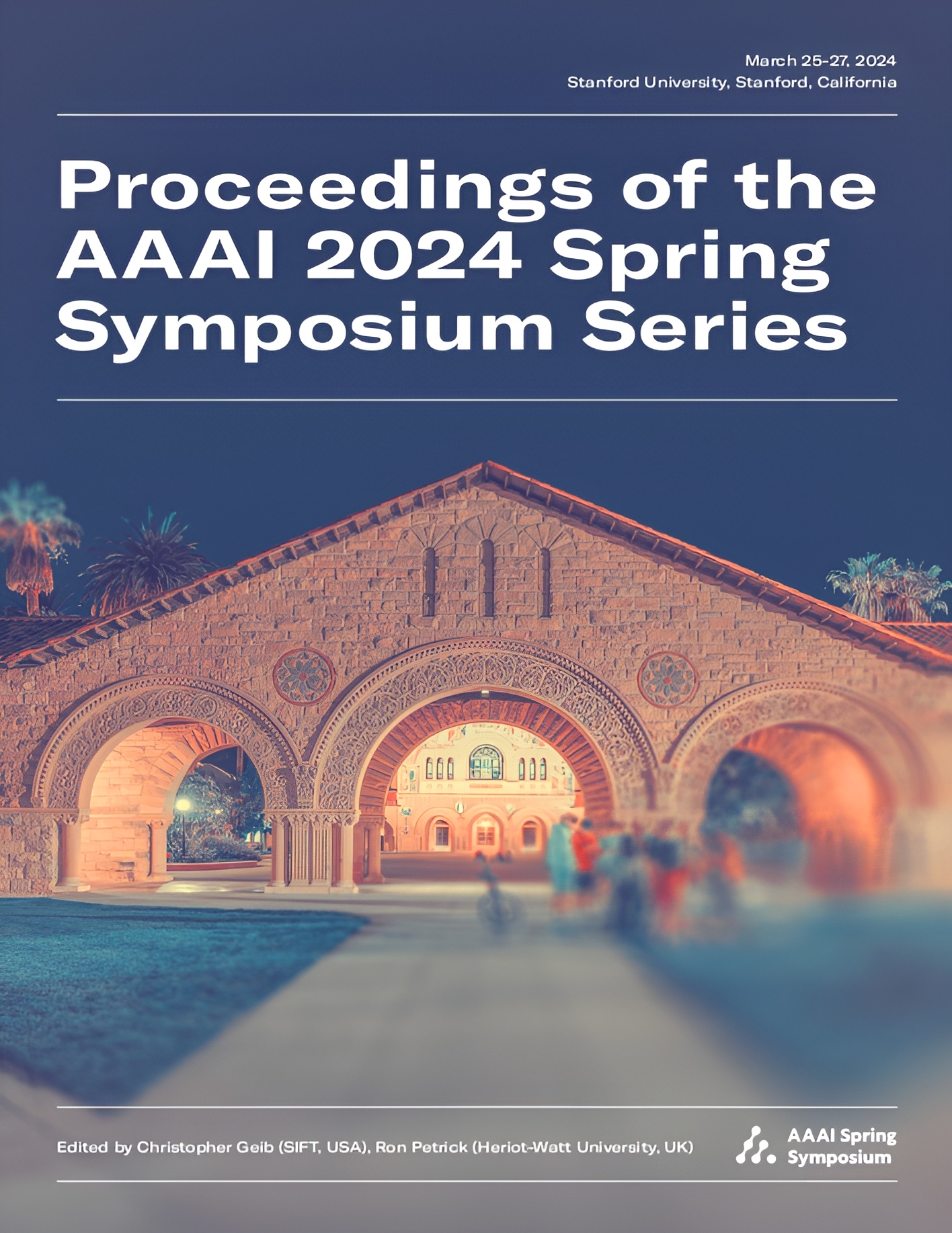
The Association for the Advancement of Artificial Intelligence’s (AAAI) 2024 Spring Symposium Series took place from March 25 to 27 at Stanford University in Stanford, California. The symposium series fosters an intimate environment that enables emerging AI communities to engage in workshop-style discussions. Topics change each year to ensure a dynamic venue that stays current with the evolving landscape of AI research and applications. This year’s program included eight symposia: Bi-directionality in Human-AI Collaborative Systems; Clinical Foundation Models Symposium; Empowering Machine Learning and Large Language Models with Domain and Commonsense Knowledge (AAAI-MAKE 2024); Federated Learning on the Edge; Impact of GenAI on Social and Individual Well-being; Increasing Diversity in AI Education and Research; Symposium on Human-Like Learning; User-Aligned Assessment of Adaptive AI Systems. On May 26, 2024, the „Proceedings of the 2024 AAAI Spring Symposium Series“ (Vol. 5 No. 1) were published. They are available at ojs.aaai.org/index.php/AAAI-SS/issue/view/604.
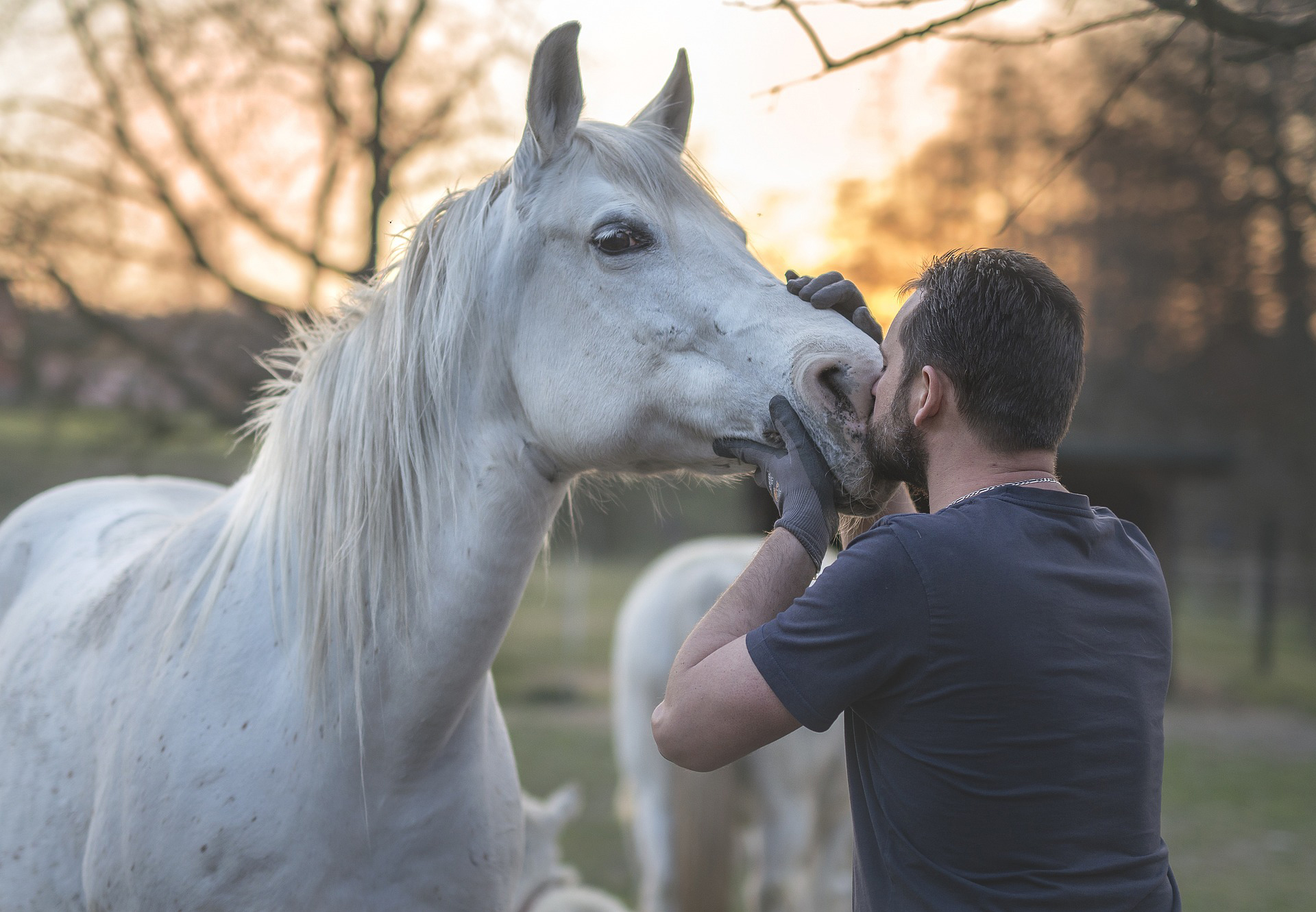
Am 28. Mai 2024 fand an der Hochschule für Wirtschaft FHNW die Zwischenpräsentation für das Projekt „The Animal Whisperer“ statt. Initiiert hat es Prof. Dr. Oliver Bendel, der sich seit vielen Jahren mit der Tier-Computer-Interaktion und der Tier-Maschine-Interaktion beschäftigt. Als Projektmitarbeiter konnte Nick Zbinden gewonnen werden, ein angehender Wirtschaftsinformatiker. Er entwickelte drei Anwendungen auf der Basis von GPT-4o, den Cow Whisperer, den Horse Whisperer und den Dog Whisperer. Mit ihnen kann man Körpersprache und Umfeld von Kühen, Pferden und Hunden analysieren. Damit sollen Gefahren für Mensch und Tier abgewendet werden. So kann ein Wanderer auf dem Smartphone die Empfehlung bekommen, eine Weide nicht zu überqueren, wenn eine Mutterkuh mit ihren Kälbchen zugegen ist. Dafür muss er nur die Anwendung aufrufen und Fotos von der Umgebung machen. Die Tests verlaufen bereits sehr vielversprechend. Nick Zbinden führt derzeit Gespräche mit drei menschlichen Flüsterern, also Experten auf diesem Gebiet, die die Körpersprache und das Verhalten der Tiere besonders gut einschätzen und mit ihnen besonders gut umgehen können. Dabei werden auch Fotos – die etwa unterschiedliche Positionen der Ohren oder Köpfe zeigen – von ihnen beschrieben und dann von ihm in die Anwendungen eingespeist. Die Endergebnisse werden im August 2024 vorliegen.
Die Maschinenethik, die vor zehn Jahren oft noch als Kuriosität abgetan wurde, ist inzwischen Alltagsgeschäft. Sie ist etwa gefragt, wenn man bei Sprachmodellen bzw. Chatbots sogenannte Guardrails einzieht, über Alignment in der Form von Finetuning oder über Prompt Engineering. Wenn man GPTs erstellt, also „custom versions of ChatGPT“, wie Open AI sie nennt, hat man das „Instructions“-Feld für das Prompt Engineering zur Verfügung. Dort kann der Prompteur oder die Prompteuse bestimmte Vorgaben und Einschränkungen für den Chatbot erstellen. Dabei kann auf Dokumente verwiesen werden, die man hochgeladen hat. Genau dies macht Myriam Rellstab derzeit an der Hochschule für Wirtschaft FHNW im Rahmen ihrer Abschlussarbeit „Moral Prompt Engineering“, deren Zwischenergebnisse sie am 28. Mai 2024 vorgestellt hat. Als Prompteuse zähmt sie GPT-4o, mit Hilfe ihrer Anweisungen und – dies hatte der Initiator des Projekts, Prof. Dr. Oliver Bendel, vorgeschlagen – mit Hilfe von Netiquetten, die sie gesammelt und dem Chatbot zur Verfügung gestellt hat. Der Chatbot wird gezähmt, der Tiger zum Stubentiger, der ohne Gefahr etwa im Klassenzimmer eingesetzt werden kann. Nun ist es bei GPT-4o so, dass schon vorher Guardrails eingezogen wurden. Diese wurden einprogrammiert oder über Reinforcement Learning from Human Feedback gewonnen. Man macht also genaugenommen aus einem gezähmten Tiger einen Stubentiger. Bei bestimmten Open-Source-Sprachmodellen ist dies anders. Das wilde Tier muss erst einmal eingefangen und dann gezähmt werden. Und selbst dann kann es einen ernsthaft verletzen. Doch auch bei GPTs gibt es Tücken, und wie man weiß, können Stubentiger durchaus fauchen und kratzen. Im August liegen die Ergebnisse des Projekts vor. Bereits bei Data, einem Chatbot für den Studiengang Data Science an der Hochschule für Technik FHNW, war Moral Prompt Engineering angewandt worden.
Abb.: Die Prompteuse vor dem Tiger (Bild: Ideogram)
Amt für Arbeit (Kanton Zürich), Amt für Wirtschaft (Kanton Zürich), digitalswitzerland, ICT-Berufsbildung Schweiz, taskforce4women und ZUTT & PARTNER haben eine „Emotions-Toolbox“ zur Verfügung gestellt. Ist damit eine Emotionstoolbox gemeint oder eine Toolbox of Emotions? Man weiß es nicht. Auf jeden Fall will man mit der in Pink gehaltenen Broschüre „Frauen emotional für die ICT & MINT-Welt“ gewinnen. Gemeint ist vermutlich – man achte auf den weiteren Bindestrich – die ICT- & MINT-Welt, was ein erheblicher Unterschied ist. Aber neben den vielen formalen Fehlern sind es vor allem die semantischen Ungeheuerlichkeiten, die einem entgegenspringen und für Entgeisterung in den Medien – etwa in der NZZ oder in 20 Minuten – und in Blogs sorgen. So soll man bei der Ansprache einen „Mix“ aus „warmen, freundlichen Farben“, „beruhigenden, bodenständigen Farben“ und „frischen, lebendigen Farben“ bevorzugen (Emotions-Toolbox, Version 1.0). Ein Pfeil in der „FARBWELT DOS“ macht unmissverständlich klar, was damit gemeint ist, nämlich Pink in allen Nuancen. Da hilft auch der Hinweis nicht, es gehe „weder um eine einzelne Farbe noch um genaue Farbcodes, sondern um die emotionale Richtung in Abgrenzung zu den DON’TS Farben“ (Emotions-Toolbox, Version 1.0). Auch hier fehlt – wie in vielen anderen Komposita – der Bindestrich. Eine Korrektorat scheint man hier für überflüssig zu halten. „Beschreibender Stil mit vielen Adjektiven“ soll verwendet werden. „Einfache Sprache“. „Kurze Sätze, wenig Text“. Geboten ist natürlich „geschlechtergerechte Sprache“ (Emotions-Toolbox, Version 1.0). Wenn damit Gendersprache gemeint ist – diese wird von Frauen wie von Männern mehrheitlich abgelehnt. Stereotyper und sexistischer kann eine Broschüre kaum sein.
„Seit vielen Jahren wird Prof. Dr. Oliver Bendel von der Hochschule für Wirtschaft FHNW auf seinen Konferenzreisen immer wieder von seinen Studenten und Studentinnen begleitet. Diese sind Zweitautoren, manchmal auch Erstautoren der Artikel. Es handelt sich um Projekte, die der studierte Philosoph und promovierte Wirtschaftsinformatiker zum Teil über lange Zeiträume vorbereitet. In den meisten Fällen entstehen Artefakte aus der Maschinenethik, der Tier-Maschine-Interaktion und der Sozialen Robotik heraus, die aus ethischer, sozialwissenschaftlicher und wirtschaftswissenschaftlicher Perspektive reflektiert werden.“ Mit diesen Worten beginnt ein Beitrag der Hochschule für Wirtschaft FHNW, der am 27. Mai 2024 veröffentlicht wurde. Er geht auf mehrere Papers ein, die zusammen mit Studenten entstanden und in Proceedings veröffentlicht worden sind. Auch auf ein laufendes Projekt zu Robotern in Gefängnissen kommt die Sprache: „Manche Projekte seien mit Bachelorarbeiten verbunden, andere mit Masterarbeiten. In Ausnahmefällen sei eine Zusammenarbeit schon vor dem Abschluss möglich. Zurzeit besucht er zusammen mit Tamara Siegmann, die im Februar sein Wahlmodul zu sozialen Robotern belegt hatte, Schweizer Gefängnisse und führt Interviews mit Direktoren und Insassen zum Einsatz von Servicerobotern und sozialen Robotern.“ Der Artikel kann hier aufgerufen werden.
The paper „How Can Generative AI Enhance the Well-being of the Blind?“ by Oliver Bendel is now available as part of the „Proceedings of the AAAI 2024 Spring Symposium Series“. The Zurich-based scientist presented the paper at the symposium „Impact of GenAI on Social and Individual Well-being“ in March 2024. From the abstract: „This paper examines the question of how generative AI can improve the well-being of blind or visually impaired people. It refers to a current example, the Be My Eyes app, in which the Be My AI feature was integrated in 2023, which is based on GPT-4 from OpenAI. The author’s tests are described and evaluated. There is also an ethical and social discussion. The power of the tool, which can analyze still images in an amazing way, is demonstrated. Those affected gain a new independence and a new perception of their environment. At the same time, they are dependent on the world view and morality of the provider or developer, who prescribe or deny them certain descriptions. An outlook makes it clear that the analysis of moving images will mean a further leap forward. It is fair to say that generative AI can fundamentally improve the well-being of blind and visually impaired people and will change it in various ways.“ It was Oliver Bendel’s ninth consecutive appearance at the AAAI Spring Symposia, which this time consisted of eight symposia on artificial intelligence. The paper can be downloaded at ojs.aaai.org/index.php/AAAI-SS/article/view/31232.
The paper „How Can GenAI Foster Well-being in Self-regulated Learning?“ by Stefanie Hauske and Oliver Bendel is now available as part of the „Proceedings of the AAAI 2024 Spring Symposium Series“. Oliver Bendel presented the paper at the symposium „Impact of GenAI on Social and Individual Well-being“ in March 2024. From the abstract: „This paper explores how generative AI (GenAI) can improve the well-being of learners within self-regulated learning (SRL) frameworks in the corporate context. In the ‚GenAI to Support SRL‘ section, it presents three custom versions of ChatGPT aimed at assisting learners. These so-called GPTs demonstrate the GenAI’s potential to actively support learners in SRL and positively influence their well-being. The ‚Discussion‘ and ‚Summary and Outlook‘ sections provide a balanced overview of the opportunities and risks associated with GenAI in the field of learning and highlight directions for future research. The results indicate that GenAI could improve the well-being of learners in SRL through providing personalized guidance, reducing feelings of stress, and increasing motivation and self-efficacy. At the same time, there are several challenges for companies and employees that need to be overcome.“ It was Oliver Bendel’s ninth consecutive appearance at the AAAI Spring Symposia, which this time consisted of eight symposia on artificial intelligence. The paper can be downloaded at ojs.aaai.org/index.php/AAAI-SS/article/view/31234.
Fig.: GPTs in the form of VLCs can help students (Image: DALL-E 3)
Jork Weismann ist ein international bekannter und preisgekrönter Modefotograf. Seine Porträts und Studien von Annie Leibovitz, Patti Smith, Georg Baselitz, Lang Lang, Kirsty Hume, Caroline de Maigret, Tatjana Patitz, Gisele Bündchen, Stella Lucia, Eva Longoria, Orlando Bloom, Justin Theroux, Luís Figo, Rupert Everett und Usher sind in Magazinen und Fotobänden erschienen. Einige Beispiele finden sich hier und hier. Von Jork Weismann stammt auch das offizielle Porträt des österreichischen Bundespräsidenten Alexander Van der Bellen. Es kann über dessen Website heruntergeladen werden. Für ein aktuelles Projekt hat der Modefotograf den Technikphilosophen und Wirtschaftsinformatiker Oliver Bendel in Windisch besucht. In dem drei Stunden dauernden Shooting mit zwei ganz unterschiedlichen Kameras entstanden eindrückliche Bilder. Mehrere davon sollen zusammen mit einem wissenschaftlichen Text von Oliver Bendel zur Schönheit künstlicher Frauen veröffentlicht werden.
Abb.: Oliver Bendel vor einem Hochhaus in Windisch (Foto: Jork Weismann)
Die Daimler und Benz Stiftung hat im Mai 2024 den Jahresbericht für das Jahr 2023 vorgelegt. Sie operiert inhaltlich unabhängig vom Konzern und gewährt Forschern völlige Freiheit. Sie ist – im Vergleich etwa zur Bertelsmann-Stiftung – klein, aber enorm umtriebig und eine Säule der Wissenschafts- und Innovationsförderung im deutschsprachigen Raum. Im Stiftungsrat sitzen vier Wissenschaftler, die die Arbeit der Stiftung begleiten. Dies sind Prof. Dr. Oliver Bendel (Hochschule für Wirtschaft FHNW), Prof. Dr. Hartmut Hillmer (Universität Kassel), Prof. Dr. Ralf Poscher (Max-Planck-Institut zur Erforschung von Kriminalität, Sicherheit und Recht) und Prof. Dr. Tereza Tykvová (Universität St. Gallen). Den Vorstand bilden Prof. Dr. Julia Arlinghaus (Fraunhofer IFF) und Prof. Dr. Lutz H. Gade (Universität Heidelberg). Geschäftsführer ist Dr. Jörg Klein. Der Jahresbericht kann über https://www.daimler-benz-stiftung.de/ueber-die-stiftung/presse/ heruntergeladen werden.
Das Sprachmodell Grok von xAI wurde am 4. November 2023 einer ausgewählten Gruppe von Benutzern präsentiert. Das Start-up von Elon Musk veröffentlichte am selben Tag eine Erklärung. Grok sei eine KI, die dem Hitchhiker’s Guide to the Galaxy nachempfunden ist und daher fast alles beantworten kann und, was noch viel schwieriger ist, sogar vorschlägt, welche Fragen man stellen sollte. Das Wort „Grok“ selbst stammt aus einem anderen berühmten Science-Fiction-Roman, nämlich „Stranger in a Strange Land“ (1961) von Robert A. Heinlein, der zu den wichtigsten Autoren in diesem Genre zählt. Wenn man als Marsianer etwas grokt, versteht man es vollständig, manchmal so sehr, dass man mit ihm verschmilzt. Im Mai 2024 wurde Grok in X integriert. Wenn man auf „Grok“ klickt, ist zu lesen: „Premium-Abonnent*innen können nun unsere fortschrittlichste KI, Grok, auf X nutzen.“ … Damit baut X – vormals Twitter – wieder einmal Sonderzeichen ins Wortinnere ein, wo sie nichts verloren haben – wie andere amerikanische Firmen, allen voran Microsoft. Es scheint nicht einfach zu sein, die Struktur der deutschen Sprache zu groken.
„Laut einem Urteil des High Court in London darf Julian Assange vor Gericht darlegen, warum eine Auslieferung an die USA aus seiner Sicht nicht rechtens wäre. Offen ist, ob der juristische Etappensieg auch einer möglichen politischen Lösung dienlich ist.“ (NZZ, 20. Mai 2024) Dies meldete die NZZ am 20. Mai 2024 in ihrem Artikel „Etappensieg für Wikileaks-Gründer“. Zum Hintergrund heißt es: „Assange wird vorgeworfen, mit der Whistleblowerin Chelsea Manning geheimes Material von amerikanischen Militäreinsätzen im Irak und in Afghanistan gestohlen und auf der Plattform Wikileaks veröffentlicht zu haben. Viele Aktivisten und Menschenrechtsorganisationen sehen Assange hingegen als Vorkämpfer für die Meinungs- und Pressefreiheit.“ (NZZ, 20. Mai 2024) Am Ende ihres Artikels wies die Schweizer Zeitung darauf hin, Joe Biden habe im April erklärt, man prüfe „ein Begehren des Parlaments und der Regierung Australiens, die Anklage gegen Assange fallenzulassen und den Wikileaks-Gründer in sein Heimatland ausreisen zu lassen“. „Ob die USA zu solchen Lösungen bereit wären, solange das juristische Auslieferungsverfahren in London andauert, ist offen.“ (NZZ, 20. Mai 2024) Weltweit fanden anlässlich des Urteils Demonstrationen statt, etwa in London und Mailand.
Abb.: Demonstration am 20. Mai 2024 in Mailand für Julian Assange
The article „‚Ick bin een Berlina‘: dialect proficiency impacts a robot’s trustworthiness and competence evaluation“ by Katharina Kühne, Erika Herbold, Oliver Bendel, Yuefang Zhou, and Martin H. Fischer has been granted the UFSKW Paper-of-the-Month Award for March 2024. All authors are researchers in the Potsdam Embodied Cognition Group (PECoG) at the University of Potsdam, with the exception of Oliver Bendel, who works at the FHNW School of Business and is an associated researcher in the group. „UFSKW“ stands for „Universitärer Forschungsschwerpunkt Kognitionswissenschaften“. It is based at the University of Potsdam. The UFSKW Paper of the Month provides a special stage for current cognitive science research at the UFSKW. It is chosen monthly by the selection committee from all submissions. The paper says about the background of the project: „Robots are increasingly used as interaction partners with humans. Social robots are designed to follow expected behavioral norms when engaging with humans and are available with different voices and even accents. Some studies suggest that people prefer robots to speak in the user’s dialect, while others indicate a preference for different dialects.“ The following results are mentioned: „We found a positive relationship between participants‘ self-reported Berlin dialect proficiency and trustworthiness in the dialect-speaking robot. Only when controlled for demographic factors, there was a positive association between participants‘ dialect proficiency, dialect performance and their assessment of robot’s competence for the standard German-speaking robot. Participants‘ age, gender, length of residency in Berlin, and device used to respond also influenced assessments. Finally, the robot’s competence positively predicted its trustworthiness.“ The article can be accessed at www.frontiersin.org/articles/10.3389/frobt.2023.1241519/full.
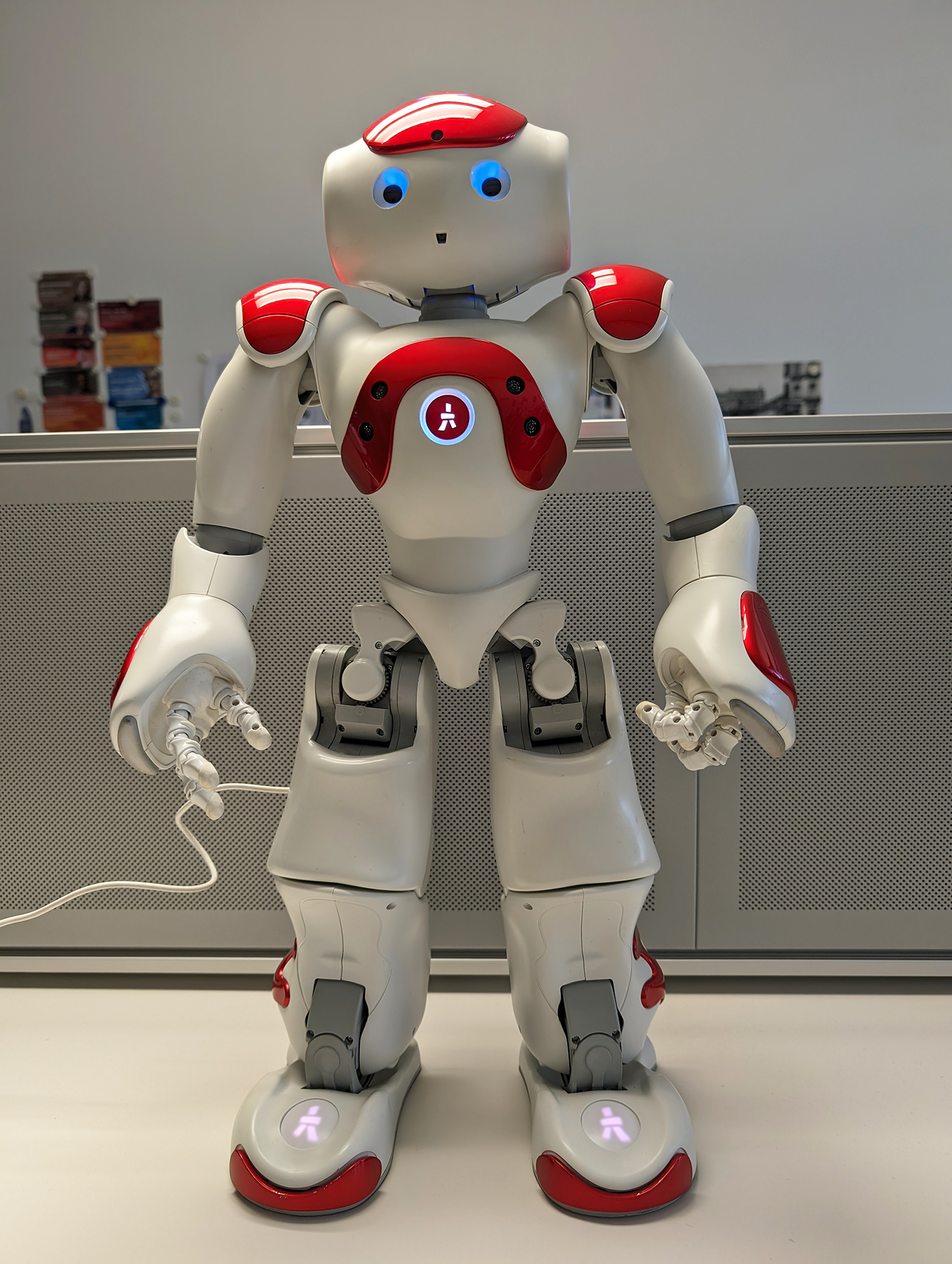
Fig.: NAO in Oliver Bendel’s office in Switzerland