Mauna Kea volcano is the highest mountain in the world, measured from the bottom of the sea. It is considered a sacred place in the culture of Hawai’i. In this context, the famous and important telescopes on the top are always the cause of bitter disputes. The operation of drones is also not allowed on the mountain. However, a small robot made it on it in 2008. This was reported by several media outlets, including Science Daily. „During the field experiment, Nov. 1-13, the robot called Scarab will simulate a lunar mission to extract water, hydrogen, oxygen and other compounds that could potentially be mined for use by future lunar explorers. The four-wheeled robot will trek to different sites, using a Canadian-built drill to obtain a one-meter geologic core at each site. Each core will be chemically analyzed by on-board instruments developed by NASA.“ (Science Daily, 14 October 2008) After that, it became increasingly difficult for robots to climb Mauna Kea. It is easier for scientists and tourists, who only need 4-wheel drive and robust health.
Fig.: Oliver Bendel on the top of Mauna Kea with a few snowflakes (Photo: Stefanie Hauske)
The west coast of the Big Island is known for its beautiful white sandy beaches and coral reefs, from Honomalino Beach in the south to Hapuna beach in the north. It is now threatened by climate change, drought, fire, invasive species, and human impact. The region of Hawai’i has been classified as a vulnerable ecosystem zone. A Boeing Company describes these dangers on its website and has developed technology to counteract the dangers. The Liquid Robotics Support Operations Test and Evaluation Facility in Kawaihae, Hawai’i is the main hub for Wave Glider development, ocean testing, and regional operations, as well as the birthplace of the Wave Glider. The Wave Glider sits on the surface and is connected to another device floating in the water eight meters below it. The two look like mother whale and baby whale, except baby whale is a little off. The Wave Glider is capable of collecting and communicating ocean data in real time through unpredictable conditions for up to a year. It connects and communicates undersea data to satellites and land, creating an ocean network. The Wave Glider is designed to support a wide variety of sensors and payloads. The modular and adaptable payload design is coupled with a powerful solar power system and on-board computing environment.
The K5, a security robot, comes from Knightscope in Silicon Valley. It can be seen there regularly. It provides, e.g., security at the Stanford Shopping Center. The conical robot is autonomous. It can see, hear, and even smell smoke and gas. The classic security robot also made it to Hawaii (Hawaiian: Hawai’i), for the first time in 2021, according to the Khon2 platform: „There is a new security guard getting a lot of attention at the Financial Plaza of the Pacific in downtown Honolulu, but it is not what you would think — it is actually a robot and the newest member of Bank of Hawaii’s security force. It looks like something out of a sci-fi movie – only it is actually real. Currently, the security robot is patrolling the busy area in and around the Bank of Hawaii’s Financial Plaza on Bishop and Merchant streets. For many people, the robot is a curiosity – attracting lots of odd looks – with some people capturing video and even posing for selfies. But many others, like Nasir Randall, are not quite sure what to make of it.“ (Khon2, 28 October 2021) Security robots, along with cleaning robots and transport robots, are among the service robots that are largely error-free and already saving money. Over the next few years, they are likely to become widely used and accepted around the world.
Fig.: The K5 could also guard the Kona Joe coffee plantation on the Big Island
Cleaning robots, along with security robots and transport robots, are among the service robots that work largely error-free and are already saving costs. The Hawaii Department of Transportation Airports Division continues to modernize Daniel K. Inouye International Airport (HNL) and give HNL an open, clean feel. The modernization includes the addition of two robotic floor scrubbers to supplement custodial services. This was reported by the Hawaii Department of Transportation. „The robotic scrubbers will help us keep HNL sanitary and sparkling,“ said Ross Higashi. He is the Hawaii Department of Transportation’s deputy director of airports. „Use of this technology will also allow us to maximize available staff in maintaining our busiest airport to standards.“ (Website Hawaii Department of Transportation) Without a doubt, cleaning robots are also an option for the other islands of Hawai’i, such as the Big Island and Kaua’i. On the Big Island, there are two airports that come into question. In addition, cleaning robots could be used in the streets of Hilo. Also other service robots are entering the market that can clear beaches and lawns of litter.
Surveying and collecting rare plant species that grow on steep cliffs has been a risky business for scientists and conservationists for centuries. The world’s first aerial sampling system, which uses a robotic arm suspended from a drone, is attempting to solve this problem in Hawai’i. An article published by Mongabay magazine back in November 2022 states: „In Hawai’i’s Kaua’i island, the world’s first aerial sampling system has successfully flown into high-altitude cliff faces to cut out samples from rare plants and bring them back to a nursery. Scientists call it ‚the Mamba,‘ a cutting mechanism on a remote-controlled robotic arm suspended from a drone. The system was developed by Hawai’i-based not-for-profit conservation organization National Tropical Botanical Garden (NTBG) and Quebec-based technology company Outreach Robotics and the University of Sherbrooke in Quebec.“ (Mongabay, 9. November 2023) Ben Nyberg, the NTBG’s geographic information system and drone program coordinator, told Mongabay in an interview: „It is really unlocking a lot of areas that have previously been completely inaccessible.“ (Mongabay, 9. November 2023) Of course, criminals could also adopt the technology. But it would be almost impossible to smuggle rare plants out of Hawai’i due to strict customs controls.
Ruby Tuesday is a popular restaurant in Hawaii (Hawaiian: Hawai’i), on the island of O’ahu. The location close to the airport is not one of the most beautiful ones. The food is also not praised by everyone. But the restaurant is known for its artificial staff. „Our KEENON DINERBOT is helping the staff here deliver trays and plates, so that they can pay more attention to improving customer satisfaction.“ This is the message in a promotional video from Keenon Robotics in Singapore. The robot is a classic transport and serving robot. It has large, square blue eyes. In Europe and Asia, BellaBot is best known. It has a cat face and cat ears and is controlled via user input and voice commands. The European model Plato is also shaking up the market. Khon2, a platform from Hawaii, first reported on the new employee at Ruby Tuesday in 2022. „Staffing is such a problem now. Everything from managers down to servers and kitchen help cooks so this really helps our servers out,“ Ruby Tuesday owner Rick Nakashima told Khon2 journalists. Indeed, robots of this kind seem to be at least a band-aid for the shortage of skilled workers. Customers‘ reactions vary. Some seem to find the robots entertaining. Others say that direct contact with waiters is important to them. The restaurant emphasises that the robot is not intended to replace waiters. Rather, the robot acts as a support.
Hawaii (Hawaiian: Hawai’i) is not necessarily associated with robots. But in the larger cities, you can be sure to encounter them. There are service robots such as the Keenon Dinerbot and surgical robots such as the da Vinci Surgical System. In addition, robots are used in the wild, for example for nature conservation. The hospital group in the east of the archipelago advertises with the following words: „East Hawaii Health Clinics is excited to introduce our fully operational robotic surgery center. This state-of-the-art equipment allows us to perform minimally invasive surgeries that would otherwise require greater surgery time and recovery time. We look forward to continuing to provide East Hawaii with exceptional surgical options.“ (Website East Hawaii Health Clinics) This type of care is available in Hilo, among other places. The small town on the Big Island has the latest medical technology, such as that used in Basel and Berlin. Hilo is surrounded by tropical rainforest. Nearby are Akaka Falls and Hawai’i Volcanoes National Park. In the city itself, giant banyan trees grow. One must not forget the many homeless people who are at the end of their tether. Like California, Hawai’i has not dealt with this problem. These people will never be able to afford treatment with a surgical robot.
Fig.: Oliver Bendel at the Akaka Falls (Photo: Stefanie Hauske)
„Zur Employee Experience … gehören die Erlebnisse, Beobachtungen und Befindlichkeiten von Mitarbeitern in einer Organisation, mit den entsprechenden Interaktionen und Emotionen. Bei einem weiten Begriff kann man auch die Erfahrungen von Bewerbern dazurechnen. Die Customer Experience zielt auf die Wahrnehmung von Kunden, etwa in Bezug auf Produkte und Marken oder das Unternehmen insgesamt. Sie hängt in vielerlei Hinsicht mit der Employee Experience zusammen.“ Mit diesen Worten beginnt ein neuer Beitrag im Gabler Wirtschaftslexikon von Oliver Bendel. Im zweiten Abschnitt werden Beispiele und Merkmale genannt. So heißt es: „Zu einer positiven Employee Experience können Eigenständigkeit und Verantwortung im Berufsleben, Klarheit und Vollständigkeit von Abläufen, Respekt in der Zusammenarbeit, Gesundheit, Diversity und Inclusion, Intim- und Privatsphäre im Bürogebäude, Flexibilität in der Beschäftigung sowie berufliche und finanzielle Sicherheit beitragen.“ Der dritte Abschnitt widmet sich dem Employee Experience Management, der vierte der Perspektive der Wirtschaftsethik, speziell der Unternehmensethik. Der Beitrag ist am 10. Mai 2023 erschienen und kann über wirtschaftslexikon.gabler.de/definition/employee-experience-124947 abgerufen werden.
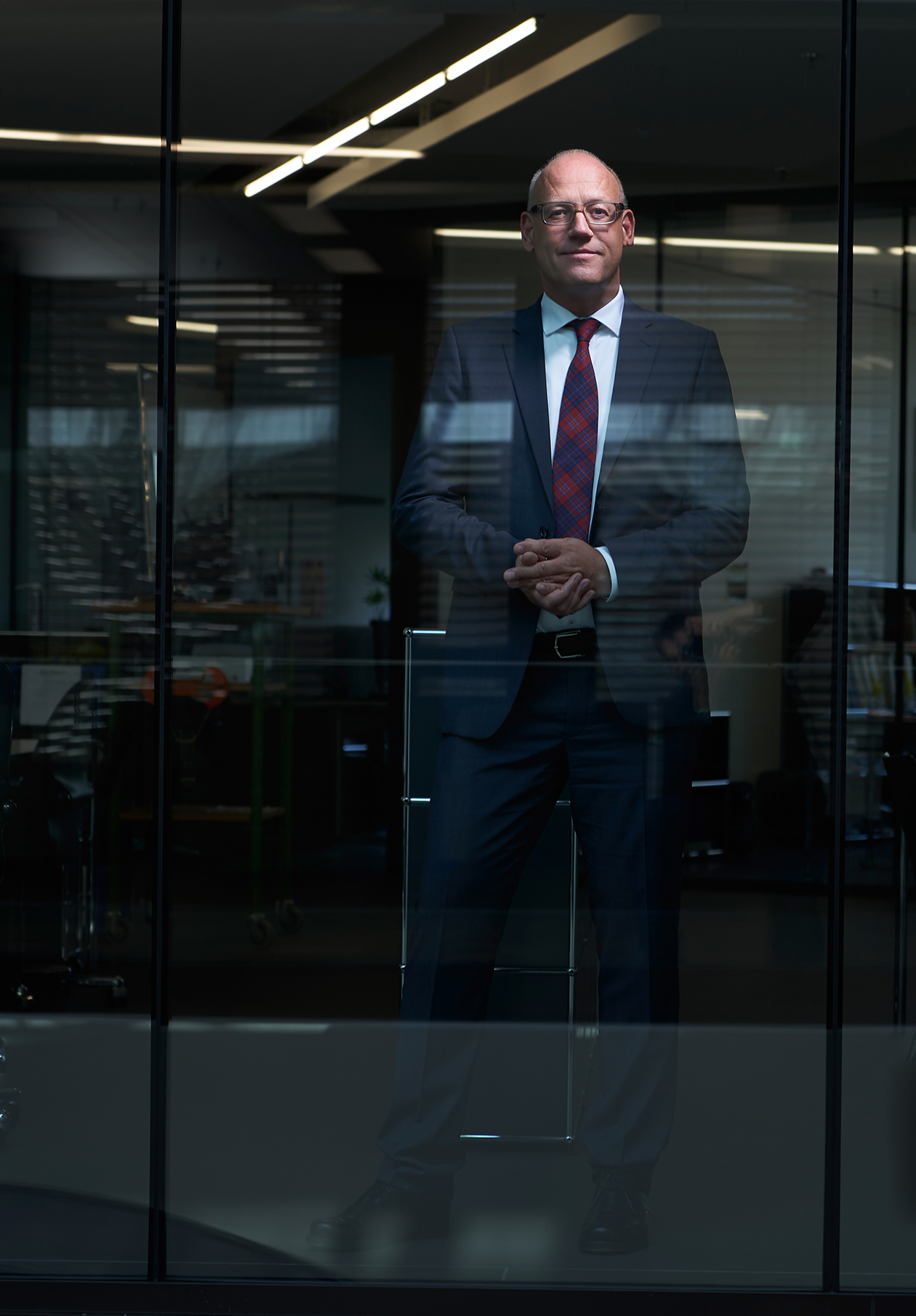
„Inspirierend anders“, der Podcast von Luca Beutel, ging vor kurzem in die Forschung. Für die ersten beiden Folgen hat der Mann mit dem Schnäuzer mit Prof. Dr. Oliver Bendel gesprochen. Der Technikphilosoph lebt in Zürich und arbeitet an mehreren Hochschulen der FHNW. Die erste Folge, ausgestrahlt seit dem 2. Mai 2023, heißt „#165 IAF – Die ultimative Maschine: Wie Robotik die Grenzen der Menschheit erweitert“. Oliver Bendel stellt darin die Grundlagen der Robotik dar und bringt diese in einen Zusammenhang mit der Künstlichen Intelligenz (KI). Ursprünglich wurden deren Gegenstände zusammengedacht. Dann haben sie sich aber getrennt entwickelt. Nun wachsen Roboter und KI-Systeme immer mehr zusammen. Am 9. Mai 2023 erschien die zweite Folge mit dem Titel „#167 IAF – Menschliche Bedürfnisse, robotische Lösungen: Die Zukunft der menschenähnlichen Roboter“. Darin geht es u.a. um ethische und ästhetische Fragen, die sich zu sozialen Robotern wie Pflegerobotern und Sexrobotern stellen. Auch die zweite Folge kann u.a. über Spotify aufgerufen werden.
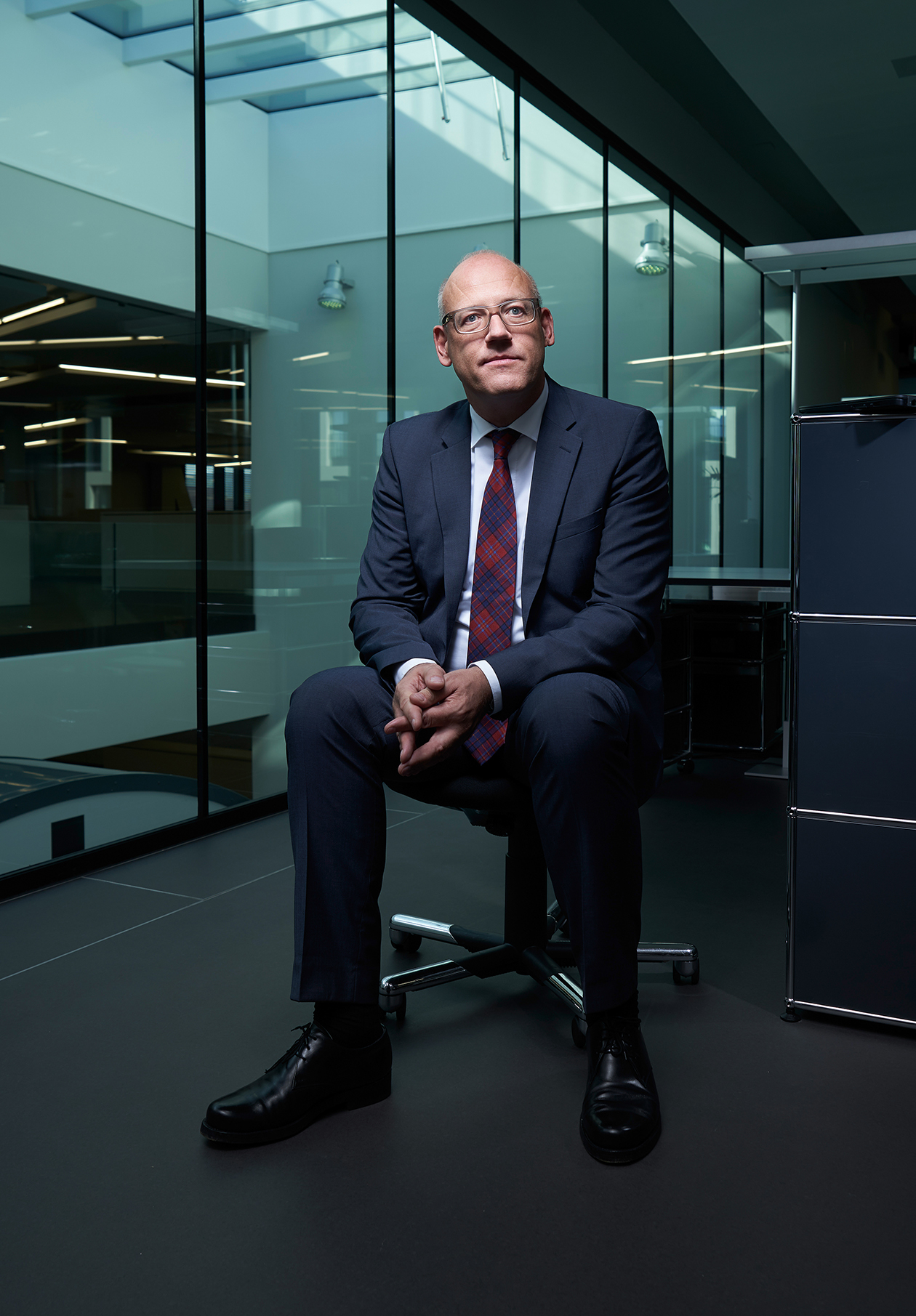
Abb.: Oliver Bendel am Campus Brugg-Windisch (Foto: Dominic Büttner)
The CONVERSATIONS 2023, a two-day workshop on chatbot research, applications, and design, will take place at the University of Oslo, Norway. According to the CfP, contributions concerning applications of large language models such as the GPT family, are warmly welcome, as are contributions on applications combining information retrieval approaches and large language model approaches. Building on the results from previous six CONVERSATIONS workshops, the following topics are of particular interest: 1. Chatbot users and implications, 2. Chatbot user experience, design, and evaluation, 3. Chatbot frameworks and platforms, 4. Chatbots for collaboration, 5. Democratizing chatbots – chatbots for all, 6. Ethics and safety implications of chatbots and large language models, 7. Leveraging advances in AI technology and large language models. More information via 2023.conversations.ws.
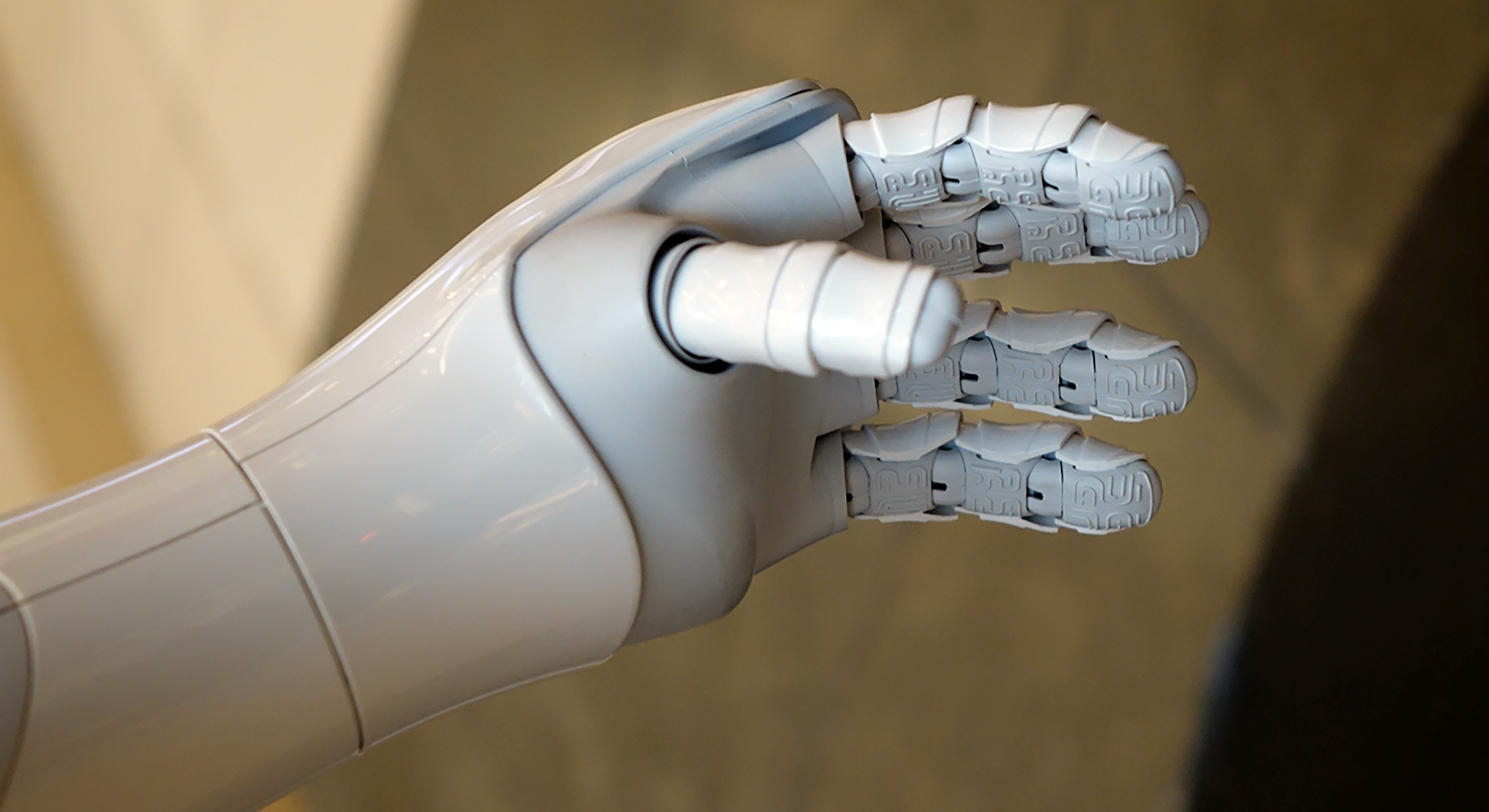
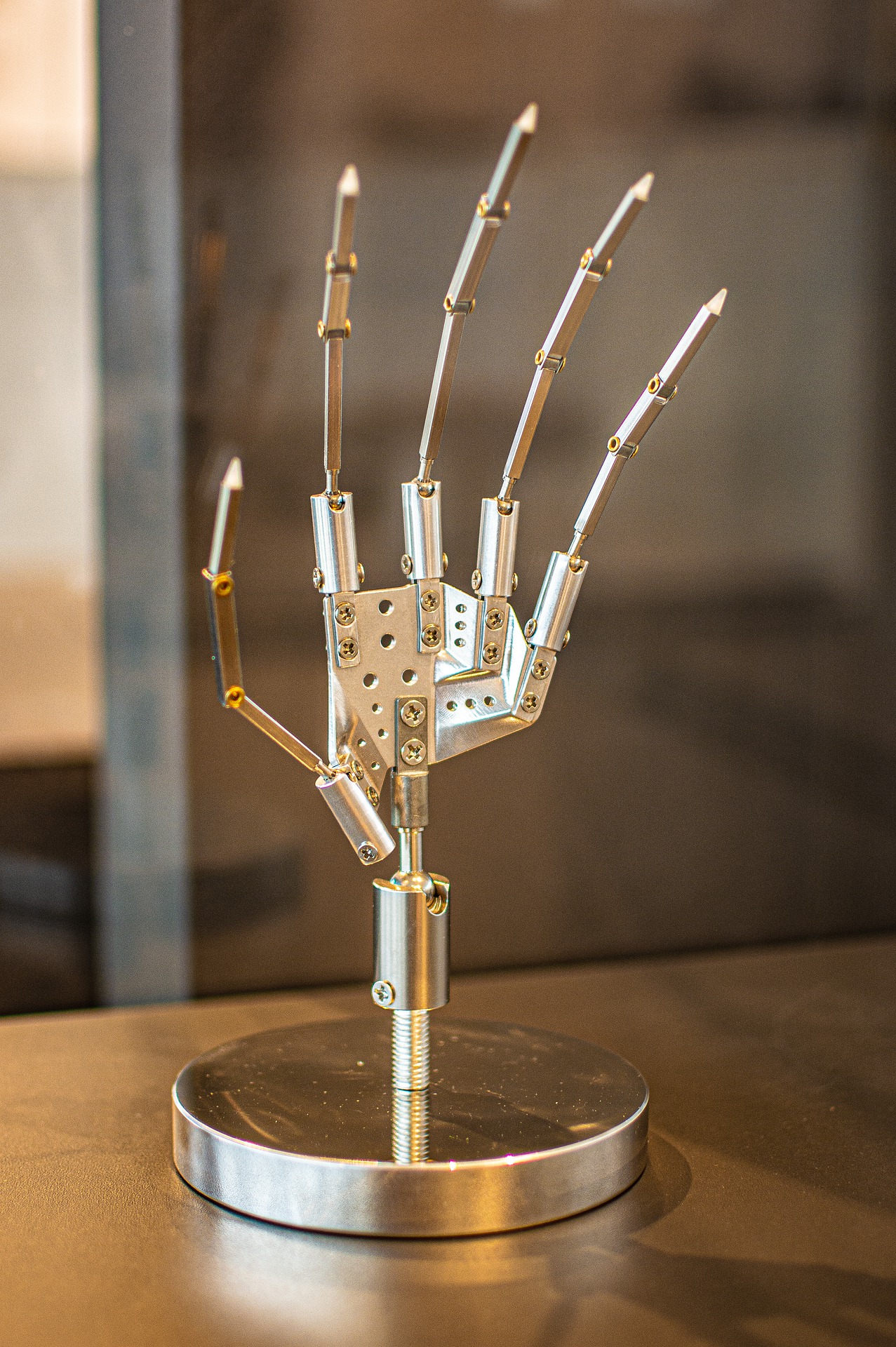
„Researchers at Columbia Engineering have demonstrated a highly dexterous robot hand, one that combines an advanced sense of touch with motor learning algorithms in order to achieve a high level of dexterity.“ (Website Columbia Engineering, 28 April 2023) Columbia Engineering reported this on its website on April 28, 2023. The text goes on to say: „As a demonstration of skill, the team chose a difficult manipulation task: executing an arbitrarily large rotation of an unevenly shaped grasped object in hand while always maintaining the object in a stable, secure hold. This is a very difficult task because it requires constant repositioning of a subset of fingers, while the other fingers have to keep the object stable. Not only was the hand able to perform this task, but it also did it without any visual feedback whatsoever, based solely on touch sensing.“ (Website Columbia Engineering, 28 April 2023) „While our demonstration was on a proof-of-concept task, meant to illustrate the capabilities of the hand, we believe that this level of dexterity will open up entirely new applications for robotic manipulation in the real world“, said Matei Ciocarlie according to the website. He is the Associate Professor in the Departments of Mechanical Engineering and Computer Science who developed the hand together with his graduate student Gagan Khandate.
In einer Doktorarbeit an der Universität Potsdam wird seit 2023 untersucht, wie Muster aus der Mensch-Mensch-Interaktion auf die Mensch-Roboter-Interaktion übertragen werden. Die Doktorandin Katharina Kühne wird von Prof. Dr. Martin Fischer (Universität Potsdam) und Prof. Dr. Oliver Bendel (FHNW) betreut. Beide forschen u.a. zu sozialen Robotern und geben in der Arte-Dokumentation „Werden wir Roboter lieben?“ einen Einblick in ihre Arbeit. Die Betreuungsvereinbarung wurde dieser Tage unterzeichnet. Oliver Bendel ist seit Dezember 2021 assoziierter Forscher der PECoG-Gruppe an der Universität Potsdam. Er tauscht sich seit 2019 regelmäßig mit ihren Mitgliedern aus und hält Vorträge vor Ort. Zudem publiziert man zusammen. Seine Forschungsinteressen sind soziale Roboter (Perspektiven: Informationsethik, Roboterethik, Maschinenethik; Themen: Informationelle Autonomie, Verantwortung in Pflege und Therapie, Wohlbefinden beim Einsatz von Sexrobotern, Chatbots und Sprachassistenten mit simulierter Empathie, Entscheidungsbäume mit moralischen Annotationen, Moralmenüs), Serviceroboter (Perspektiven: Informationsethik, Roboterethik, Maschinenethik; Themen: Informationelle Autonomie, Verantwortung beim Einsatz im öffentlichen Raum, Entscheidungsbäume mit moralischen Annotationen, Moralmenüs) und tierfreundliche Maschinen (Perspektiven: Informationsethik, Maschinenethik, Tier-Maschine-Interaktion; Themen: Schutz von Haus- und Wildtieren beim Einsatz von Robotern und Autos, Gesichtserkennung für Bären und Wölfe). Weitere assoziierte Forscher und Forscherinnen sind über www.uni-potsdam.de/de/pecog/mitarbeiterinnen/assoziierte-forscher aufgeführt.
In der c’t 11/2023 ist der Artikel „Virtuelle Freunde? KI-Chatbots leisten Gesellschaft und wecken einseitige Gefühle“ erschienen. Arne Grävemeyer geht auf fünf Seiten auf das Thema ein. Befragt hat er dazu Prof. Dr. Oliver Bendel. Eine Frage war, ob solche Programme und Figuren – die Emotionen zeigen (ohne sie zu haben) und hervorrufen – sich als solche offenbaren sollten. Seine Antwort: „Aus ethischer Sicht würde ich das fordern. Man sollte wissen, ob man mit Menschen oder Maschinen kommuniziert. Unsere eigenen Emotionen sind ein wertvolles Gut. Wir entwickeln sie fast automatisch, wenn wir auf menschenähnliche Entitäten stoßen. Wir haben aber die Möglichkeit, die Emotionen zu begrenzen, wenn wir wissen, dass es sich um Programme und Maschinen handelt. Dazu gehört, dass wir diese abstellen und nicht ständig an sie denken, wenn sie nicht bei uns sind. Auch unsere Zeit ist ein kostbares Gut. Wir sollten selbst entscheiden, mit wem oder was wir sie verbringen.“ (c’t, 11/2023) Insgesamt wurden schriftlich und telefonisch etliche Fragen gestellt. Einige Antworten sind in den Artikel eingeflossen, der seit 5. Mai 2023 erhältlich ist.
„Manche Menschen gehen bereits romantische Beziehungen mit Chatbots ein. Künstliche Intelligenz simuliert Zuneigung und Trost. Kann man Gefühle einfach so programmieren?“ (Tagesspiegel, 3. Mai 2023) Dies fragt Max Tholl in einem Essay mit dem Titel „Wenn die KI den Partner ersetzt: Können Maschinen uns lieben?“ vom 3. Mai 2023. Zu Wort kommt mehrmals Prof. Dr. Oliver Bendel, der seit einem Vierteljahrhundert über Chatbots, Sprachassistenten und soziale Roboter schreibt und forscht. Er nähert sich dem Gegenstand mit einem Rückblick: „Innige Beziehungen zwischen Menschen und künstlichen Kreaturen haben eine lange Tradition in der Ideengeschichte, sagt der Philosoph und Wirtschaftsinformatiker Oliver Bendel. Sie finden sich schon in den mythologischen Erzählungen von Homer oder Ovid, später dann als Motiv in Science-Fiction-Geschichten.“ (Tagesspiegel, 3. Mai 2023) Der ganze Beitrag ist im Tagesspiegel hinter der Bezahlschranke zu finden und wird auch noch in der gedruckten Ausgabe erscheinen.
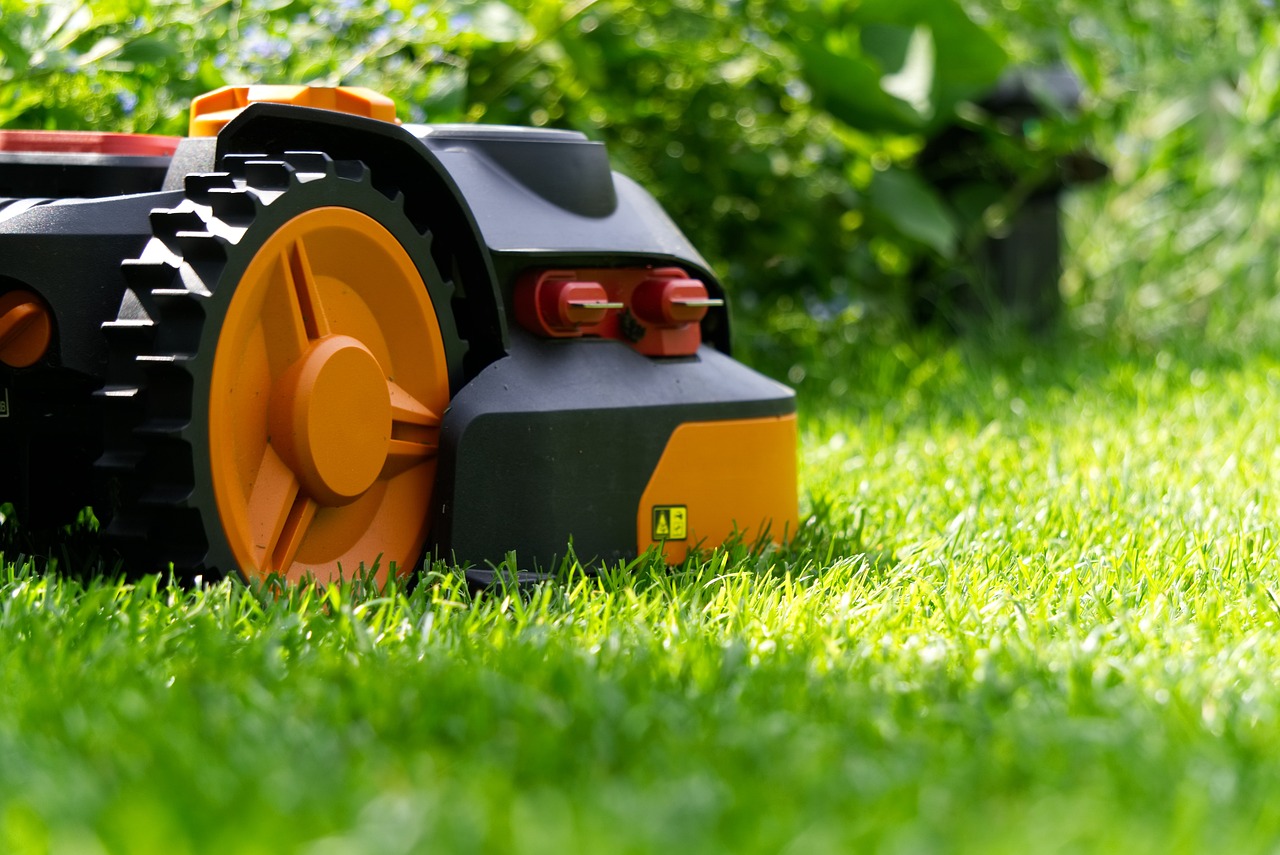
Seit einigen Jahren bauen Prof. Dr. Oliver Bendel und seine Teams tierfreundliche Roboter als Prototypen. 2014 wurde LADYBIRD konzipiert, 2017 implementiert. Der vereinfachte Prototyp eines Saugroboters erkannte (simulierte) Marienkäfer auf dem (realen) Boden und stellte zu ihrem (angenommenen) Schutz seinen Betrieb ein. 2019 wurde HAPPY HEDGEHOG (HHH) umgesetzt. Der hochentwickelte Prototyp eines Mähroboters erkannte (simulierte) Igel auf dem (simulierten) Rasen und stellte zu ihrem (angenommenen) Schutz seinen Betrieb ein. Beide Prototypen wurden bei den AAAI Spring Symposia vorgestellt, LADYBIRD 2017, HHH 2021. Ideen dieser Art werden mehr und mehr von der Wirtschaft übernommen. Berti Kolbow-Lehradt hat für Golem den Goat G1 getestet. Das chinesische Unternehmen verspricht, „dass der Robomäher anhand KI-geschulter Kameras Igel, Lieblingsblumen und auch den Weg kreuzende Menschen verschont“ (Golem, 4. Mai 2023). Bei HAPPY HEDGEHOG wurden eine Wärmebildkamera und Objekterkennung auf der Basis von Machine Learning verwendet. Beim Goat G1 beauftragt man per App-Funktion „die Kameras, speziell auf Igel, Katzen, Hunde und Schläuche zu achten, um diesen rechtzeitig auszuweichen“ (Golem, 4. Mai 2023). Bei den Testläufen des Magazins war das Ergebnis mit Igelattrappen aber unbefriedigend. „Eines von zwei Modellen überfährt der Goat G1 und lässt einen Scherbenhaufen zurück. Vor dem zweiten, etwas größeren und abweichend gefärbten Modell dreht er zumindest in den meisten Fällen rechtzeitig ab. Auf Anfrage erklärt Ecovacs, dass das KI-Training mit Igelbildern noch andauere und bisher nicht alle regionalen Varianten vollständig erfasst habe.“ (Golem, 4. Mai 2023) Wichtig ist insgesamt, dass die Industrie mit Blick auf den Einsatz von autonomen Maschinen erkannt hat, dass Tierschutz wichtig ist und man dies auch den Kunden vermitteln kann. Damit hat sich die (Vor-)Arbeit der Wissenschaft mehr als gelohnt.
Ein Forscherteam von der University of Texas hat ein neues Verfahren für Brain-Computer-Interfaces vorgestellt, mit dem die Vision des Gedankenlesens ein wenig näher rückt. Verwendet wird in der Studie – das ist ein entscheidender Punkt – ein Sprachmodell wie GPT, in Kombination mit Magnetresonanztomografie. Generell können solche Systeme im Moment allenfalls wahrscheinliche Phrasen vorschlagen. Sie machen noch viele Fehler. Diese dürften sich in Zukunft aber zum Teil beheben lassen. Von Bedeutung wären solche Verfahren für Schwerbehinderte, etwa Querschnittsgelähmte. Diese können über Brain-Computer-Interfaces bereits Geräte mit Gedanken steuern – in ein paar Jahren wären sie in der Lage, über Gedanken mit anderen zu kommunizieren. Interessiert werden auch Polizei, Geheimdienst und Verfassungsschutz sein. Selbst bei gegebenem Kooperationswillen kann es sich um einen Übergriff handeln. Ohne einen gegebenen Kooperationswillen, der im Moment noch Grundlage der Methode ist, kann es sich um psychische Gewalt handeln. Es wäre auf jeden Fall ein Eingriff in die Intim- und Privatsphäre. Der Mensch steht mit seinen Gedanken nackt vor den anderen da. Dies gilt insbesondere, aber nicht nur, bei sexuellen Vorstellungen. Ferner kann man evtl. auch an politische und moralische Überzeugungen oder an Passwörter herankommen. Die Studie zeigt, dass Sprachmodelle für alle möglichen Zwecke eingesetzt werden können und auch eingesetzt werden, bei den entsprechenden Chancen und Risiken. Die Nachrichtensendung 10 vor 10 im SRF hat dem Thema am 3. Mai 2023 einen Beitrag gewidmet. Darin kommen Prof. Dr. Lutz Jäncke (Universität Zürich), Dr. Ricardo Chavarriaga (ZHAW) und Prof. Dr. Oliver Bendel (FHNW) zu Wort. Der Artikel mitsamt dem Video kann über www.srf.ch/news/experiment-in-den-usa-gedanken-entschluesseln-dank-hirn-scans-und-ki abgerufen werden.
„Inspirierend anders“, der Podcast von Luca Beutel, geht in die Forschung. Für die ersten beiden Folgen hat der Mann mit dem Schnäuzer mit Prof. Dr. Oliver Bendel gesprochen. Der Technikphilosoph lebt in Zürich und arbeitet an mehreren Hochschulen der FHNW. Die erste Folge, ausgestrahlt seit dem 2. Mai 2023, heißt „#165 IAF – Die ultimative Maschine: Wie Robotik die Grenzen der Menschheit erweitert“. Oliver Bendel stellt darin die Grundlagen der Robotik dar und bringt diese in einen Zusammenhang mit der Künstlichen Intelligenz (KI). Ursprünglich wurden deren Gegenstände zusammengedacht. Dann haben sie sich aber getrennt entwickelt. Nun wachsen Roboter und KI-Systeme immer mehr zusammen. Eine Woche später erscheint die zweite Folge mit dem Titel „#167 IAF – Menschliche Bedürfnisse, robotische Lösungen: Die Zukunft der menschenähnlichen Roboter“. Darin geht es u.a. um ethische und ästhetische Fragen, die sich zu sozialen Robotern wie Pflegerobotern und Sexrobotern stellen. Die erste Folge kann u.a. über Spotify aufgerufen werden.
Abb.: Oliver Bendel am Campus Brugg-Windisch (Foto: Dominic Büttner)
Der Senioren Ratgeber (eigene Schreibweise) ist ein Partner der Apotheken Umschau (eigene Schreibweise). Im aktuellen Heft 5/2023 findet sich ein fünfseitiger Artikel über Roboter in der Pflege. Er beginnt mit Lio, dem Assistenzroboter von F&P Robotics, der seit Jahren in einer Kleinserie vorliegt und in mehreren Alten- und Pflegeheimen getestet wird. Zu Wort kommt mehrmals Prof. Dr. Oliver Bendel von der Hochschule für Wirtschaft FHNW, der seit 2016 in Kontakt mit dem Unternehmen ist, mit Mitarbeitern ein Paper zu Lio publiziert und zuletzt zusammen mit Marc Heimann ein Moralmodul (CARE-MOMO) entwickelt hat, das Lio erweitern kann. Inzwischen arbeitet das Schweizer Unternehmen mit weiteren Hochschulen wie der Fachhochschule Graubünden und der ETH Zürich zusammen … „Der Senioren Ratgeber begleitet ältere Menschen in ihrem Alltag. Hier finden Sie Tipps rund um Vorsorge, Ernährung, Bewegung, Reise, Partnerschaft und Pflege. Blättern Sie in der aktuellen Ausgabe des Senioren Ratgeber. Das komplette Magazin erhalten Sie in Ihrer Apotheke …“ (Website Senioren Ratgeber) Gemeint ist praktisch jede Apotheke in Deutschland. Eine Leseprobe ist jeweils über www.apotheken-umschau.de/unsere-marken/senioren-ratgeber/ erhältlich.
Im Juni 2023 kommt das Buch „Assistive Technologien, technische Rehabilitation und Unterstützte Kommunikation“, herausgegeben von Martin Groß, Birgit Hennig, Stefan Kappel und Frank Wallhoff, auf den Markt. Darin enthalten ist der Beitrag „Therapieroboter aus ethischer Sicht“ von Oliver Bendel. Aus dem Abstract: „Der vorliegende Beitrag geht auf Therapieroboter ein. Diese werden wie Pflegeroboter als soziale Roboter verstanden. Es werden die Ziele, Aufgaben und Merkmale geklärt, es werden Beispiele gegeben, sowohl aus der Psychotherapie als auch aus der Ergo- und Physiotherapie, die etwa der orthopädischen und sportmedizinischen Rehabilitation dienen können, und es findet eine Diskussion aus Sicht der klassischen Bereichsethiken und der Maschinenethik statt. Deutlich wird, dass manche Antworten bereits heute geliefert werden können, andere jedoch noch empirischer Forschung und analytischer Arbeit bedürfen. Nicht zuletzt hängen einige von der sich entwickelnden Praxis ab, etwa davon, welche Rolle der Therapeut und Betreuer in Zukunft spielt, welcher Art die Therapieroboter sind und welche Verbreitung sie haben.“ Das Buch erscheint bei Springer und ist über den Verlag oder eine beliebige Buchhandlung erhältlich.
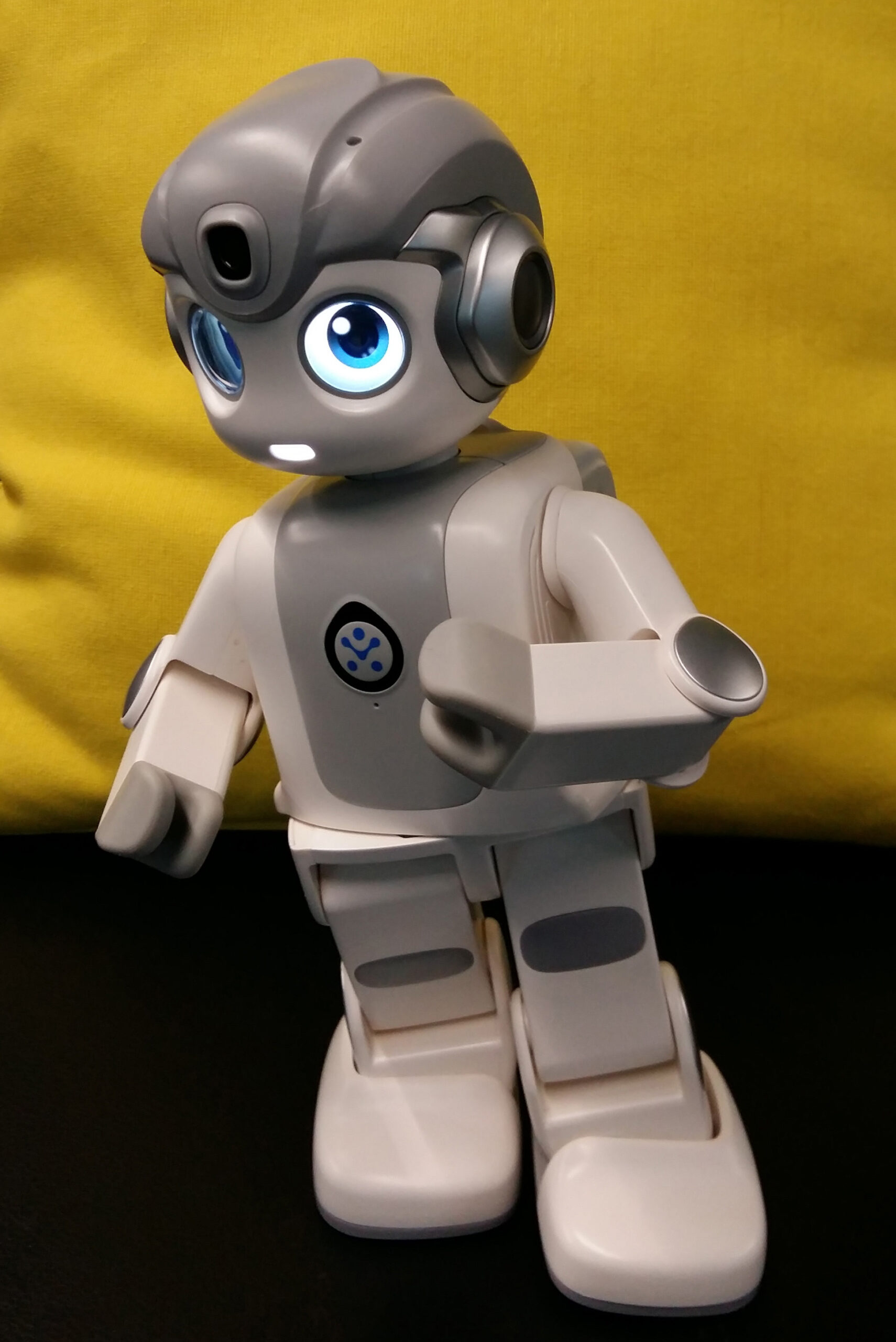
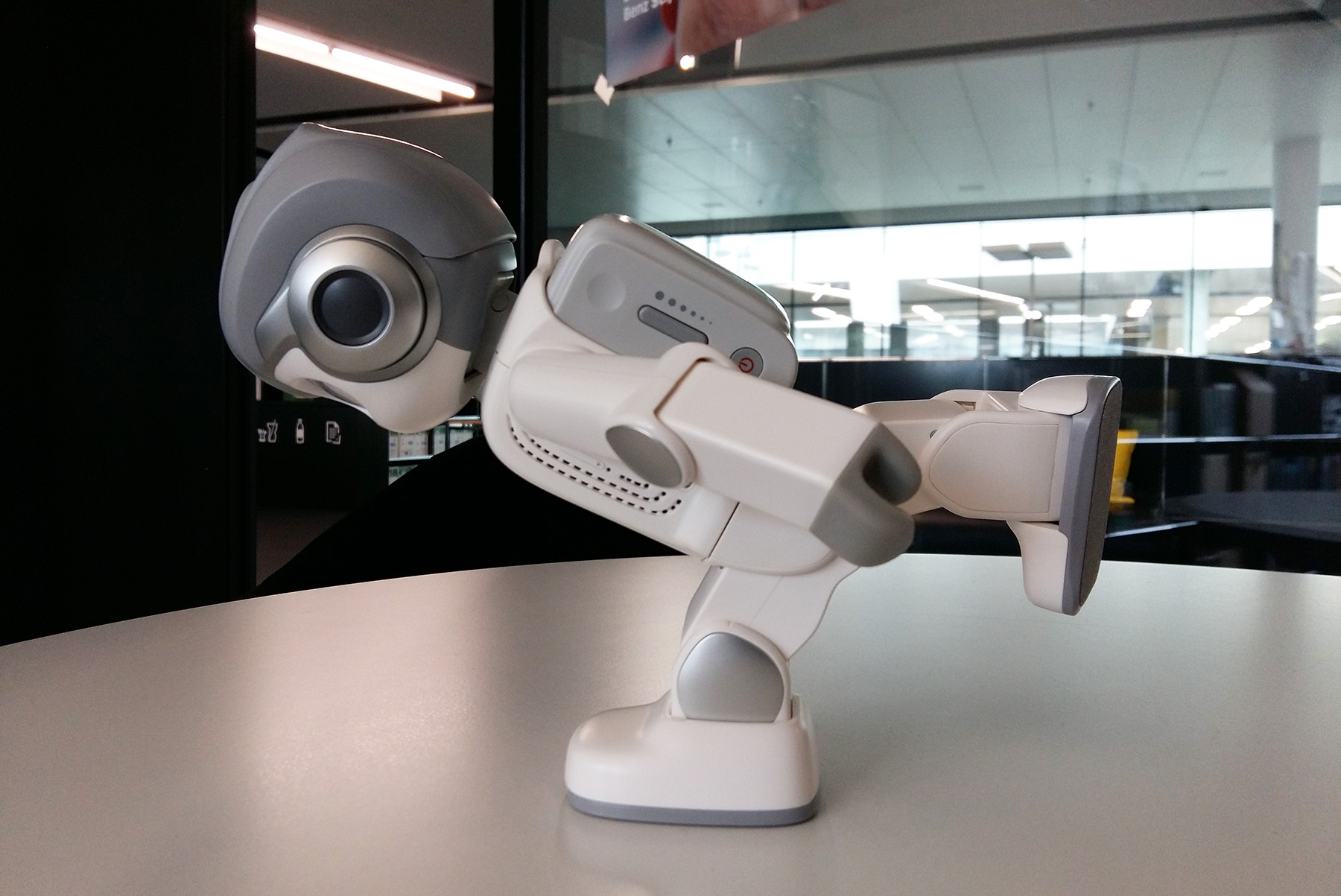
Abb.: Alpha Mini beim Yoga im Büro von Oliver Bendel
From March 27-29, 2023, the AAAI 2023 Spring Symposia featured the symposium „Socially Responsible AI for Well-being“ by Takashi Kido (Teikyo University, Japan) and Keiki Takadama (The University of Electro-Communications, Japan). This time the venue was exceptionally not Stanford University, but the Hyatt Regency SFO Airport. On March 28, Prof. Dr. Oliver Bendel presented the paper „Increasing Well-being through Robotic Hugs“, written by himself, Andrea Puljic, Robin Heiz, Furkan Tömen, and Ivan De Paola. The paper has now been published as a preprint and can be downloaded via arxiv.org/abs/2304.14409. From the abstract: „This paper addresses the question of how to increase the acceptability of a robot hug and whether such a hug contributes to well-being. It combines the lead author’s own research with pioneering research by Alexis E. Block and Katherine J. Kuchenbecker. First, the basics of this area are laid out with particular attention to the work of the two scientists. The authors then present HUGGIE Project I, which largely consisted of an online survey with nearly 300 participants, followed by HUGGIE Project II, which involved building a hugging robot and testing it on 136 people. At the end, the results are linked to current research by Block and Kuchenbecker, who have equipped their hugging robot with artificial intelligence to better respond to the needs of subjects.“ More information on the conference via aaai.org/conference/spring-symposia/sss23/.
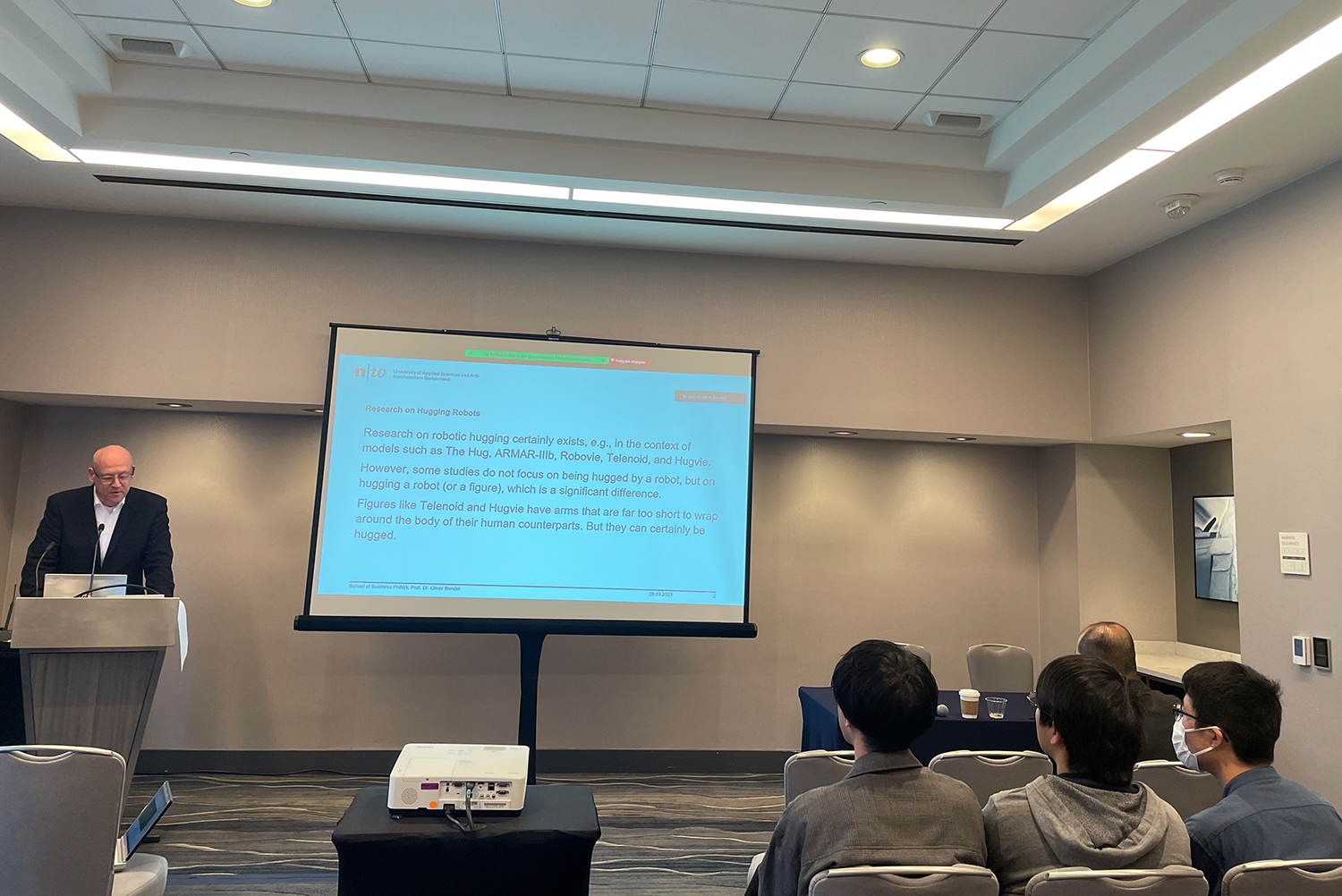
Fig.: Oliver Bendel during his talk (Photo: Lea Peier)
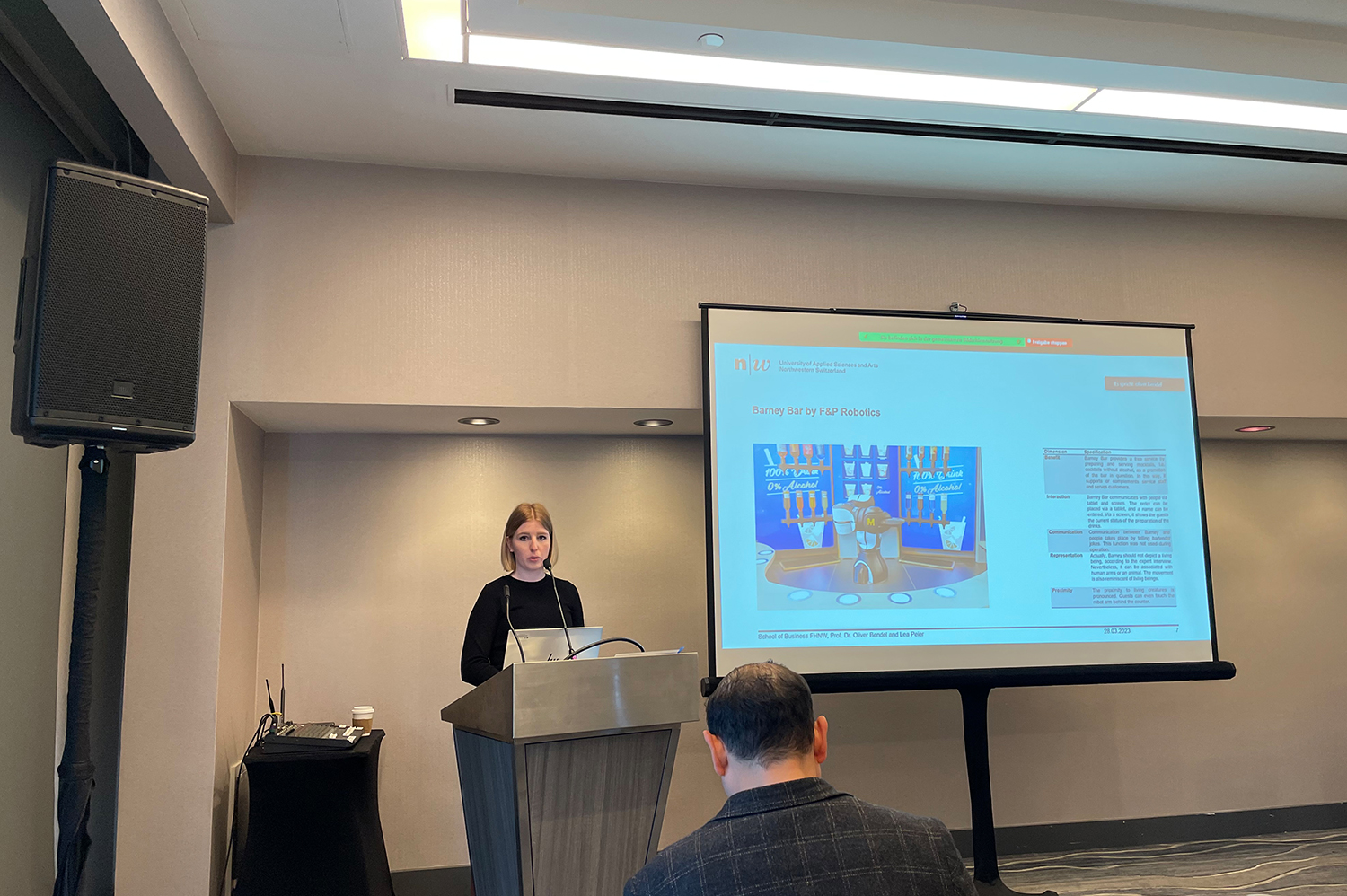
From March 27-29, 2023, the AAAI 2023 Spring Symposia featured the symposium „Socially Responsible AI for Well-being“ by Takashi Kido (Teikyo University, Japan) and Keiki Takadama (The University of Electro-Communications, Japan). This time the venue was exceptionally not Stanford University, but the Hyatt Regency SFO Airport. On March 28, Prof. Dr. Oliver Bendel and Lea Peier presented their paper „How Can Bar Robots Enhance the Well-being of Guests?“. The paper has now been published as a preprint and can be downloaded via arxiv.org/abs/2304.14410. From the abstract: „This paper addresses the question of how bar robots can contribute to the well-being of guests. It first develops the basics of service robots and social robots. It gives a brief overview of which gastronomy robots are on the market. It then presents examples of bar robots and describes two models used in Switzerland. A research project at the School of Business FHNW collected empirical data on them, which is used for this article. The authors then discuss how the robots could be improved to increase the well-being of customers and guests and better address their individual wishes and requirements. Artificial intelligence can play an important role in this. Finally, ethical and social problems in the use of bar robots are discussed and possible solutions are suggested to counter these.“ More information on the conference via aaai.org/conference/spring-symposia/sss23/.
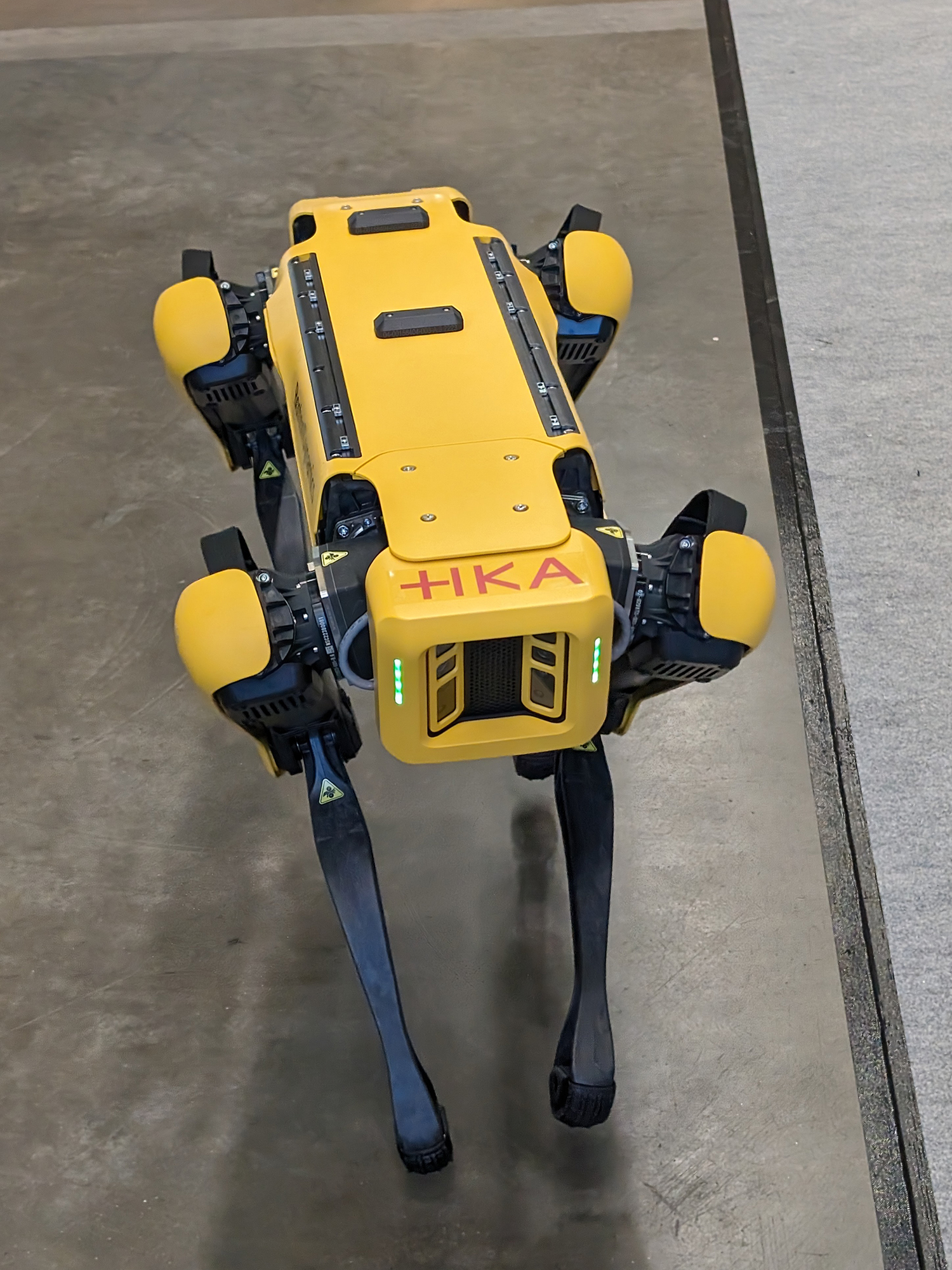
Im Innovation Lab der Polizei Nordrhein-Westfalen testet man seit einer Weile den Einsatz von Spot, eines vierbeinigen Roboters von Boston Dynamics. Dieser erkundete u.a. ein ausgebranntes Haus in Essen. Mit Spot experimentiert auch die New Yorker Polizei, was immer wieder für Diskussionen sorgt. Baden-Württemberg („The Länd“) hat in diesen Tagen nachgezogen. Die offizielle Website des Landes zitiert Innenminister Thomas Strobel mit den Worten: „Laufroboter können sich in schwierigem Gelände und im urbanen Umfeld mit Hindernissen wie Treppen oder Absätzen sicher fortbewegen und sind schnell, unkompliziert und vielseitig einsetzbar. Sie sind schneller und verwischen am Tatort weniger Spuren als herkömmliche Roboter auf Rädern oder Ketten, wie sie beispielsweise unser Landeskriminalamt bereits einsetzt.“ (Baden-Württemberg, 28. April 2023) Spot wird neben anderen Systemen in dem Paper „Robots in Policing“ von Prof. Dr. Oliver Bendel thematisiert, das in den Proceedings „Social Robots in Social Institutions“ der Robophilosophy 2022 erschienen ist. Polizeiroboter und KI-Systeme sind auch Gegenstand des CAS Zukunftsorientierte Polizeiarbeit. Verantwortlich für diesen Teil ist wiederum Oliver Bendel.